
身体活动可改善阿尔茨海默病患者的认知功能:一项随机对照试验的系统评价和荟萃分析。
Physical activity can improve cognition in patients with Alzheimer's disease: a systematic review and meta-analysis of randomized controlled trials.
机构信息
Department of Internal Nursing, School of Nursing, Jilin University, Changchun, Jilin, 130020, People's Republic of China,
Department of Anesthesiology, The First Hospital of Jilin University, Changchun, Jilin, 130021, People's Republic of China,
出版信息
Clin Interv Aging. 2018 Sep 4;13:1593-1603. doi: 10.2147/CIA.S169565. eCollection 2018.
BACKGROUND/OBJECTIVE: Alzheimer's disease (AD) is mainly characterized by decline of cognitive functions such as memory and learning, which has a high prevalence and poor drug efficacy in treatment regimes. A systematic review and meta-analysis of randomized controlled trials (RCTs) were conducted to evaluate the effectiveness of exercise on cognitive function in patients diagnosed with AD.
METHODS
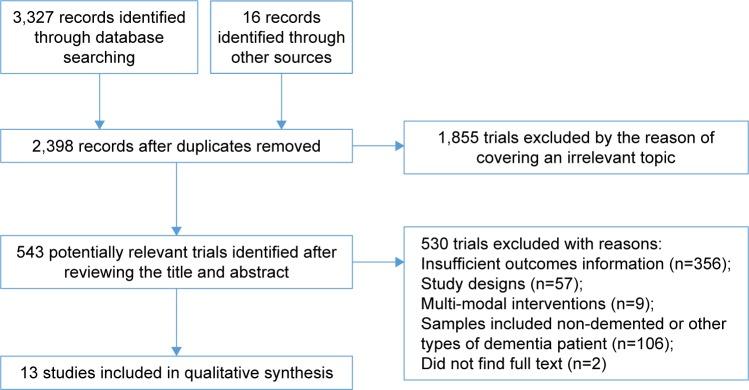
The bibliographic databases (PubMed, Cochrane Library and Embase, and Web of Science) and four Chinese databases (Wanfang data, CBM, CNKI, and VIP) were searched to identify RCTs published in any language between January 1, 1960, and January 1, 2018. Only peer-reviewed articles and RCTs were included. The collected data were analyzed by Review Manager (5.3).
RESULTS
Overall, 869 patients diagnosed with AD were included from 13 RCTs. Patients in the intervention group received pure exercise interventions and a cognitive test. Although there was heterogeneity in intervention methods and cognitive measures among studies, meta-analysis (seven studies) supports positive effects of physical activity on cognitive function of patients with AD (mean difference [MD] =2.53, the 95% CI=0.84 to 4.22, test for overall effect: =2.93 [=0.003]). Eight studies demonstrated that exercise improves cognitive function for individuals with AD. However, the remaining five studies did not display a beneficial effect of exercise on cognitive function in patients with AD.
CONCLUSION
This meta-analysis and systematic review indicated that exercise intervention might improve the cognitive function of AD or slow down the decline of cognition; however, this relationship was not always true across studies. RCTs with clear intervention criteria, large samples, and long-term follow-up are needed in the future to demonstrate the benefits of exercise for cognitive function in AD patients.
背景/目的:阿尔茨海默病(AD)主要表现为记忆力和学习能力等认知功能下降,其在治疗方案中的患病率高,疗效差。本系统评价和荟萃分析对随机对照试验(RCT)进行了评估,以评估运动对 AD 患者认知功能的有效性。
方法
检索了文献数据库(PubMed、Cochrane 图书馆和 Embase 以及 Web of Science)和四个中文数据库(万方数据、CBM、CNKI 和 VIP),以查找 1960 年 1 月 1 日至 2018 年 1 月 1 日期间发表的任何语言的 RCT。仅纳入同行评议文章和 RCT。使用 Review Manager(5.3)分析收集的数据。
结果
共有 13 项 RCT 纳入了 869 名 AD 患者。干预组患者接受单纯运动干预和认知测试。尽管研究之间的干预方法和认知测量存在异质性,但荟萃分析(七项研究)支持身体活动对 AD 患者认知功能的积极影响(平均差异 [MD]=2.53,95%置信区间 [CI]=0.84 至 4.22,检验总体效应:=2.93 [=0.003])。八项研究表明运动可以改善 AD 患者的认知功能。然而,其余五项研究并未显示运动对 AD 患者认知功能有益。
结论
本荟萃分析和系统评价表明,运动干预可能改善 AD 患者的认知功能或减缓认知下降;然而,这种关系并非总是适用于所有研究。未来需要具有明确干预标准、大样本和长期随访的 RCT 来证明运动对 AD 患者认知功能的益处。



 Zotero 插件