
用于短波红外荧光生物成像及αβ表达肿瘤分子靶向的稀土掺杂纳米颗粒
Rare-Earth-Doped Nanoparticles for Short-Wave Infrared Fluorescence Bioimaging and Molecular Targeting of αβ-Expressing Tumors.
作者信息
Naczynski Dominik Jan, Stafford Jason H, Türkcan Silvan, Jenkins Cesare, Koh Ai Leen, Sun Conroy, Xing Lei
机构信息
1 Department of Radiation Oncology, Stanford University School of Medicine, Palo Alto, CA, USA.
2 Stanford Nanocharacterization Laboratory, Stanford University, Palo Alto, CA, USA.
出版信息
Mol Imaging. 2018 Jan-Dec;17:1536012118799131. doi: 10.1177/1536012118799131.
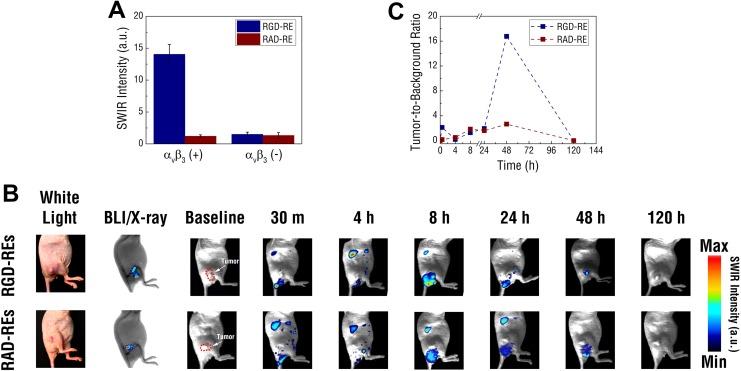
The use of short-wave infrared (SWIR) light for fluorescence bioimaging offers the advantage of reduced photon scattering and improved tissue penetration compared to traditional shorter wavelength imaging approaches. While several nanomaterials have been shown capable of generating SWIR emissions, rare-earth-doped nanoparticles (REs) have emerged as an exceptionally bright and biocompatible class of SWIR emitters. Here, we demonstrate SWIR imaging of REs for several applications, including lymphatic mapping, real-time monitoring of probe biodistribution, and molecular targeting of the αβ integrin in a tumor model. We further quantified the resolution and depth penetration limits of SWIR light emitted by REs in a customized imaging unit engineered for SWIR imaging of live small animals. Our results indicate that SWIR light has broad utility for preclinical biomedical imaging and demonstrates the potential for molecular imaging using targeted REs.
与传统的较短波长成像方法相比,使用短波红外(SWIR)光进行荧光生物成像具有减少光子散射和改善组织穿透性的优势。虽然已经证明几种纳米材料能够产生SWIR发射,但稀土掺杂纳米颗粒(REs)已成为一类特别明亮且生物相容的SWIR发射体。在这里,我们展示了REs在多种应用中的SWIR成像,包括淋巴管测绘、探针生物分布的实时监测以及肿瘤模型中αβ整合素的分子靶向。我们还在为活体小动物的SWIR成像设计的定制成像单元中,对REs发射的SWIR光的分辨率和深度穿透极限进行了量化。我们的结果表明,SWIR光在临床前生物医学成像中具有广泛的用途,并证明了使用靶向REs进行分子成像的潜力。


 Zotero 插件