
ω-3与利培酮对难治性癫痫合并注意缺陷多动障碍儿童癫痫发作频率疗效评估的临床试验
Clinical Trial of Efficacy Evaluation of Omega-3 with Risperidone on Seizures Frequency in Children with Refractory Epilepsy and Attention-Deficit/Hyperactivity Disorder.
作者信息
Fallah Razieh, Eiliaei Shiva, Ferdosian Farzad
机构信息
Department of Pediatrics, Growth Disorders of Children Research Center, Shahid Sadoughi University of Medical Sciences, Yazd, Iran.
General Physician, Shahid Sadoughi University of Medical Sciences, Yazd, Iran.
出版信息
Iran J Child Neurol. 2018 Fall;12(4):28-36.
OBJECTIVES
We aimed to answer the question whether or not previous antiepileptic drugs with combination of omega-3 and risperidone are more efficient than previous antiepileptic drugs with risperidone alone in decreasing of seizures monthly frequency of children with refractory epilepsy and attention-deficit/hyperactivity disorder (ADHD).
MATERIAL & METHODS: In a randomized clinical trial (IRCT201604212639N18), participants referred to Pediatric Neurology Clinic of Shahid Sadoughi Hospital, Yazd, Iran from Jun 2015 were distributed randomly into two groups. In group I, one capsule of omega-3 daily and 0.5 mg of risperidone was divided into two doses with previous antiepileptic drugs and in group II, 0.5 mg of risperidone was divided into two doses with previous antiepileptic drugs were given. The drugs use was continued for three months and the children were followed up monthly for three consecutive months. Primary outcomes included seizure monthly frequency and good response (more than 50% of reduction in seizures monthly frequency). Secondary outcome was clinical side effects.
RESULTS
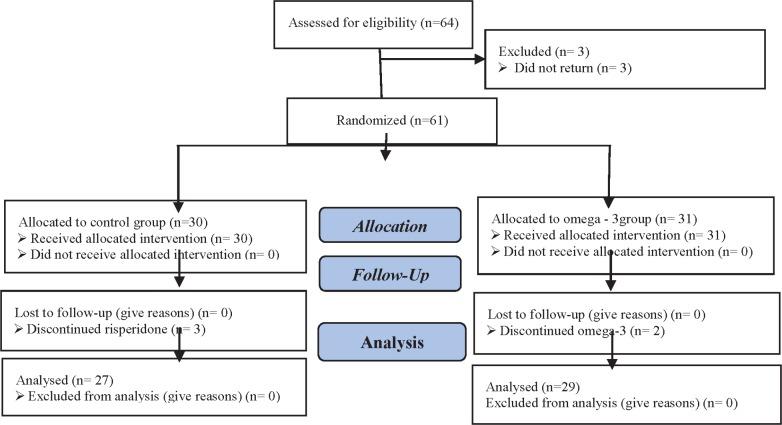
Overall, 23 girls and 33 boys with mean age of 9.24+0.15 yr (29 children in omega-3 group and 27 children in control group) were evaluated. Omega-3 therapy was effective in decreasing of seizures monthly frequency (10.41±3.92 times vs. 17.01±4.98, =0.03). Good response was seen in three children (11.1%) in control (95% confidence interval: 8%-22.8%) and in 9 children (31%) in omega-3 (95% CI: 47.83%-14.17%) group, which showed that omega-3 was more effective in seizure control. (=0.001). Frequency of side effects was not different in the two groups (14.8 % in control vs. 20.7% in omega-3 groups, =0.5).
CONCLUSION
Omega-3 might be used as an effective and safe drug in seizures control of children with refractory epilepsy and ADHD.
目的
我们旨在回答以下问题:对于患有难治性癫痫和注意力缺陷多动障碍(ADHD)的儿童,以往使用ω-3与利培酮联合的抗癫痫药物在降低每月癫痫发作频率方面是否比单独使用利培酮的以往抗癫痫药物更有效。
材料与方法
在一项随机临床试验(IRCT201604212639N18)中,2015年6月起转诊至伊朗亚兹德沙希德萨杜基医院儿科神经科诊所的参与者被随机分为两组。第一组,每日服用一粒ω-3胶囊,0.5毫克利培酮分两次与以往的抗癫痫药物一起服用;第二组,0.5毫克利培酮分两次与以往的抗癫痫药物一起服用。药物持续使用三个月,连续三个月每月对儿童进行随访。主要结局包括每月癫痫发作频率和良好反应(每月癫痫发作频率降低超过50%)。次要结局是临床副作用。
结果
总体上,评估了23名女孩和33名男孩,平均年龄为9.24±0.15岁(ω-3组29名儿童,对照组27名儿童)。ω-3治疗在降低每月癫痫发作频率方面有效(10.41±3.92次对17.01±4.98次,P=0.03)。对照组有3名儿童(11.1%)(95%置信区间:8%-22.8%)有良好反应,ω-3组有9名儿童(31%)(95%CI:47.83%-14.17%)有良好反应,这表明ω-3在癫痫控制方面更有效(P=0.001)。两组副作用发生率无差异(对照组14.8%对ω-3组20.7%,P=0.5)。
结论
ω-3可作为一种有效且安全的药物用于难治性癫痫和ADHD儿童的癫痫控制。
 Zotero 插件