
出狱后 3 年内艾滋病毒护理的保留率:一项队列研究。
Retention in HIV care during the 3 years following release from incarceration: A cohort study.
机构信息
AIDS Program, Section of Infectious Diseases, Yale School of Medicine, New Haven, Connecticut, United States of America.
Department of Epidemiology of Microbial Diseases, Yale School of Public Health, New Haven, Connecticut, United States of America.
出版信息
PLoS Med. 2018 Oct 9;15(10):e1002667. doi: 10.1371/journal.pmed.1002667. eCollection 2018 Oct.
BACKGROUND
Sustained retention in HIV care (RIC) and viral suppression (VS) are central to US national HIV prevention strategies, but have not been comprehensively assessed in criminal justice (CJ) populations with known health disparities. The purpose of this study is to identify predictors of RIC and VS following release from prison or jail.
METHODS AND FINDINGS
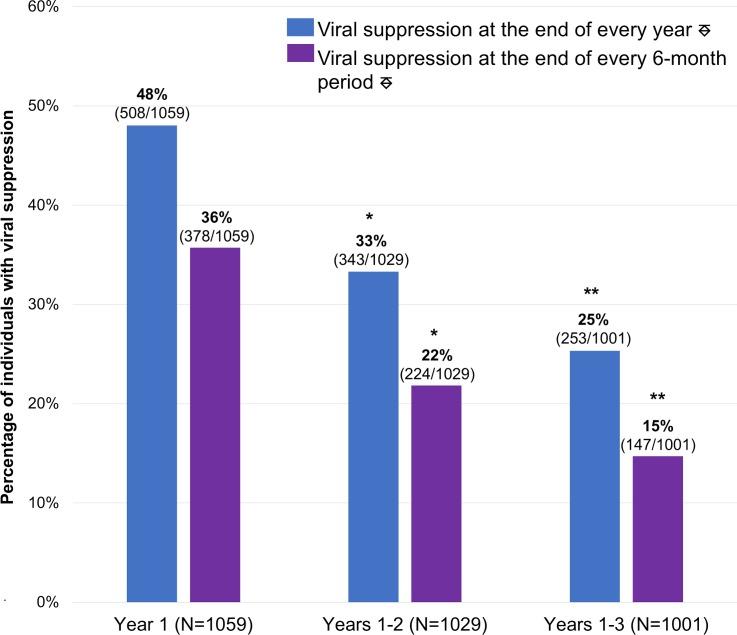
This is a retrospective cohort study of all adult people living with HIV (PLWH) incarcerated in Connecticut, US, during the period January 1, 2007, to December 31, 2011, and observed through December 31, 2014 (n = 1,094). Most cohort participants were unmarried (83.7%) men (77.0%) who were black or Hispanic (78.1%) and acquired HIV from injection drug use (72.6%). Prison-based pharmacy and custody databases were linked with community HIV surveillance monitoring and case management databases. Post-release RIC declined steadily over 3 years of follow-up (67.2% retained for year 1, 51.3% retained for years 1-2, and 42.5% retained for years 1-3). Compared with individuals who were not re-incarcerated, individuals who were re-incarcerated were more likely to meet RIC criteria (48% versus 34%; p < 0.001) but less likely to have VS (72% versus 81%; p = 0.048). Using multivariable logistic regression models (individual-level analysis for 1,001 individuals after excluding 93 deaths), both sustained RIC and VS at 3 years post-release were independently associated with older age (RIC: adjusted odds ratio [AOR] = 1.61, 95% CI = 1.22-2.12; VS: AOR = 1.37, 95% CI = 1.06-1.78), having health insurance (RIC: AOR = 2.15, 95% CI = 1.60-2.89; VS: AOR = 2.01, 95% CI = 1.53-2.64), and receiving an increased number of transitional case management visits. The same factors were significant when we assessed RIC and VS outcomes in each 6-month period using generalized estimating equations (for 1,094 individuals contributing 6,227 6-month periods prior to death or censoring). Additionally, receipt of antiretroviral therapy during incarceration (RIC: AOR = 1.33, 95% CI 1.07-1.65; VS: AOR = 1.91, 95% CI = 1.56-2.34), early linkage to care post-release (RIC: AOR = 2.64, 95% CI = 2.03-3.43; VS: AOR = 1.79; 95% CI = 1.45-2.21), and absolute time and proportion of follow-up time spent re-incarcerated were highly correlated with better treatment outcomes. Limited data were available on changes over time in injection drug use or other substance use disorders, psychiatric disorders, or housing status.
CONCLUSIONS
In a large cohort of CJ-involved PLWH with a 3-year post-release evaluation, RIC diminished significantly over time, but was associated with HIV care during incarceration, health insurance, case management services, and early linkage to care post-release. While re-incarceration and conditional release provide opportunities to engage in care, reducing recidivism and supporting community-based RIC efforts are key to improving longitudinal treatment outcomes among CJ-involved PLWH.
背景
持续的艾滋病毒护理(RIC)和病毒抑制(VS)是美国国家艾滋病毒预防战略的核心,但在有已知健康差距的刑事司法(CJ)人群中尚未得到全面评估。本研究的目的是确定从监狱或监狱释放后 RIC 和 VS 的预测因素。
方法和发现
这是一项对 2007 年 1 月 1 日至 2011 年 12 月 31 日期间在美国康涅狄格州被监禁的所有成年艾滋病毒感染者(PLWH)进行的回顾性队列研究,并于 2014 年 12 月 31 日进行了观察(n = 1,094)。队列参与者大多数是未婚(83.7%)男性(77.0%),他们是黑人和西班牙裔(78.1%),通过注射吸毒感染了 HIV(72.6%)。监狱药房和羁押数据库与社区艾滋病毒监测监测和病例管理数据库相链接。发布后的 RIC 在 3 年的随访中稳步下降(第 1 年保留 67.2%,第 1-2 年保留 51.3%,第 1-3 年保留 42.5%)。与未再次入狱的个体相比,再次入狱的个体更有可能符合 RIC 标准(48% 与 34%;p <0.001),但不太可能实现 VS(72% 与 81%;p = 0.048)。使用多变量逻辑回归模型(排除 93 例死亡后对 1,001 例个体进行个体水平分析),RIC 和 VS 在 3 年后的持续时间均与年龄较大(RIC:调整后的优势比 [AOR] = 1.61,95%CI = 1.22-2.12;VS:AOR = 1.37,95%CI = 1.06-1.78)、有健康保险(RIC:AOR = 2.15,95%CI = 1.60-2.89;VS:AOR = 2.01,95%CI = 1.53-2.64)和接受更多过渡性病例管理就诊有关。当我们使用广义估计方程(在 1,094 名个体贡献的 6,227 个 6 个月时间段之前,直到死亡或删失)评估每个 6 个月的 RIC 和 VS 结果时,同样的因素也是显著的。此外,在监禁期间接受抗逆转录病毒治疗(RIC:AOR = 1.33,95%CI 1.07-1.65;VS:AOR = 1.91,95%CI = 1.56-2.34)、释放后早期获得护理(RIC:AOR = 2.64,95%CI = 2.03-3.43;VS:AOR = 1.79,95%CI = 1.45-2.21)以及监禁期间随访时间的绝对值和比例与更好的治疗结果高度相关。关于注射吸毒或其他物质使用障碍、精神疾病或住房状况随时间变化的数据有限。
结论
在对有 3 年发布后评估的参与 CJ 的大量 PLWH 队列中,RIC 随时间显著下降,但与监禁期间的艾滋病毒护理、健康保险、病例管理服务和发布后早期获得护理有关。虽然再次入狱和有条件释放提供了参与护理的机会,但减少累犯并支持基于社区的 RIC 工作是改善参与 CJ 的 PLWH 的纵向治疗结果的关键。


 Zotero 插件