
肥胖调节睡眠呼吸暂停治疗与CHI3L1水平之间的关联,但不影响中度至重度阻塞性睡眠呼吸暂停患者的CHIT1活性:一项观察性研究。
Obesity modulates the association between sleep apnea treatment and CHI3L1 levels but not CHIT1 activity in moderate to severe OSA: an observational study.
作者信息
Teitsdottir Unnur Dilja, Arnardottir Erna Sif, Bjornsdottir Erla, Gislason Thorarinn, Petersen Petur Henry
机构信息
Faculty of Medicine, Department of Biochemistry and Molecular Biology, Biomedical Center, University of Iceland, Reykjavik, Iceland.
Faculty of Medicine, University of Iceland, Reykjavik, Iceland.
出版信息
Sleep Breath. 2018 Dec;22(4):1101-1109. doi: 10.1007/s11325-018-1731-6. Epub 2018 Oct 11.
PURPOSE
The inflammatory markers chitinase-3-like protein 1 (CHI3L1) and chitotriosidase (CHIT1) have both been associated with cardiovascular complications. The aim of this preliminary observational study was to assess the roles and interaction of obstructive sleep apnea (OSA) severity and body mass index (BMI) with plasma CHI3L1 levels and CHIT1 activity in patients with moderate to severe OSA. The second aim was to assess the roles and interaction of positive airway pressure (PAP) treatment and BMI on the expression of the same proteins.
METHODS
The study included 97 OSA patients with an apnea-hypopnea index (AHI) ≥ 15 and full usage of PAP treatment after 4 months. Plasma CHI3L1 levels and CHIT1 activity were measured before and after treatment.
RESULTS
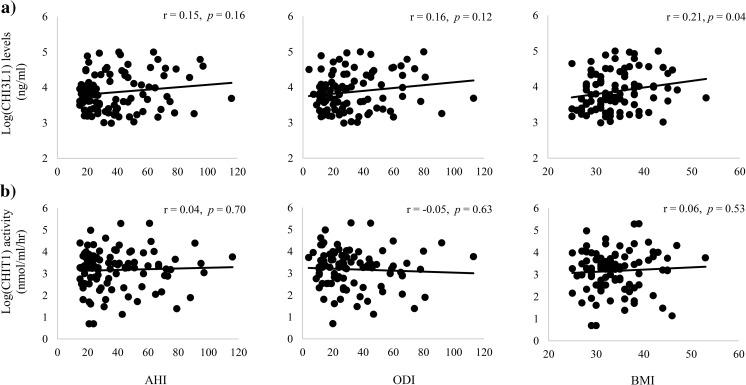
Multiple linear regression analysis demonstrated an independent association of BMI on CHI3L1 levels (p < 0.05) but not on CHIT1 activity. The OSA severity markers (AHI and oxygen desaturation index) did not independently or in interaction with BMI levels associate with CHI3L1 levels or with CHIT1 activity (p > 0.05). A two-way repeated measures ANOVA revealed a significant interaction between PAP treatment effect (before vs. after) and BMI groups (< 35 kg/m vs. ≥ 35 kg/m) on CHI3L1 levels (p = 0.03) but not on CHIT1 activity (p = 0.98).
CONCLUSIONS
Obesity independently associated with CHI3L1 levels. Association between OSA severity and CHI3L1 levels or CHIT1 activity (independent of or dependent on obesity level) could not be confirmed. However, decrease was observed in CHI3L1 levels after PAP treatment in severely obese OSA patients but not in those less obese.
目的
炎症标志物几丁质酶-3样蛋白1(CHI3L1)和壳三糖苷酶(CHIT1)均与心血管并发症有关。这项初步观察性研究的目的是评估中重度阻塞性睡眠呼吸暂停(OSA)严重程度和体重指数(BMI)与血浆CHI3L1水平及CHIT1活性之间的作用及相互关系。第二个目的是评估气道正压通气(PAP)治疗和BMI对相同蛋白表达的作用及相互关系。
方法
该研究纳入了97例呼吸暂停低通气指数(AHI)≥15且在4个月后完全使用PAP治疗的OSA患者。在治疗前后测量血浆CHI3L1水平和CHIT1活性。
结果
多元线性回归分析表明,BMI与CHI3L1水平独立相关(p<0.05),但与CHIT1活性无关。OSA严重程度标志物(AHI和氧去饱和指数)与CHI3L1水平或CHIT1活性均无独立关联,也未与BMI水平相互作用(p>0.05)。双向重复测量方差分析显示,PAP治疗效果(治疗前与治疗后)和BMI组(<35kg/m²与≥35kg/m²)对CHI3L1水平存在显著交互作用(p=0.03),但对CHIT1活性无显著交互作用(p=0.98)。
结论
肥胖与CHI3L1水平独立相关。无法证实OSA严重程度与CHI3L1水平或CHIT1活性之间存在关联(无论是否独立于肥胖水平或依赖于肥胖水平)。然而,在严重肥胖的OSA患者中,PAP治疗后CHI3L1水平下降,但在肥胖程度较轻的患者中未观察到这种下降。

 Zotero 插件