
通过逆转录定量聚合酶链反应测定乳腺癌生物标志物的稳健性:肿瘤细胞含量、导管原位癌和非肿瘤性乳腺组织的影响
Robustness of biomarker determination in breast cancer by RT-qPCR: impact of tumor cell content, DCIS and non-neoplastic breast tissue.
作者信息
Hartmann Kerstin, Schlombs Kornelia, Laible Mark, Gürtler Claudia, Schmidt Marcus, Sahin Ugur, Lehr Hans-Anton
机构信息
BioNTech Diagnostics GmbH, An der Goldgrube 12, 55131, Mainz, Germany.
Department of Obstetrics and Gynecology, Johannes Gutenberg University, Langenbeckstraße 1, 55131, Mainz, Germany.
出版信息
Diagn Pathol. 2018 Oct 20;13(1):83. doi: 10.1186/s13000-018-0760-6.
BACKGROUND
Tissue heterogeneity in formalin-fixed paraffin-embedded (FFPE) breast cancer specimens may affect the accuracy of reverse transcription quantitative real-time PCR (RT-qPCR). Herein, we tested the impact of tissue heterogeneity of breast cancer specimen on the RT-qPCR-based gene expression assay MammaTyper®.
METHODS
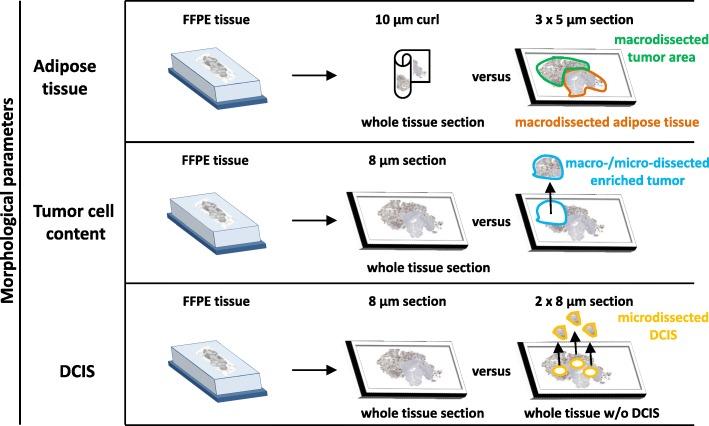
MammaTyper® quantifies the mRNA expression of the four biomarkers ERBB2, ESR1, PGR, and MKI67. Based on pre-defined cut-off values, this molecular in vitro diagnostic assay permits binary marker classification and determination of breast cancer subtypes as defined by St Gallen 2013. In this study, we compared data from whole FFPE sections with data obtained in paired RNA samples after enrichment for invasive carcinoma via macro- or laser-capture micro-dissection.
RESULTS
Compared to whole sections, removal of surrounding adipose tissue by macrodissection generated mean absolute 40-ddCq differences of 0.28-0.32 cycles for all four markers, with ≥90% concordant binary classifications. The mean raw marker Cq values in the adipose tissue were delayed by 6 to 7 cycles compared with the tumor-enriched sections, adding a trivial linear fold change of 1.0078 to 1.0156. Comparison of specimens enriched for invasive tumor with whole sections with as few as 20% tumor cell content resulted in mean absolute differences that remained on average below 0.59 Cq. The mean absolute difference between whole sections containing up to 60% ductal carcinoma in situ (DCIS) and specimens after dissection of DCIS was only 0.16-0.25 cycles, although there was a tendency for higher gene expression in DCIS. Observed variations were related to small size of samples and proximity of values to the limit of detection.
CONCLUSION
Expression of ESR1, PGR, ERBB2 and MKI67 by MammaTyper® is robust in clinical FFPE samples. Assay performance was unaffected by adipose tissue and was stable in samples with as few as 20% tumor cell content and up to 60% DCIS.
背景
福尔马林固定石蜡包埋(FFPE)乳腺癌标本中的组织异质性可能会影响逆转录定量实时PCR(RT-qPCR)的准确性。在此,我们测试了乳腺癌标本的组织异质性对基于RT-qPCR的基因表达检测方法MammaTyper®的影响。
方法
MammaTyper®可定量检测四种生物标志物ERBB2、ESR1、PGR和MKI67的mRNA表达。基于预先定义的临界值,这种分子体外诊断检测方法允许进行二元标志物分类,并确定2013年圣加仑会议所定义的乳腺癌亚型。在本研究中,我们将全FFPE切片的数据与通过宏观或激光捕获显微切割富集浸润性癌后在配对RNA样本中获得的数据进行了比较。
结果
与全切片相比,通过宏观解剖去除周围脂肪组织后,所有四种标志物的平均绝对40-ddCq差异为0.28 - 0.32个循环,二元分类的一致性≥90%。脂肪组织中的原始标志物Cq值平均比富含肿瘤的切片延迟6至7个循环,线性倍数变化仅为1.0078至1.0156。将富含浸润性肿瘤的标本与肿瘤细胞含量低至20%的全切片进行比较,平均绝对差异平均保持在0.59 Cq以下。含有高达60%导管原位癌(DCIS)的全切片与DCIS切除后的标本之间的平均绝对差异仅为0.16 - 0.25个循环,尽管DCIS中的基因表达有升高趋势。观察到的差异与样本量小以及值接近检测限有关。
结论
MammaTyper®检测的ESR1、PGR、ERBB2和MKI67在临床FFPE样本中的表达具有稳健性。检测性能不受脂肪组织影响,在肿瘤细胞含量低至20%且DCIS高达60%的样本中也很稳定。



 Zotero 插件