
探讨 flhF 失活对空肠弯曲杆菌在鸡和小鼠肠道定植的影响。
Insights into the impact of flhF inactivation on Campylobacter jejuni colonization of chick and mice gut.
机构信息
Jiangsu Key Lab of Zoonosis/Jiangsu Co-Innovation Center for Prevention and Control of Important Animal Infectious Diseases and Zoonoses, Yangzhou University, 48 East Wenhui Road, Yangzhou, 225009, Jiangsu, China.
Key Laboratory of Prevention and Control of Biological Hazard Factors (Animal Origin) for Agrifood Safety and Quality, Ministry of Agriculture of China, Yangzhou, 225009, Jiangsu, China.
出版信息
BMC Microbiol. 2018 Oct 22;18(1):149. doi: 10.1186/s12866-018-1318-1.
BACKGROUND
Campylobacter jejuni (C. jejuni) is a leading cause of foodborne gastroenteritis worldwide. This bacterium lacks many of the classical virulence factors, and flagellum-associated persistent colonization has been shown to be crucial for its pathogenesis. The flagellum plays a multifunctional role in C. jejuni pathogenesis, and different flagellar elements make diverse contributions. The flhF gene encodes the flagellar biosynthesis regulator, which is important for flagellar biosynthesis. In this study, the influence of flhF on C. jejuni colonization was systematically studied, and the possible mechanisms were also analyzed.
RESULTS
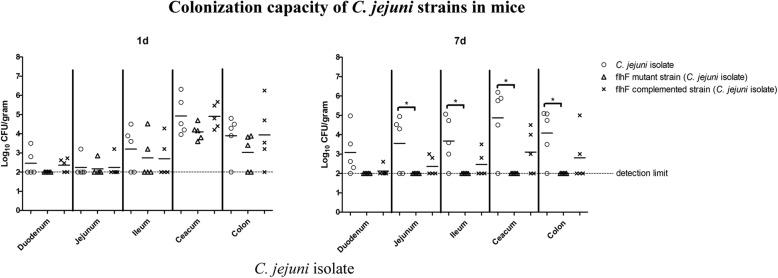
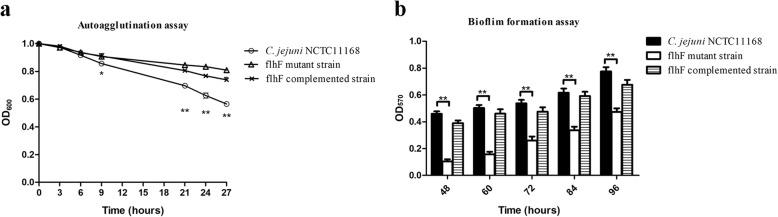
The flhF gene has a significant influence on C. jejuni colonization, and its inactivation resulted in severe defects in the commensal colonization of chicks, with approximately 10- to 10-fold reductions (for NCTC 11168 and a C. jejuni isolate respectively) observed in the bacterial caecal loads. Similar effects were observed in mice where the flhF mutant strain completely lost the ability to continuously colonize mice, which cleared the isolate at 7 days post inoculation. Characterization of the phenotypic properties of C. jejuni that influence colonization showed that the adhesion and invasion abilities of the C. jejuni flhF mutant were reduced to approximately 52 and 27% of that of the wild-type strain, respectively. The autoagglutination and biofilm-formation abilities of the flhF mutant strain were also significantly decreased. Further genetic investigation revealed that flhF is continuously upregulated during the infection process, which indicates a close association of this gene with C. jejuni pathogenesis. The transcription of some other infection-related genes that are not directly involved in flagellar assembly were also influenced by its inactivation, with the flagellar coexpressed determinants (Feds) being apparently affected.
CONCLUSIONS
Inactivation of flhF has a significant influence on C. jejuni colonization in both birds and mammals. This defect may be caused by the decreased adhesion, invasion, autoagglutination and biofilm-formation abilities of the flhF mutant strain, as well as the influence on the transcription of other infection related genes, which provides insights into this virulence factor and the flagellum mediated co-regulation of C. jejuni pathogenesis.
背景
空肠弯曲菌(C. jejuni)是世界范围内食源性胃肠炎的主要原因。该细菌缺乏许多经典的毒力因子,并且已证明鞭毛相关的持续定植对于其发病机制至关重要。鞭毛在 C. jejuni 发病机制中发挥着多功能作用,不同的鞭毛元件做出不同的贡献。flhF 基因编码鞭毛生物合成调节剂,对鞭毛生物合成很重要。在这项研究中,系统研究了 flhF 对 C. jejuni 定植的影响,并分析了可能的机制。
结果
flhF 基因对 C. jejuni 定植有重要影响,其失活导致鸡共生定植严重缺陷,细菌盲肠负荷分别减少了约 10-10 倍(分别为 NCTC 11168 和 C. jejuni 分离株)。在小鼠中也观察到类似的影响,flhF 突变株完全丧失了连续定植小鼠的能力,在接种后 7 天清除了分离株。对影响定植的 C. jejuni 表型特性的表征表明,C. jejuni flhF 突变体的粘附和侵袭能力分别降低到野生型菌株的约 52%和 27%。flhF 突变株的自凝集和生物膜形成能力也明显降低。进一步的遗传研究表明,flhF 在感染过程中持续上调,这表明该基因与 C. jejuni 发病机制密切相关。一些不直接参与鞭毛组装的其他感染相关基因的转录也受到其失活的影响,明显影响了鞭毛共表达决定因素(Feds)。
结论
flhF 的失活对鸟类和哺乳动物中的 C. jejuni 定植有重要影响。这种缺陷可能是由于 flhF 突变体的粘附、侵袭、自凝集和生物膜形成能力降低,以及对其他感染相关基因转录的影响所致,这为该毒力因子和鞭毛介导的 C. jejuni 发病机制的共调控提供了新的认识。



 Zotero 插件