
染料木黄酮通过调节胆碱能神经传递、抗氧化系统以及ERK/CREB/BDNF信号通路改善东莨菪碱诱导的小鼠记忆缺失。
Genistein Ameliorates Scopolamine-Induced Amnesia in Mice Through the Regulation of the Cholinergic Neurotransmission, Antioxidant System and the ERK/CREB/BDNF Signaling.
作者信息
Lu Cong, Wang Yan, Xu Teng, Li Qi, Wang Donghui, Zhang Lijing, Fan Bei, Wang Fengzhong, Liu Xinmin
机构信息
Institute of Food Science and Technology, Chinese Academy of Agricultural Sciences, Beijing, China.
Research Center for Pharmacology and Toxicology, Institute of Medicinal Plant Development, Chinese Academy of Medical Sciences and Peking Union Medical College, Beijing, China.
出版信息
Front Pharmacol. 2018 Oct 12;9:1153. doi: 10.3389/fphar.2018.01153. eCollection 2018.
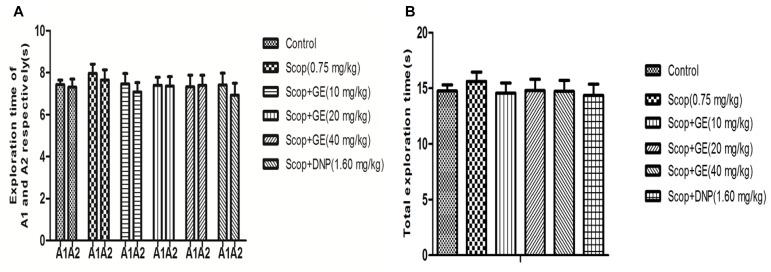
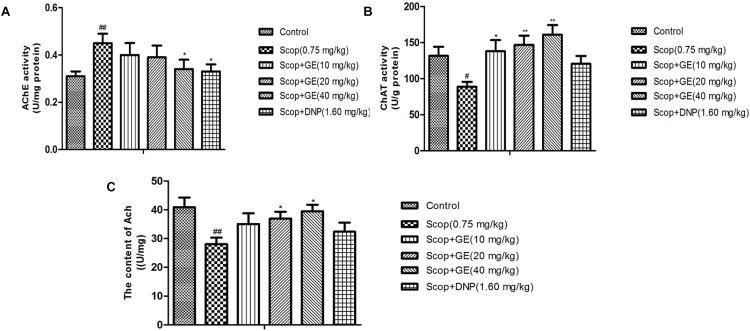
Genistein (GE) was reported to exert a wide spectrum of biological activities, including antioxidant, anti-inflammatory, anti-mutagenic, anticancer, and cardio-protective effects. In addition, both clinical and preclinical studies have recently suggested GE a potential neuroprotective and memory-enhancing drug against neurodegenerative diseases. The animal model of scopolamine (Scop)-induced amnesia is widely used to study underlying mechanisms and treatment of cognitive impairment in neurodegenerative diseases. However, there is no report about the effects of GE on Scop-induced amnesia in mice. Therefore, the present study was carried out to investigate the beneficial effects and potential mechanism of GE against Scop-induced deficits in mice. The mice were orally pretreated with either GE (10, 20, and 40 mg/kg) or donepezil (1.60 mg/kg) for 14 days. After the pretreatment, the open field test was conducted to assess the effect of GE on the locomotor activity of mice. Thereafter, mice were daily injected with Scop (0.75 mg/kg) intraperitoneally to induce memory deficits and subjected to the cognitive behavioral tests including the Object Location Recognition (OLR) experiment and Morris Water Maze (MWM) task. After the behavioral tests, biochemical parameter assay and western blot analysis were used to examine the underlying mechanisms of its action. The results showed that GE administration significantly improved the cognitive performance of Scop-treated mice in OLR and Morris water maze tests, exerting the memory-enhancing effects. Additionally, GE remarkably promoted the cholinergic neurotransmission and protected against the oxidative stress damage in the hippocampus of Scop-treated mice, as indicated by decreasing AChE activity, elevating ChAT activity and Ach level, increasing SOD activity, lowering the level of MDA and increasing GSH content. Furthermore, GE was found to significantly upregulate the expression levels of p-ERK, p-CREB and BDNF proteins in the hippocampus of Scop-treated mice. Taken together, these results for the first time found that GE exerts cognitive-improving effects in Scop-induced amnesia and suggested it may be a potential candidate compound for the treatment of some neurodegenerative diseases such as Alzheimer's Disease (AD).
据报道,金雀异黄素(GE)具有广泛的生物学活性,包括抗氧化、抗炎、抗诱变、抗癌和心脏保护作用。此外,近期的临床和临床前研究均表明,GE是一种针对神经退行性疾病的潜在神经保护和记忆增强药物。东莨菪碱(Scop)诱导的失忆动物模型被广泛用于研究神经退行性疾病中认知障碍的潜在机制和治疗方法。然而,尚无关于GE对Scop诱导的小鼠失忆影响的报道。因此,本研究旨在探讨GE对Scop诱导的小鼠缺陷的有益作用及其潜在机制。小鼠口服给予GE(10、20和40mg/kg)或多奈哌齐(1.60mg/kg),持续14天。预处理后,进行旷场试验以评估GE对小鼠运动活性的影响。此后,每天给小鼠腹腔注射Scop(0.75mg/kg)以诱导记忆缺陷,并进行包括物体位置识别(OLR)实验和莫里斯水迷宫(MWM)任务在内的认知行为测试。行为测试后,采用生化参数测定和蛋白质印迹分析来研究其作用的潜在机制。结果表明,给予GE可显著改善Scop处理小鼠在OLR和莫里斯水迷宫测试中的认知表现,发挥记忆增强作用。此外,GE显著促进Scop处理小鼠海马中的胆碱能神经传递,并防止氧化应激损伤,表现为降低乙酰胆碱酯酶(AChE)活性、提高胆碱乙酰转移酶(ChAT)活性和乙酰胆碱(Ach)水平、增加超氧化物歧化酶(SOD)活性、降低丙二醛(MDA)水平以及增加谷胱甘肽(GSH)含量。此外,发现GE可显著上调Scop处理小鼠海马中磷酸化细胞外信号调节激酶(p-ERK)蛋白、磷酸化环磷腺苷反应元件结合蛋白(p-CREB)蛋白和脑源性神经营养因子(BDNF)的表达水平。综上所述,这些结果首次发现GE对Scop诱导的失忆具有认知改善作用,并表明它可能是治疗某些神经退行性疾病如阿尔茨海默病(AD)的潜在候选化合物。





 Zotero 插件