
根据两种模式(欧洲健康、老龄化和退休调查(SHARE))在欧洲,积极和健康老龄化的流行率及其相关因素。
Prevalence and related factors of Active and Healthy Ageing in Europe according to two models: Results from the Survey of Health, Ageing and Retirement in Europe (SHARE).
机构信息
Health and Healthcare Research Group, University of Girona, Girona, Catalonia, Spain.
Nursing Department, University of Girona, Girona, Catalonia, Spain.
出版信息
PLoS One. 2018 Oct 29;13(10):e0206353. doi: 10.1371/journal.pone.0206353. eCollection 2018.
BACKGROUND
Active and Healthy Ageing (AHA) is the process of optimizing opportunities related to health, participation, and safety in order to improve quality of life. The approach most often used to measure AHA is Rowe and Kahn's Satisfactory Ageing model. Nonetheless, this model has limitations. One of the strategic objectives of the WHO Global Strategy and Action Plan (2016) is to improve Healthy Ageing measurement. Our objectives were to compare two models of assessing AHA and further compare the results by country and sociodemographic variables.
METHODS
This was a cross-sectional, observational analysis of a representative sample of the general population aged 50 years and older in Europe. The data analysed were obtained by the Study of Health, Ageing and Retirement in Europe (SHARE). The dependent variable was AHA and its dimensions, measured using the Rowe and Kahn AHA model (AHA-B) and the authors' model based on the WHO definition (AHA-BPS). A descriptive analysis and multivariate models of binary logistical regression were developed.
RESULTS
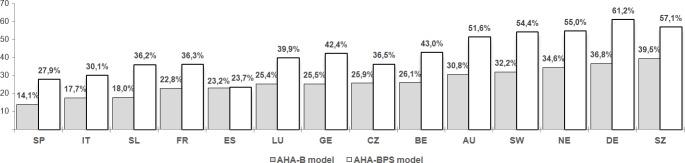
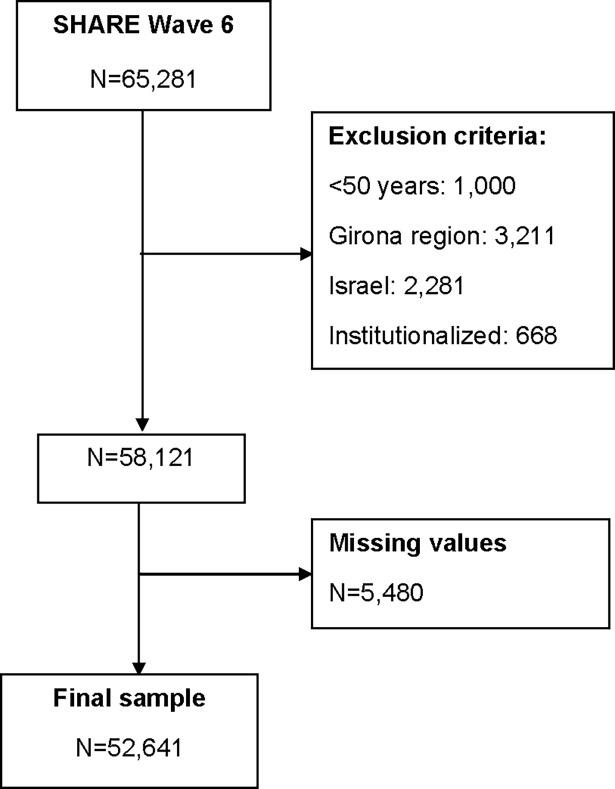
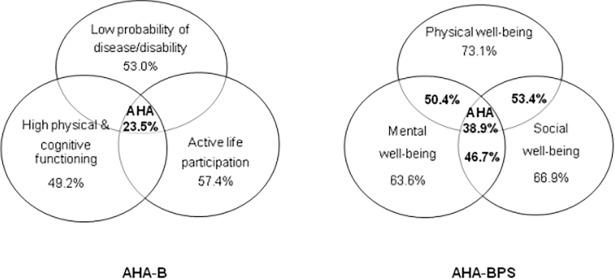
The sample consisted of 52,641 participants (mean age 65.24 years [SD = 10.18; Range = 50-104], 53.2% women). Healthy Ageing prevalence in the AHA-B model was 23.5% (95%CI = 23.1%-23.9%). In the AHA-BPS model, this prevalence was 38.9%. In both models, significant variations were observed between countries, and were distributed along a north-western to south-eastern gradient. The sociodemographic variables associated with the absence of AHA were advanced age, female sex, death of spouse, low educational level, lack of employment, and low financial status. Comparing the two models, the strength of association between absence of AHA and advanced age (85 years and older) was four times greater in the AHA-B model.
CONCLUSIONS
Our results showing differences between these two models provide evidence that the AHA-BPS model does not penalize older age and is more likely to characterize AHA from a health promotion perspective.
背景
积极健康老龄化(AHA)是优化与健康、参与和安全相关机会的过程,目的是提高生活质量。最常用于衡量 AHA 的方法是罗和卡恩的满意老龄化模型。尽管如此,这种模式存在局限性。世界卫生组织全球战略和行动计划(2016 年)的战略目标之一是改善健康老龄化的衡量标准。我们的目标是比较两种评估 AHA 的模型,并进一步按国家和社会人口统计学变量比较结果。
方法
这是一项对欧洲 50 岁及以上普通人群的代表性样本进行的横断面、观察性分析。分析的数据来自欧洲健康、老龄化和退休研究(SHARE)。因变量是 AHA 及其维度,使用罗和卡恩的 AHA 模型(AHA-B)和作者基于世界卫生组织定义的模型(AHA-BPS)进行测量。进行了描述性分析和多元二项逻辑回归模型。
结果
该样本由 52641 名参与者组成(平均年龄 65.24 岁[标准差=10.18;范围=50-104],53.2%为女性)。AHA-B 模型中健康老龄化的患病率为 23.5%(95%置信区间[CI]=23.1%-23.9%)。在 AHA-BPS 模型中,这一患病率为 38.9%。在这两种模型中,各国之间都观察到了显著的差异,并呈西北到东南梯度分布。与缺乏 AHA 相关的社会人口统计学变量是年龄较大、女性、配偶死亡、教育水平低、失业和经济状况不佳。将这两种模型进行比较后,AHA-B 模型中 85 岁及以上人群缺乏 AHA 与年龄之间的关联强度是 AHA-BPS 模型的四倍。
结论
我们的研究结果表明这两种模型之间存在差异,这表明 AHA-BPS 模型不会惩罚年龄较大的人群,并且更有可能从健康促进的角度来描述 AHA。
 Zotero 插件