
优化蛋白质组学分析的培养上清液中外泌体的分离方法的协调一致。
Harmonization of exosome isolation from culture supernatants for optimized proteomics analysis.
机构信息
Maria Sklodowska-Curie Institute - Oncology Center, Gliwice Branch, Gliwice, Poland.
Institute of Bioorganic Chemistry, Polish Academy of Sciences, Poznan, Poland.
出版信息
PLoS One. 2018 Oct 31;13(10):e0205496. doi: 10.1371/journal.pone.0205496. eCollection 2018.
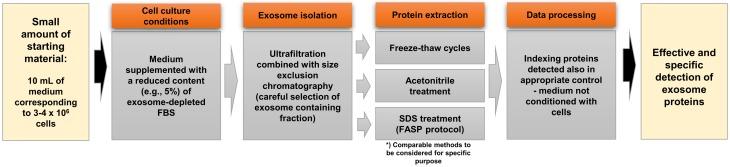
Exosomes, the smallest subset of extracellular vesicles (EVs), have recently attracted much attention in the scientific community. Their involvement in intercellular communication and molecular reprogramming of different cell types created a demand for a stringent characterization of the proteome which exosomes carry and deliver to recipient cells. Mass spectrometry (MS) has been extensively used for exosome protein profiling. Unfortunately, no standards have been established for exosome isolation and their preparation for MS, leading to accumulation of artefactual data. These include the presence of high-abundance exosome-contaminating serum proteins in culture media which mask low-abundance exosome-specific components, isolation methods that fail to yield "pure" vesicles or variability in protein solubilization protocols. There is an unmet need for the development of standards for exosome generation, harvesting, and isolation from cellular supernatants and for optimization of protein extraction methods before proteomics analysis by MS. In this communication, we illustrate the existing problems in this field and provide a set of recommendations that are expected to harmonize exosome processing for MS and provide the faithful picture of the proteomes carried by exosomes. The recommended workflow for effective and specific identification of proteins in exosomes released by the low number of cells involves culturing cells in medium with a reduced concentration of exosome-depleted serum, purification of exosomes by size-exclusion chromatography, a combination of different protein extraction method and removal of serum-derived proteins from the final dataset using an appropriate sample of cell-unexposed medium as a control. Application of this method allowed detection of >250 vesicle-specific proteins in exosomes from 10 mL of culture medium.
外泌体是细胞外囊泡(EVs)的最小子集,最近在科学界引起了广泛关注。它们在细胞间通讯和不同类型细胞的分子重编程中的作用,导致人们对外泌体携带并递送到受体细胞的蛋白质组进行严格的特征描述的需求增加。质谱(MS)已广泛用于外泌体蛋白谱分析。不幸的是,目前还没有建立外泌体分离及其用于 MS 制备的标准,导致人为数据的积累。这些问题包括在培养物中存在高丰度的外泌体污染的血清蛋白,这些蛋白掩盖了低丰度的外泌体特异性成分,分离方法无法产生“纯”囊泡,或者蛋白质溶解方案的可变性。因此,需要制定从细胞上清液中外泌体生成、收获和分离的标准,并在通过 MS 进行蛋白质组学分析之前优化蛋白质提取方法。在本通讯中,我们说明了该领域存在的问题,并提供了一组建议,这些建议有望协调 MS 中外泌体处理,提供外泌体携带的蛋白质组的真实图像。有效和特异性鉴定由少量细胞释放的外泌体中的蛋白质的推荐工作流程涉及在含有低浓度外泌体耗尽血清的培养基中培养细胞,通过大小排阻色谱法纯化外泌体,结合使用不同的蛋白质提取方法,并使用适当的未暴露于细胞的培养基样本作为对照从最终数据集去除血清衍生蛋白。应用该方法可在 10 mL 培养物培养基中外泌体中检测到>250 种囊泡特异性蛋白。

 Zotero 插件