
外显子组测序在来自古巴的大型、多效双相情感障碍家系中的应用。
Exome sequencing in large, multiplex bipolar disorder families from Cuba.
机构信息
Institute of Human Genetics, University of Bonn School of Medicine & University Hospital Bonn, Bonn, Germany.
Department of Genomics, Life & Brain Center, University of Bonn, Bonn, Germany.
出版信息
PLoS One. 2018 Oct 31;13(10):e0205895. doi: 10.1371/journal.pone.0205895. eCollection 2018.
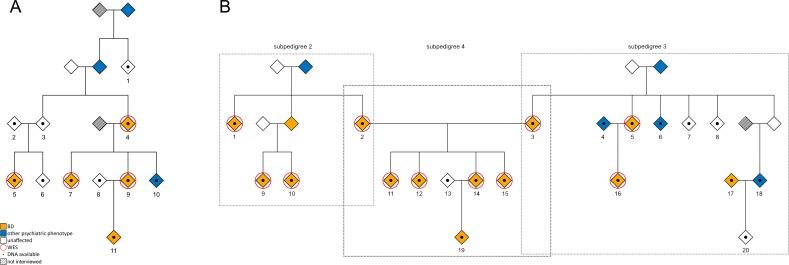
Bipolar disorder (BD) is a major psychiatric illness affecting around 1% of the global population. BD is characterized by recurrent manic and depressive episodes, and has an estimated heritability of around 70%. Research has identified the first BD susceptibility genes. However, the underlying pathways and regulatory networks remain largely unknown. Research suggests that the cumulative impact of common alleles with small effects explains only around 25-38% of the phenotypic variance for BD. A plausible hypothesis therefore is that rare, high penetrance variants may contribute to BD risk. The present study investigated the role of rare, nonsynonymous, and potentially functional variants via whole exome sequencing in 15 BD cases from two large, multiply affected families from Cuba. The high prevalence of BD in these pedigrees renders them promising in terms of the identification of genetic risk variants with large effect sizes. In addition, SNP array data were used to calculate polygenic risk scores for affected and unaffected family members. After correction for multiple testing, no significant increase in polygenic risk scores for common, BD-associated genetic variants was found in BD cases compared to healthy relatives. Exome sequencing identified a total of 17 rare and potentially damaging variants in 17 genes. The identified variants were shared by all investigated BD cases in the respective pedigree. The most promising variant was located in the gene SERPING1 (p.L349F), which has been reported previously as a genome-wide significant risk gene for schizophrenia. The present data suggest novel candidate genes for BD susceptibility, and may facilitate the discovery of disease-relevant pathways and regulatory networks.
双相情感障碍(BD)是一种影响全球约 1%人口的主要精神疾病。BD 的特征是反复发作的躁狂和抑郁发作,其遗传率约为 70%。研究已经确定了第一个 BD 易感性基因。然而,其潜在的途径和调控网络在很大程度上仍然未知。研究表明,具有小效应的常见等位基因的累积影响仅能解释 BD 表型变异的 25-38%左右。因此,一个合理的假设是,罕见的、高外显率的变异可能会导致 BD 风险。本研究通过全外显子组测序,在来自古巴的两个大型、多代受影响的家族中的 15 例 BD 病例中,研究了罕见的非同义且可能具有功能的变异的作用。这些家系中 BD 的高患病率使得它们在鉴定具有大效应大小的遗传风险变异方面很有前途。此外,还使用 SNP 芯片数据计算了受影响和未受影响的家庭成员的多基因风险评分。经过多重检验校正后,与健康亲属相比,BD 病例中常见的、与 BD 相关的遗传变异的多基因风险评分没有显著增加。外显子组测序总共在 17 个基因中鉴定出了 17 个罕见的、潜在有害的变异。在所研究的家系中,所有被调查的 BD 病例均共享鉴定出的变异。最有希望的变异位于 SERPING1 基因(p.L349F)中,该基因先前被报道为全基因组范围内精神分裂症的显著风险基因。本数据提示了 BD 易感性的新候选基因,可能有助于发现与疾病相关的途径和调控网络。
 Zotero 插件