
掺铒钇铝石榴石激光治疗种植体周围疾病的有效性:临床、微生物学及生化标志物分析
Effectiveness of an erbium-doped: yttrium, aluminum and garnet laser for treatment of peri-implant disease: Clinical, microbiological, and biochemical marker analyses.
作者信息
Komatsu Yasutaka, Kubota Takehiko, Yasuda Tadashi, Takahashi Tsurayuki, Yamamoto Atsuhiko, Kono Tomoo, Tabata Hajime, Nohno Kaname, Shibutani Toshiaki, Umeda Makoto, Yoshie Hiromasa
机构信息
Division of Periodontology, Department of Oral Biological Science, Niigata University Graduate School of Medical and Dental Sciences, Niigata, Japan.
Department of Periodontology, Asahi University, School of Dentistry, Gifu, Japan.
出版信息
J Clin Exp Dent. 2018 Oct 1;10(10):e970-e978. doi: 10.4317/jced.55016. eCollection 2018 Oct.
BACKGROUND
The effectiveness of an erbium-doped: yttrium, aluminum and garnet (Er: YAG) laser (EYL) for the treatment of peri-implant disease (PID) remains unclear. The aim of this study was to compare non-surgical EYL therapy for PID with locally delivered minocycline hydrochloride (MC) ointment therapy by evaluating clinical, microbiological, and biochemical markers.
MATERIAL AND METHODS
Thirty-seven patients with PID were randomly assigned to either the EYL group (n = 18) or the MC group (n = 19). The clinical, microbiological, and biochemical markers at baseline and at 1 and 3 months after treatment were compared between the two groups. Subgingival plaque and peri-implant crevicular fluid (PICF) were collected from the diseased pockets.
RESULTS
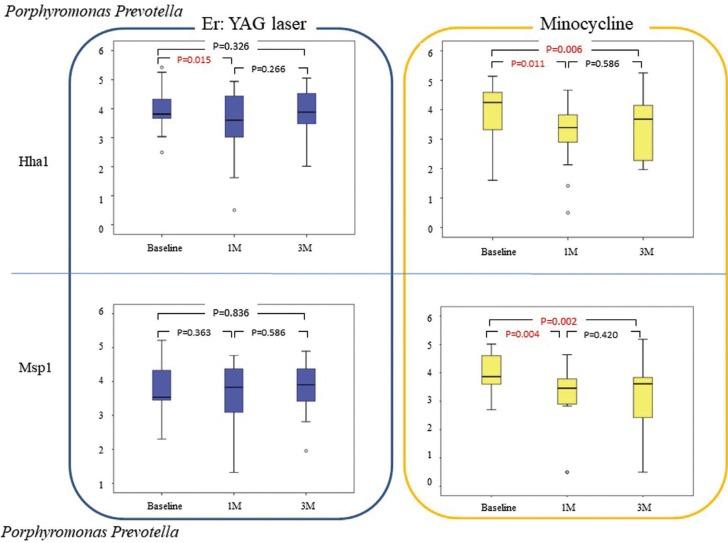
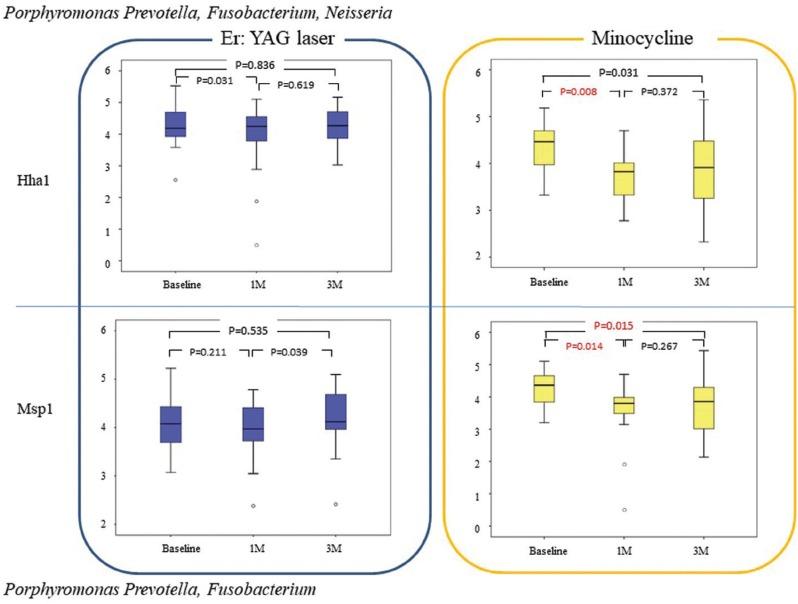
In the EYL group, probing pocket depth (PPD) was significantly decreased after treatment when compared with baseline. On the other hand, in the MC group, there was no significant decrease in PPD after treatment. Specific bacteria associated with PID were not determined. The counts of both Gram-positive and -negative species did not significantly decrease in the EYL group at 3 months after treatment. In the MC group, the counts of almost all bacterial species were significantly decreased after treatment. Biochemical marker analysis of PICF revealed significantly lower levels of metalloproteinase (MMP)-9 in the EYL group, as compared with the MC group at 3 months after treatment (= 0.009).
CONCLUSIONS
Non-surgical therapy with an EYL for PID was clinically effective, with decreased MMP-9 levels in PICF, which may lead to reduced peri-implant tissue destruction. Er: YAG laser; peri-implant disease; biomarker; peri-implant crevicular fluid.
背景
掺铒钇铝石榴石(Er:YAG)激光(EYL)治疗种植体周围疾病(PID)的有效性尚不清楚。本研究的目的是通过评估临床、微生物学和生化指标,比较PID的非手术EYL治疗与局部应用盐酸米诺环素(MC)软膏治疗的效果。
材料与方法
37例PID患者被随机分为EYL组(n = 18)或MC组(n = 19)。比较两组治疗前及治疗后1个月和3个月时的临床、微生物学和生化指标。从患病袋中收集龈下菌斑和种植体周围龈沟液(PICF)。
结果
与基线相比,EYL组治疗后探诊深度(PPD)显著降低。另一方面,MC组治疗后PPD无显著降低。未确定与PID相关的特定细菌。治疗3个月时,EYL组革兰氏阳性菌和阴性菌的数量均未显著减少。在MC组中,几乎所有细菌种类的数量在治疗后均显著减少。PICF的生化指标分析显示,治疗3个月时,EYL组的金属蛋白酶(MMP)-9水平显著低于MC组(P = 0.009)。
结论
EYL非手术治疗PID在临床上是有效的,PICF中MMP-9水平降低,这可能导致种植体周围组织破坏减少。Er:YAG激光;种植体周围疾病;生物标志物;种植体周围龈沟液。

 Zotero 插件