
γ-干扰素的直接抗病毒机制
Direct Antiviral Mechanisms of Interferon-Gamma.
作者信息
Kang Soowon, Brown Hailey M, Hwang Seungmin
机构信息
Department of Pathology, The University of Chicago, Chicago, IL 60637, USA.
Committee on Immunology, The University of Chicago, Chicago, IL 60637, USA.
出版信息
Immune Netw. 2018 Oct 17;18(5):e33. doi: 10.4110/in.2018.18.e33. eCollection 2018 Oct.
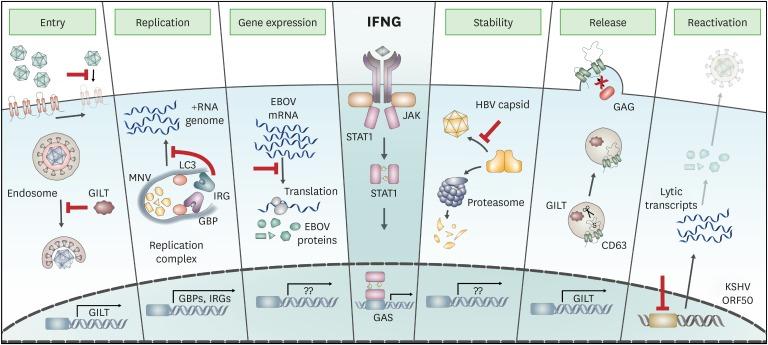
Interferon-gamma (IFNG) is a pleiotropic cytokine that modulates both innate and adaptive immune networks; it is the most potent activator of macrophages and a signature cytokine of activated T lymphocytes. Though IFNG is now appreciated to have a multitude of roles in immune modulation and broad-spectrum pathogen defense, it was originally discovered, and named, as a secretory factor that interferes with viral replication. In contrast to the prototypical type I interferons produced by any cells upon viral infection, only specific subsets of immune cells can produce IFNG upon infection or stimulation with antigen or mitogen. Still, virtually all cells can respond to both types of interferons. This makes IFNG a versatile anti-microbial cytokine and also gives it a unique position in the antiviral defense system. The goal of this review is to highlight the direct antiviral mechanisms of IFNG, thereby clarifying its antiviral function in the effective control of viral infections.
干扰素-γ(IFNG)是一种多效性细胞因子,可调节先天性和适应性免疫网络;它是巨噬细胞最有效的激活剂,也是活化T淋巴细胞的标志性细胞因子。尽管现在人们认识到IFNG在免疫调节和广谱病原体防御中具有多种作用,但它最初是作为一种干扰病毒复制的分泌因子被发现并命名的。与病毒感染时任何细胞产生的典型I型干扰素不同,只有特定的免疫细胞亚群在受到抗原或有丝分裂原感染或刺激时才能产生IFNG。然而,几乎所有细胞都能对这两种类型的干扰素作出反应。这使得IFNG成为一种多功能的抗微生物细胞因子,也使其在抗病毒防御系统中占据独特地位。本综述的目的是突出IFNG的直接抗病毒机制,从而阐明其在有效控制病毒感染中的抗病毒功能。
 Zotero 插件