
通过碘克沙醇密度梯度超速离心和结合洗脱色谱法从血浆中分离高纯度细胞外囊泡。
Isolation of High-Purity Extracellular Vesicles by the Combination of Iodixanol Density Gradient Ultracentrifugation and Bind-Elute Chromatography From Blood Plasma.
作者信息
Onódi Zsófia, Pelyhe Csilla, Terézia Nagy Csilla, Brenner Gábor B, Almási Laura, Kittel Ágnes, Manček-Keber Mateja, Ferdinandy Péter, Buzás Edit I, Giricz Zoltán
机构信息
Department of Pharmacology and Pharmacotherapy, Semmelweis University, Budapest, Hungary.
Institute of Experimental Medicine, Hungarian Academy of Sciences, Budapest, Hungary.
出版信息
Front Physiol. 2018 Oct 23;9:1479. doi: 10.3389/fphys.2018.01479. eCollection 2018.
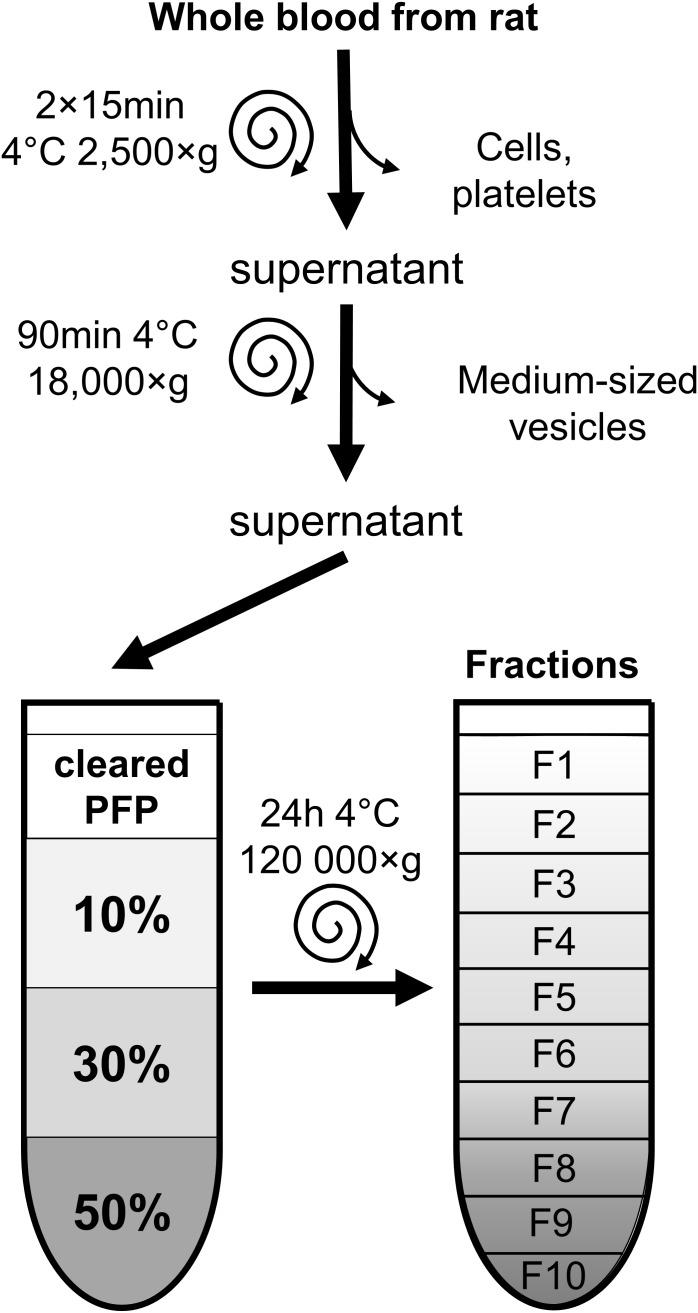
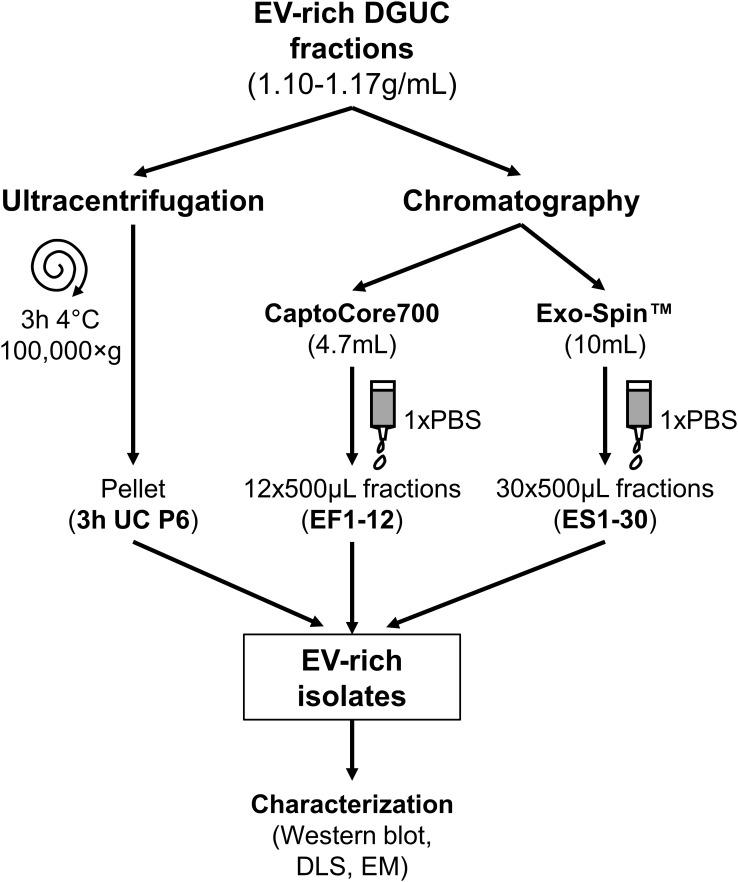
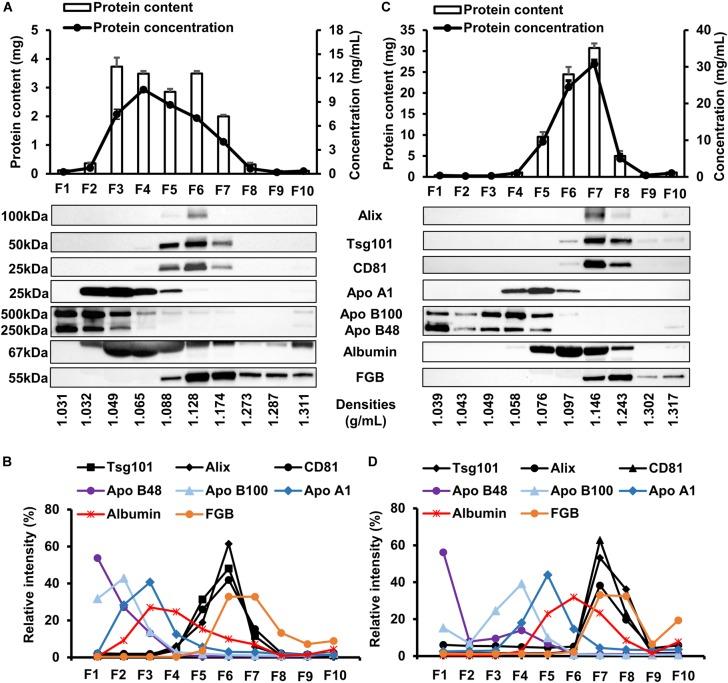
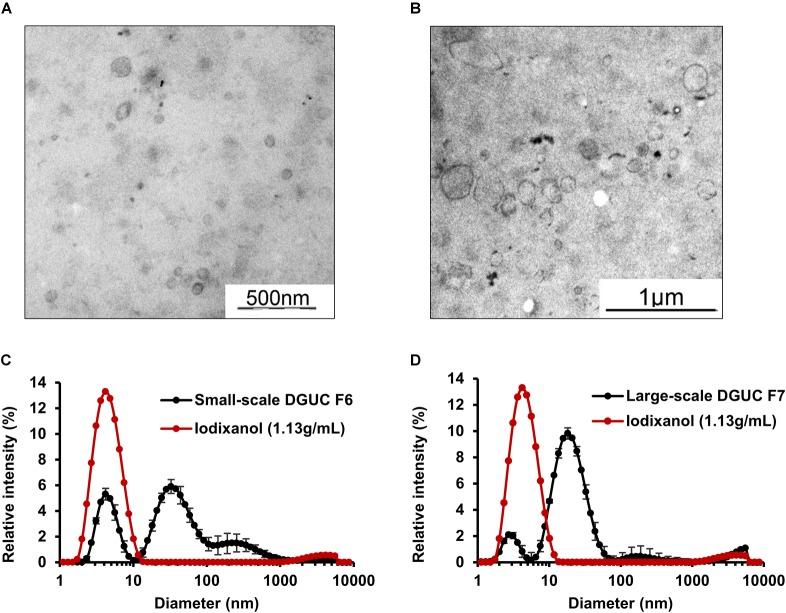
Extracellular vesicles (EVs) (isolated from blood plasma) are currently being extensively researched, both as biomarkers and for their therapeutic possibilities. One challenging aspect to this research is the efficient isolation of high-purity EVs from blood plasma in quantities sufficient for experiments. In accordance with this challenge, the aim of this study was to develop an isolation method in which to separate the majority of EVs from major impurities such as lipoprotein particles and the abundant plasma proteins albumin and fibrinogen. Samples of rat blood were centrifuged to remove cells, platelets, large EVs and protein aggregates without prior filtration. Density gradient ultracentrifugation was performed by loading plasma sample onto 50, 30, and 10% iodixanol layers and then centrifuged at 120,000 × for 24 h. Ten fractions (F1-10) were collected from top to bottom. Fractions with the highest EV content were further purified by ultracentrifugation, size exclusion, or bind-elute chromatography. Efficiency and purity were assessed by Western blots. Morphology and size distribution of particles were examined by dynamic light scattering and electron microscopy (EM). The highest band intensities of EV markers Alix, Tsg101 and CD81 were detected by Western blot in F6 of small-scale DGUC (61.5 ± 10.4%; 48.1 ± 5.8%; 41.9 ± 3.8%, respectively) at a density of 1.128-1.174 g/mL, where the presence of vesicles with a mean diameter of 38 ± 2 nm was confirmed by EM and DLS. Only 1.4 ± 0.5% of LDL and chylomicron marker, 3.0 ± 1.3% of HDL marker, and 9.9 ± 0.4% of albumin remained in the EV-rich F6. However, 32.8 ± 1.5% of the total fibrinogen beta was found in this fraction. Second-step purification by UC or SEC did not improve EV separation, while after BEC on HiScreen Capto Core 700 albumin and lipoprotein contamination were below detection limit in EV-rich fractions. However, BEC decreased efficiency of EV isolation, and fibrinogen was still present in EV-rich fractions. This is the first demonstration that DGUC is able to markedly reduce the lipoprotein content of EV isolates while it separates EVs with high efficiency. Moreover, isolation of lipoprotein- and albumin-free EVs from blood plasma can be achieved by DGUC followed by BEC, however, on the expense of reduced EV yield.
细胞外囊泡(从血浆中分离得到)目前正作为生物标志物及其治疗潜力而受到广泛研究。这项研究的一个具有挑战性的方面是从血浆中高效分离出足够数量用于实验的高纯度细胞外囊泡。针对这一挑战,本研究的目的是开发一种分离方法,以从主要杂质(如脂蛋白颗粒以及丰富的血浆蛋白白蛋白和纤维蛋白原)中分离出大部分细胞外囊泡。大鼠血液样本在未预先过滤的情况下进行离心,以去除细胞、血小板、大的细胞外囊泡和蛋白质聚集体。通过将血浆样本加载到50%、30%和10%的碘克沙醇层上进行密度梯度超速离心,然后以120,000×离心24小时。从顶部到底部收集十个级分(F1 - 10)。细胞外囊泡含量最高的级分通过超速离心、尺寸排阻或结合洗脱色谱进一步纯化。通过蛋白质免疫印迹评估效率和纯度。通过动态光散射和电子显微镜(EM)检查颗粒的形态和大小分布。在小规模密度梯度超速离心(DGUC)的F6中,通过蛋白质免疫印迹检测到细胞外囊泡标志物Alix、Tsg101和CD81的最高条带强度(分别为61.5±10.4%;48.1±5.8%;41.9±3.8%),密度为1.128 - 1.174 g/mL,通过EM和动态光散射证实存在平均直径为38±2 nm的囊泡。富含细胞外囊泡的F6中仅残留1.4±0.5%的低密度脂蛋白(LDL)和乳糜微粒标志物、3.0±1.3%的高密度脂蛋白(HDL)标志物以及9.9±0.4%的白蛋白。然而,在此级分中发现了32.8±1.5%的总纤维蛋白原β。通过超速离心(UC)或尺寸排阻色谱(SEC)进行的第二步纯化并未改善细胞外囊泡的分离效果,而在HiScreen Capto Core 700上进行结合洗脱色谱(BEC)后,富含细胞外囊泡的级分中白蛋白和脂蛋白污染低于检测限。然而,BEC降低了细胞外囊泡的分离效率,并且纤维蛋白原仍存在于富含细胞外囊泡的级分中。这是首次证明密度梯度超速离心能够在高效分离细胞外囊泡的同时显著降低细胞外囊泡分离物中的脂蛋白含量。此外,通过密度梯度超速离心继以结合洗脱色谱可以从血浆中分离出无脂蛋白和白蛋白的细胞外囊泡,然而,代价是细胞外囊泡产量降低。

 Zotero 插件