
恢复性扩张型心肌病患者停止心力衰竭的药物治疗(TRED-HF):一项开放标签、先导、随机试验。
Withdrawal of pharmacological treatment for heart failure in patients with recovered dilated cardiomyopathy (TRED-HF): an open-label, pilot, randomised trial.
机构信息
Cardiovascular Research Centre and Cardiovascular Magnetic Resonance Unit, Royal Brompton Hospital, London, UK; National Heart and Lung Institute, Imperial College London, London, UK.
Cardiovascular Research Centre and Cardiovascular Magnetic Resonance Unit, Royal Brompton Hospital, London, UK.
出版信息
Lancet. 2019 Jan 5;393(10166):61-73. doi: 10.1016/S0140-6736(18)32484-X. Epub 2018 Nov 11.
BACKGROUND
Patients with dilated cardiomyopathy whose symptoms and cardiac function have recovered often ask whether their medications can be stopped. The safety of withdrawing treatment in this situation is unknown.
METHODS
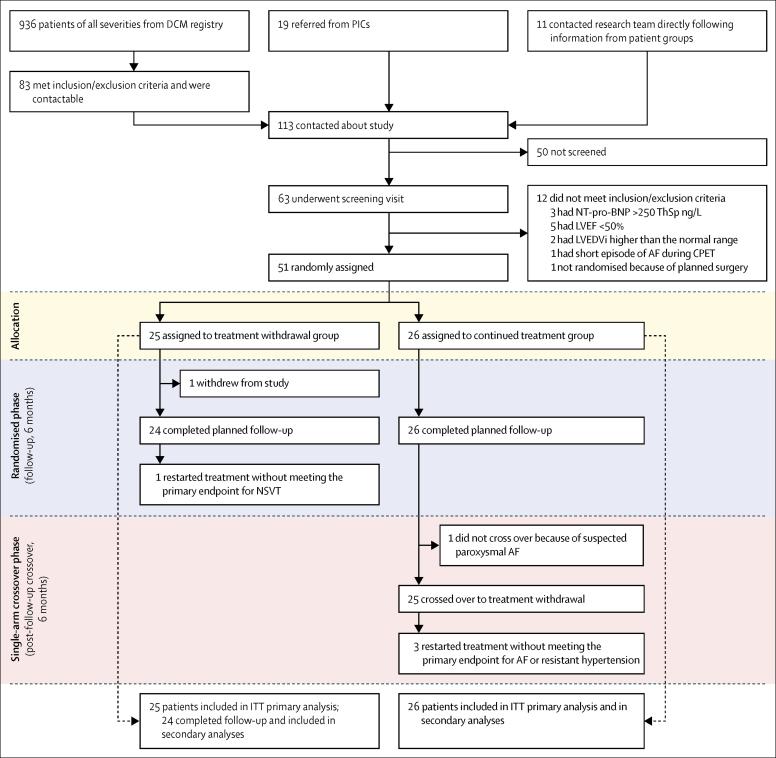
We did an open-label, pilot, randomised trial to examine the effect of phased withdrawal of heart failure medications in patients with previous dilated cardiomyopathy who were now asymptomatic, whose left ventricular ejection fraction (LVEF) had improved from less than 40% to 50% or greater, whose left ventricular end-diastolic volume (LVEDV) had normalised, and who had an N-terminal pro-B-type natriuretic peptide (NT-pro-BNP) concentration less than 250 ng/L. Patients were recruited from a network of hospitals in the UK, assessed at one centre (Royal Brompton and Harefield NHS Foundation Trust, London, UK), and randomly assigned (1:1) to phased withdrawal or continuation of treatment. After 6 months, patients in the continued treatment group had treatment withdrawn by the same method. The primary endpoint was a relapse of dilated cardiomyopathy within 6 months, defined by a reduction in LVEF of more than 10% and to less than 50%, an increase in LVEDV by more than 10% and to higher than the normal range, a two-fold rise in NT-pro-BNP concentration and to more than 400 ng/L, or clinical evidence of heart failure, at which point treatments were re-established. The primary analysis was by intention to treat. This trial is registered with ClinicalTrials.gov, number NCT02859311.
FINDINGS
Between April 21, 2016, and Aug 22, 2017, 51 patients were enrolled. 25 were randomly assigned to the treatment withdrawal group and 26 to continue treatment. Over the first 6 months, 11 (44%) patients randomly assigned to treatment withdrawal met the primary endpoint of relapse compared with none of those assigned to continue treatment (Kaplan-Meier estimate of event rate 45·7% [95% CI 28·5-67·2]; p=0·0001). After 6 months, 25 (96%) of 26 patients assigned initially to continue treatment attempted its withdrawal. During the following 6 months, nine patients met the primary endpoint of relapse (Kaplan-Meier estimate of event rate 36·0% [95% CI 20·6-57·8]). No deaths were reported in either group and three serious adverse events were reported in the treatment withdrawal group: hospital admissions for non-cardiac chest pain, sepsis, and an elective procedure.
INTERPRETATION
Many patients deemed to have recovered from dilated cardiomyopathy will relapse following treatment withdrawal. Until robust predictors of relapse are defined, treatment should continue indefinitely.
FUNDING
British Heart Foundation, Alexander Jansons Foundation, Royal Brompton Hospital and Imperial College London, Imperial College Biomedical Research Centre, Wellcome Trust, and Rosetrees Trust.
背景
症状和心功能已恢复的扩张型心肌病患者常询问其药物是否可以停药。这种情况下停药的安全性尚不清楚。
方法
我们进行了一项开放标签、先导、随机试验,以研究在先前患有扩张型心肌病的患者中,心力衰竭药物的分阶段停药效果,这些患者目前无症状,左心室射血分数(LVEF)已从低于 40%改善至 50%或更高,左心室舒张末期容积(LVEDV)已正常化,且 N 末端脑钠肽前体(NT-pro-BNP)浓度低于 250ng/L。患者是从英国的一个医院网络招募的,在一个中心(英国皇家布朗普顿和哈雷菲尔德国民保健制度信托基金会,伦敦)进行评估,并随机(1:1)分为分阶段停药或继续治疗组。6 个月后,继续治疗组的患者通过相同方法停药。主要终点是 6 个月内扩张型心肌病复发,定义为 LVEF 降低超过 10%且低于 50%、LVEDV 增加超过 10%且高于正常范围、NT-pro-BNP 浓度增加两倍且高于 400ng/L,或出现心力衰竭的临床证据,此时重新开始治疗。主要分析为意向治疗。该试验在 ClinicalTrials.gov 注册,编号为 NCT02859311。
结果
2016 年 4 月 21 日至 2017 年 8 月 22 日期间,共纳入 51 名患者。其中 25 名患者被随机分配至停药组,26 名患者继续治疗。在前 6 个月中,随机分配至停药组的 11 名(44%)患者达到了复发的主要终点,而继续治疗组无一例患者达到(风险率估计值为 45.7%[95%CI 28.5-67.2];p=0.0001)。6 个月后,最初继续治疗的 26 名患者中有 25 名尝试停药。在接下来的 6 个月中,有 9 名患者达到了复发的主要终点(风险率估计值为 36.0%[95%CI 20.6-57.8])。两组均无死亡报告,停药组报告了 3 例严重不良事件:非心脏胸痛、败血症和择期手术的住院治疗。
结论
许多被认为已从扩张型心肌病中恢复的患者在停药后会复发。在确定可靠的复发预测因素之前,应继续无限期治疗。
资金来源
英国心脏基金会、亚历山大·詹森斯基金会、皇家布朗普顿医院和帝国理工学院伦敦分校、帝国理工学院生物医学研究中心、惠康基金会和罗斯特里基金会。




 Zotero 插件