
家羊驯化后基因组选择和环境适应的特征。
Signatures of selection and environmental adaptation across the goat genome post-domestication.
机构信息
Department of Animal Science, Iowa State University, Ames, IA, 50011, USA.
National Institute of Aquatic Resources, Technical University of Denmark (DTU), 2800, Lyngby, Denmark.
出版信息
Genet Sel Evol. 2018 Nov 19;50(1):57. doi: 10.1186/s12711-018-0421-y.
BACKGROUND
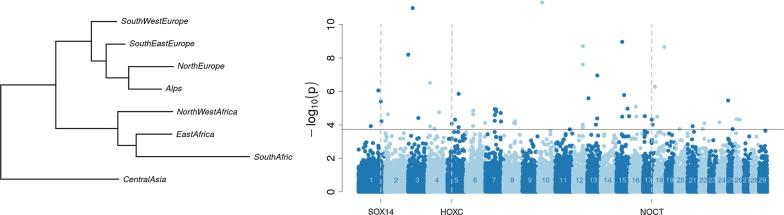
Since goat was domesticated 10,000 years ago, many factors have contributed to the differentiation of goat breeds and these are classified mainly into two types: (i) adaptation to different breeding systems and/or purposes and (ii) adaptation to different environments. As a result, approximately 600 goat breeds have developed worldwide; they differ considerably from one another in terms of phenotypic characteristics and are adapted to a wide range of climatic conditions. In this work, we analyzed the AdaptMap goat dataset, which is composed of data from more than 3000 animals collected worldwide and genotyped with the CaprineSNP50 BeadChip. These animals were partitioned into groups based on geographical area, production uses, available records on solid coat color and environmental variables including the sampling geographical coordinates, to investigate the role of natural and/or artificial selection in shaping the genome of goat breeds.
RESULTS
Several signatures of selection on different chromosomal regions were detected across the different breeds, sub-geographical clusters, phenotypic and climatic groups. These regions contain genes that are involved in important biological processes, such as milk-, meat- or fiber-related production, coat color, glucose pathway, oxidative stress response, size, and circadian clock differences. Our results confirm previous findings in other species on adaptation to extreme environments and human purposes and provide new genes that could explain some of the differences between goat breeds according to their geographical distribution and adaptation to different environments.
CONCLUSIONS
These analyses of signatures of selection provide a comprehensive first picture of the global domestication process and adaptation of goat breeds and highlight possible genes that may have contributed to the differentiation of this species worldwide.
背景
自 1 万年前山羊被驯化以来,许多因素导致了山羊品种的分化,这些因素主要分为两类:(i)适应不同的繁殖系统和/或目的,(ii)适应不同的环境。因此,全世界大约发展出了 600 种山羊品种;它们在表型特征上彼此差异很大,并适应广泛的气候条件。在这项工作中,我们分析了 AdaptMap 山羊数据集,该数据集由来自全世界 3000 多只动物的数据组成,并用 CaprineSNP50 BeadChip 进行了基因分型。这些动物根据地理区域、生产用途、固体被毛颜色的可用记录以及包括采样地理坐标在内的环境变量进行分组,以研究自然和/或人工选择在塑造山羊品种基因组方面的作用。
结果
在不同的品种、次地理聚类、表型和气候组中,在不同的染色体区域检测到了一些选择的特征。这些区域包含参与重要生物学过程的基因,如奶、肉或纤维生产、毛色、葡萄糖途径、氧化应激反应、大小和昼夜节律差异。我们的结果证实了其他物种对极端环境和人类用途适应的先前发现,并提供了新的基因,这些基因可能解释了根据地理分布和适应不同环境而导致的山羊品种之间的一些差异。
结论
这些选择特征的分析提供了山羊品种全球驯化过程和适应的全面初步图景,并突出了可能有助于该物种在全球分化的潜在基因。




 Zotero 插件