
童年社会经济地位对中年晚期认知能力影响的中介因素:一项长达四十年的纵向研究。
Mediators of the Effect of Childhood Socioeconomic Status on Late Midlife Cognitive Abilities: A Four Decade Longitudinal Study.
作者信息
Beck Asad, Franz Carol E, Xian Hong, Vuoksimaa Eero, Tu Xin, Reynolds Chandra A, Panizzon Matthew S, McKenzie Ruth M, Lyons Michael J, Toomey Rosemary, Jacobson Kristen C, Hauger Richard L, Hatton Sean N, Kremen William S
机构信息
Department of Psychology, San Diego State University, California.
Department of Psychiatry, University of California San Diego, La Jolla.
出版信息
Innov Aging. 2018 Jan 1;2(1). doi: 10.1093/geroni/igy003. Epub 2018 Feb 26.
BACKGROUND AND OBJECTIVES
Childhood socioeconomic status (cSES) is found to predict later-life cognitive abilities, yet the mechanisms underlying these associations remain unclear. The objective of this longitudinal study was to examine the direct and indirect paths through which cSES influences late midlife cognitive outcomes.
RESEARCH DESIGN AND METHODS
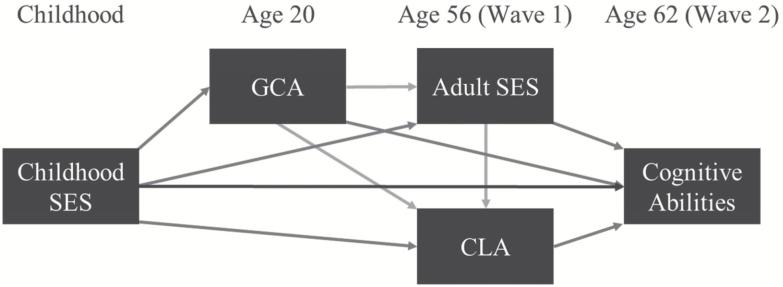
Participants were 1,009 male twins in the Vietnam Era Twin Study of Aging (VETSA). At mean ages 20 and 62, participants completed a standardized test for general cognitive ability (GCA). The age 62 cognitive assessment also included in-person tests of processing speed, episodic memory, abstract reasoning, working memory, verbal fluency, visual-spatial ability, and executive functions. At mean age 56, participants were interviewed regarding their own and their parents' education and occupation, and completed questionnaires about cognitive leisure activities and sociodemographic information. Multiple mediation analyses were conducted to examine the direct path effects and indirect path effects of cSES through age 20 GCA, adult SES, and cognitive leisure activities on seven cognitive outcomes at age 62, adjusting for age, ethnicity, and non-independence of observations.
RESULTS
Total (direct plus indirect) effects were significant for all measures with the exception of executive functions. Men from lower cSES backgrounds had poorer cognitive functioning in late midlife. The direct effect of cSES was partially mediated for abstract reasoning, and was fully mediated for the remaining six cognitive outcomes. Total indirect effects accounted for at least half of the total effects in each model, with paths through age 20 GCA explaining most of the total indirect effects.
DISCUSSION AND IMPLICATIONS
cSES predicted cognitive functioning in late middle age Using multiple mediation models, we show that lower cSES predicts poorer cognition in late midlife primarily through young adult cognitive ability and to a lesser extent through SES in adulthood and engagement in cognitively stimulating activities.
背景与目的
研究发现童年社会经济地位(cSES)可预测晚年认知能力,但这些关联背后的机制仍不明确。这项纵向研究的目的是探究cSES影响中年后期认知结果的直接和间接路径。
研究设计与方法
参与者为越南战争时期双生子老龄化研究(VETSA)中的1009名男性双胞胎。在平均年龄20岁和62岁时,参与者完成了一项通用认知能力(GCA)标准化测试。62岁时的认知评估还包括处理速度、情景记忆、抽象推理、工作记忆、语言流畅性、视觉空间能力和执行功能的现场测试。在平均年龄56岁时,就参与者自身及其父母的教育和职业对他们进行了访谈,并完成了关于认知休闲活动和社会人口统计学信息的问卷。进行了多项中介分析,以检验cSES通过20岁时的GCA、成年期社会经济地位(SES)和认知休闲活动对62岁时的七种认知结果的直接路径效应和间接路径效应,并对年龄、种族和观察值的非独立性进行了调整。
结果
除执行功能外,所有测量的总(直接加间接)效应均显著。来自较低cSES背景的男性在中年后期的认知功能较差。cSES的直接效应在抽象推理方面部分得到中介,在其余六种认知结果方面完全得到中介。每个模型中的总间接效应至少占总效应的一半,通过20岁时GCA的路径解释了大部分总间接效应。
讨论与启示
cSES可预测中年后期的认知功能。使用多个中介模型,我们表明较低的cSES主要通过年轻成人的认知能力预测中年后期较差的认知,在较小程度上通过成年期的SES和参与认知刺激活动来预测。
 Zotero 插件