
基于光学相干断层扫描的数字化监测诊室与医院眼科随访对屏幕阳性黄斑病变患者的成本效益比较。
Cost-effectiveness of digital surveillance clinics with optical coherence tomography versus hospital eye service follow-up for patients with screen-positive maculopathy.
机构信息
Health Economics Research Centre, Nuffield Department of Population Health, University of Oxford, Oxford, UK.
Gloucestershire Retinal Research Group, Cheltenham General Hospital, Cheltenham, UK.
出版信息
Eye (Lond). 2019 Apr;33(4):640-647. doi: 10.1038/s41433-018-0297-7. Epub 2018 Nov 30.
BACKGROUND
Annually 2.7 million individuals are offered screening for diabetic retinopathy (DR) in England. Spectral-Domain Optical Coherence Tomography (SD-OCT) has the potential to relieve pressure on NHS services by correctly identifying patients who are screen positive for maculopathy on two-dimensional photography without evidence of clinically significant macular oedema (CSMO), limiting the number of referrals to hospitals. We aim to assess whether the addition of SDOCT imaging in digital surveillance clinics is a cost-effective intervention relative to hospital eye service (HES) follow-up.
METHODS
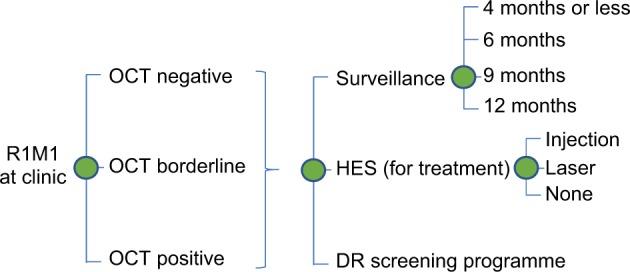
We used patient-level data from the Gloucestershire Diabetic Eye Screening Service linked to the local digital surveillance programme and HES between 2012 and 2015. A model was used to simulate the progression of individuals with background diabetic retinopathy (R1) and diabetic maculopathy (M1) following DR screening across the clinic pathways over 12 months.
RESULTS
Between January 2012 and December 2014, 696 people undergoing DR screening were found to have screen-positive maculopathy in at least one eye for the first time, with a total of 766 eyes identified as having R1M1. The mean annual cost of assessing and surveillance through the SD-OCT clinic pathway was £101 (95% CI: 91-139) as compared with £177 (95%CI: 164-219) under the HES pathway. Surveillance under an SD-OCT clinic generated cost savings of £76 (95% CI: 70-81) per patient.
CONCLUSIONS
Our analysis shows that SD-OCT surveillance of patients diagnosed as R1M1 at DR screening is not only cost-effective but generates considerable cost savings.
背景
在英格兰,每年有 270 万人接受糖尿病视网膜病变(DR)筛查。谱域光相干断层扫描(SD-OCT)有可能通过正确识别二维摄影检查阳性但无临床显著黄斑水肿(CSMO)的黄斑病变患者,从而缓解国民保健服务(NHS)的压力,限制转诊至医院的人数。我们旨在评估在数字监测诊所中添加 SD-OCT 成像相对于医院眼科服务(HES)随访是否是一种具有成本效益的干预措施。
方法
我们使用了 2012 年至 2015 年期间格洛斯特郡糖尿病眼病筛查服务的患者水平数据,这些数据与当地数字监测计划和 HES 相关联。我们使用模型来模拟 DR 筛查后患有背景性糖尿病性视网膜病变(R1)和糖尿病性黄斑病变(M1)的个体在 12 个月内通过不同诊所途径的进展情况。
结果
2012 年 1 月至 2014 年 12 月,共有 696 名接受 DR 筛查的人首次发现一只或多只眼中有筛检阳性的黄斑病变,共有 766 只眼被确定为 R1M1。与 HES 途径相比,通过 SD-OCT 诊所途径评估和监测的年平均成本为 101 英镑(95%置信区间:91-139),而通过 HES 途径的成本为 177 英镑(95%置信区间:164-219)。通过 SD-OCT 诊所进行监测可为每位患者节省 76 英镑(95%置信区间:70-81)的费用。
结论
我们的分析表明,对在 DR 筛查中诊断为 R1M1 的患者进行 SD-OCT 监测不仅具有成本效益,而且还可以节省大量成本。

 Zotero 插件