
关于Algisite™ M、Cuticerin™和Sorbact®作为小儿中厚皮片供皮区敷料的前瞻性随机对照试验。
Prospective randomised controlled trial of Algisite™ M, Cuticerin™, and Sorbact® as donor site dressings in paediatric split-thickness skin grafts.
作者信息
McBride Craig A, Kimble Roy M, Stockton Kellie A
机构信息
Pegg Leditschke Children's Burns Centre, Queensland Children's Hospital, Children's Health Queensland Hospital and Health Service, South Brisbane, Queensland Australia.
2Centre for Children's Burns and Trauma Research, Centre for Children's Health Research, University of Queensland, South Brisbane, Australia.
出版信息
Burns Trauma. 2018 Nov 27;6:33. doi: 10.1186/s41038-018-0135-y. eCollection 2018.
BACKGROUND
This is a parallel three-arm prospective randomised controlled trial (RCT) comparing Algisite™ M, Cuticerin™, and Sorbact® as donor site dressings in paediatric split-thickness skin grafts (STSG). All three were in current use within the Pegg Leditschke Children's Burn centre (PLCBC), the largest paediatric burns centre in Queensland, Australia. Our objective was to find the best performing dressing, following on from previous trials designed to rationalise dressings for the burn wound itself.
METHODS
All children for STSG, with thigh donor sites, were considered for enrolment in the trial. Primary outcome measures were days to re-epithelialisation, and pain. Secondary measures were cost, itch, and scarring at 3 and 6 months. Patients and parents were blinded to group assignment. Blinding of assessors was possible with the dressing , with partial blinding following first dressing change. Blinded photographic assessments of re-epithelialisation were used. Scar assessment was blinded. Covariates for analysis were sex, age, and graft thickness (as measured from a central biopsy).
RESULTS
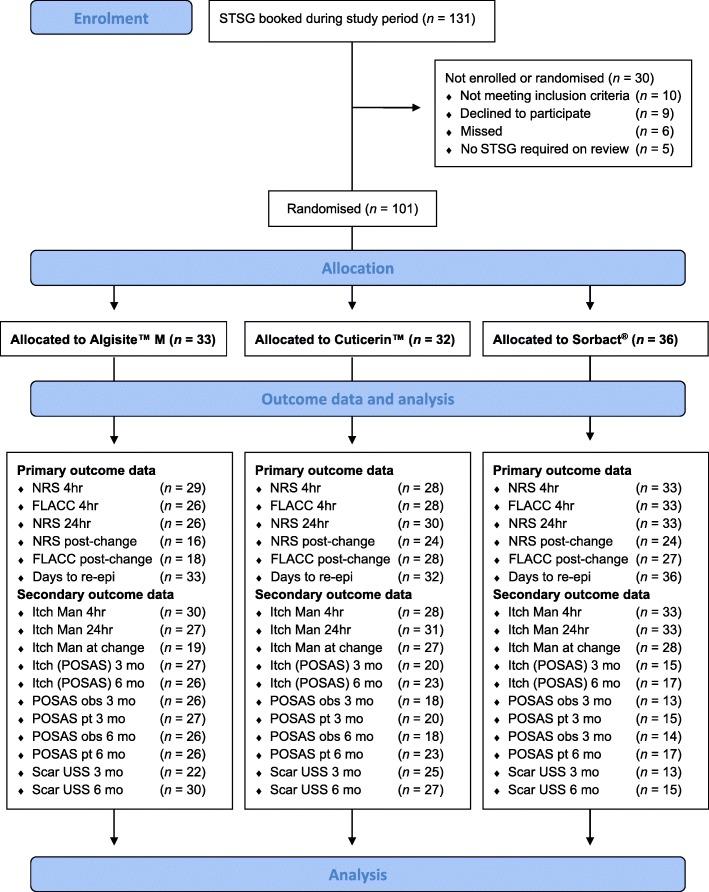
There were 101 patients randomised to the Algisite™ M (33), Cuticerin™ (32), and Sorbact® (36) arms between April 2015 and July 2016. All were analysed for time to re-epithelialisation. Pain scores were not available for all time points in all patients. There were no significant differences between the three arms regarding pain, or time to re-epithelialisation. There were no significant differences for the secondary outcomes of itch, scarring, or cost. Regression analyses demonstrated faster re-epithelialisation in younger patients and decreased donor site scarring at 3 and 6 months with thinner STSG. There were no adverse effects noted.
CONCLUSIONS
There are no data supporting a preference for one trial dressing over the others, in donor site wounds (DSW) in children. Thinner skin grafts lead to less donor site scarring in children. Younger patients have faster donor site wound healing.
TRIAL REGISTRATION
Australia and New Zealand Clinical Trials Register (ACTRN12614000380695).Royal Children's Hospital Human Research Ethics Committee (HREC/14/QRCH/36).University of Queensland Medical Research Ethics Committee (#2014000447).
背景
这是一项平行三臂前瞻性随机对照试验(RCT),比较了Algisite™ M、Cuticerin™和Sorbact®作为小儿中厚皮片移植(STSG)供皮区敷料的效果。这三种敷料当时均在澳大利亚昆士兰州最大的小儿烧伤中心佩格·莱迪施克儿童医院烧伤中心(PLCBC)使用。我们的目标是在前一项旨在使烧伤创面敷料合理化的试验基础上,找出性能最佳的敷料。
方法
所有大腿供皮区接受中厚皮片移植的儿童均被考虑纳入试验。主要结局指标为上皮化天数和疼痛程度。次要指标为3个月和6个月时的费用、瘙痒和瘢痕形成情况。患者和家长对分组情况不知情。评估人员在使用敷料时可实现盲法,首次换药后部分盲法。采用盲法摄影评估上皮化情况。瘢痕评估采用盲法。分析的协变量为性别、年龄和移植皮片厚度(通过中央活检测量)。
结果
2015年4月至2016年7月期间,共有101例患者被随机分配至Algisite™ M组(33例)、Cuticerin™组(32例)和Sorbact®组(36例)。对所有患者的上皮化时间进行了分析。并非所有患者在所有时间点的疼痛评分都可获得。三组在疼痛或上皮化时间方面无显著差异。在瘙痒、瘢痕形成或费用等次要结局方面也无显著差异。回归分析表明,年龄较小的患者上皮化速度更快,中厚皮片较薄时,3个月和6个月时供皮区瘢痕形成减少。未观察到不良反应。
结论
在小儿供皮区伤口(DSW)中,没有数据支持对一种试验敷料优于其他敷料的偏好。较薄的皮片移植导致小儿供皮区瘢痕形成较少。年龄较小的患者供皮区伤口愈合更快。
试验注册
澳大利亚和新西兰临床试验注册中心(ACTRN12614000380695)。皇家儿童医院人类研究伦理委员会(HREC/14/QRCH/36)。昆士兰大学医学研究伦理委员会(#2014000447)。
 Zotero 插件