
孟加拉国非传染性疾病家庭的消费转移。
Consumption displacement in households with noncommunicable diseases in Bangladesh.
机构信息
Global Noncommunicable Diseases Branch, Division of Global Health Protection, Center for Global Health, Centers for Disease Control and Prevention, Atlanta, GA, United States of America.
Department of Economics, Dickinson College, Carlisle, PA, United States of America.
出版信息
PLoS One. 2018 Dec 13;13(12):e0208504. doi: 10.1371/journal.pone.0208504. eCollection 2018.
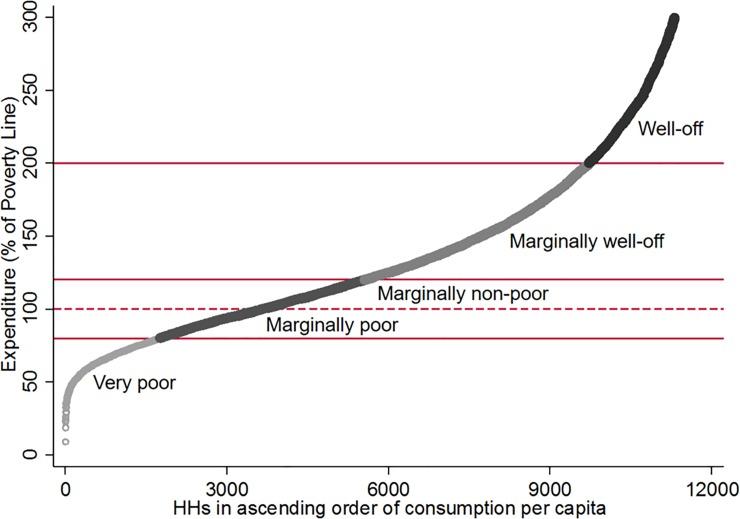
The economic burden of noncommunicable diseases (NCDs), including treatment costs and income and productivity losses, is a growing concern in developing countries, where NCD medical expenditure may offset consumption of other essential commodities. This study examines the role of NCDs in household resource allocation in Bangladesh. We use the Bangladesh Household Income and Expenditure Survey (HIES) 2010 to obtain expenditure data on 11 household expenditure categories and 12 food expenditure sub-categories for 12,240 households. Household NCD status was determined through self-report of at least one of the six major NCDs within the household-heart disease, hypertension, diabetes, kidney diseases, asthma, and cancer. We estimated unadjusted and regression-adjusted differences in household expenditure shares between NCD and non-NCD households. We further investigated how consumption of different food sub-categories is related to NCD status, distinguishing between household economic levels. The medical expenditure share was estimated to be 59% higher for NCD households than non-NCD households, and NCD households had lower expenditure shares on food, clothing, hygiene, and energy. Regression results indicated that presence of NCDs was associated with lower relative expenditure on clothing and housing in all economic subgroups, and with lower expenditure on food among marginally poor households. Having an NCD was significantly associated with higher household spending on tobacco and higher-calorie foods such as sugar, beverages, meat, dairy, and fruit, and with lower spending on fish, vegetables, and legumes. The findings indicate a link between NCDs and the possibility of adverse economic effects on the household by highlighting the potential displacement effect on household consumption that might occur through higher medical expenditure and lower spending on essentials. The findings might also point to a need for raising awareness about the link between NCDs and diet in Bangladesh.
非传染性疾病(NCDs)的经济负担,包括治疗费用以及收入和生产力损失,是发展中国家日益关注的问题,因为 NCD 医疗支出可能会抵消其他基本商品的消费。本研究考察了 NCD 在孟加拉国家庭资源配置中的作用。我们使用 2010 年孟加拉家庭收入和支出调查(HIES)获得了 12240 户家庭 11 个家庭支出类别和 12 个食品支出子类别的支出数据。家庭 NCD 状况通过家庭中至少有一人自我报告六种主要 NCD 之一来确定-心脏病,高血压,糖尿病,肾脏疾病,哮喘和癌症。我们估计了 NCD 家庭和非 NCD 家庭之间家庭支出份额的未调整和回归调整差异。我们进一步调查了不同食品子类别的消费如何与 NCD 状况相关,同时区分了家庭经济水平。与非 NCD 家庭相比,NCD 家庭的医疗支出份额估计要高 59%,而 NCD 家庭在食品,服装,卫生和能源方面的支出份额较低。回归结果表明,在所有经济群体中,NCD 的存在与服装和住房的相对支出较低有关,而在边缘贫困家庭中,与食品支出较低有关。NCD 的存在与家庭在烟草和高热量食品(如糖,饮料,肉类,乳制品和水果)上的支出较高显著相关,而与鱼类,蔬菜和豆类的支出较低显著相关。这些发现表明 NCD 与家庭可能遭受的经济不利影响之间存在联系,突出了通过更高的医疗支出和对必需品的支出减少,对家庭消费可能产生的替代效应。这些发现还可能表明需要提高人们对 NCD 与孟加拉国饮食之间联系的认识。
 Zotero 插件