
帕金森病的疾病模型生物:黑腹果蝇。
Disease model organism for Parkinson disease: Drosophila melanogaster.
机构信息
Department of Bio and Fermentation Convergence Technology, Kookmin University, BK21 PLUS Project, Seoul 02707, Korea.
出版信息
BMB Rep. 2019 Apr;52(4):250-258. doi: 10.5483/BMBRep.2019.52.4.204.
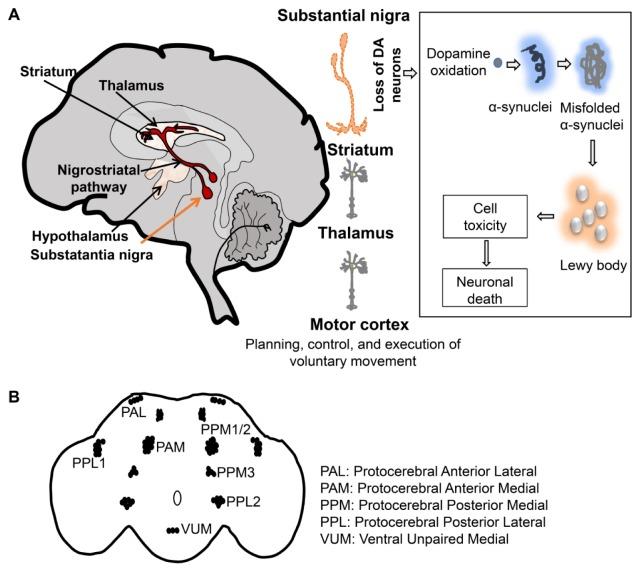
Parkinson's disease (PD) is a common neurodegenerative disorder characterized by selective and progressive loss of dopaminergic neurons. Genetic and environmental risk factors are associated with this disease. The genetic factors are composed of approximately 20 genes, such as SNCA, parkin, PTEN-induced kinase1 (pink1), leucine-rich repeat kinase 2 (LRRK2), ATP13A2, MAPT, VPS35, and DJ-1, whereas the environmental factors consist of oxidative stress-induced toxins such as 1-methyl-4-phenyl-1, 2, 3, 6-tetrahydropyridine (MPTP), rotenone, and paraquat. The analyses of their functions and mechanisms have provided important insights into the disease process, which has demonstrated that these factors cause oxidative damage and mitochondrial dysfunction. The most invaluable studies have been performed using disease model organisms, such as mice, fruit flies, and worms. Among them, Drosophila melanogaster has emerged as an excellent model organism to study both environmental and genetic factors and provide insights to the pathways relevant for PD pathogenesis, facilitating development of therapeutic strategies. In this review, we have focused on the fly model organism to summarize recent progress, including pathogenesis, neuroprotective compounds, and newer approaches. [BMB Reports 2019; 52(4): 250-258].
帕金森病(PD)是一种常见的神经退行性疾病,其特征是多巴胺能神经元的选择性和进行性丧失。遗传和环境风险因素与这种疾病有关。遗传因素由大约 20 个基因组成,如 SNCA、parkin、PTEN 诱导的激酶 1(pink1)、富含亮氨酸重复激酶 2(LRRK2)、ATP13A2、MAPT、VPS35 和 DJ-1,而环境因素则由氧化应激诱导的毒素组成,如 1-甲基-4-苯基-1,2,3,6-四氢吡啶(MPTP)、鱼藤酮和百草枯。对这些基因功能和机制的分析为疾病的发生机制提供了重要的见解,表明这些因素会导致氧化损伤和线粒体功能障碍。最有价值的研究是使用疾病模型生物进行的,如老鼠、果蝇和蠕虫。其中,黑腹果蝇已成为研究环境和遗传因素的优秀模型生物,并为 PD 发病机制的相关途径提供了见解,有助于开发治疗策略。在这篇综述中,我们专注于果蝇模型生物来总结最近的进展,包括发病机制、神经保护化合物和更新的方法。[BMB 报告 2019;52(4):250-258]。

 Zotero 插件