
在一个热带国家的呼吸道病毒感染的流行病学和严重程度:厄瓜多尔,2009-2016 年。
The epidemiology and severity of respiratory viral infections in a tropical country: Ecuador, 2009-2016.
机构信息
Netherlands Institute for Health Services Research (NIVEL), Utrecht, The Netherlands.
National Institute of Public Health Research (INSPI), Guayaquil, Ecuador.
出版信息
J Infect Public Health. 2019 May-Jun;12(3):357-363. doi: 10.1016/j.jiph.2018.12.003. Epub 2018 Dec 17.
BACKGROUND
Respiratory viral infections (RVI) are a leading cause of mortality worldwide. We compared the epidemiology and severity of RVI in Ecuador during 2009-2016.
METHODS
Respiratory specimens collected within the national surveillance system were tested for influenza viruses, respiratory syncytial virus (RSV), adenovirus, parainfluenza virus, and human metapneumovirus. Overall and virus-specific positive detection rate (PDR) were calculated and compared the timing of epidemics caused by the different viruses. Logistic regression models were used to compare the age distribution and risk of death across respiratory viruses.
RESULTS
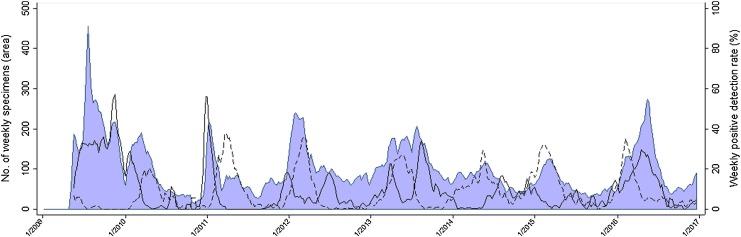
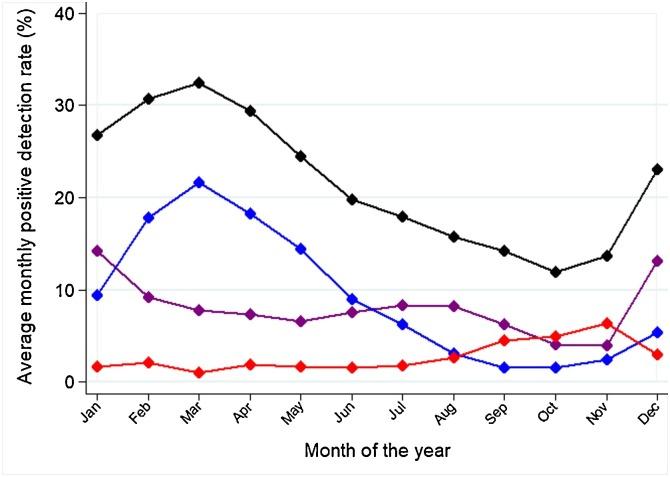
A total of 41,172 specimens were analyzed: influenza (PDR=14.3%) and respiratory syncytial virus (RSV) (PDR=9.5%) were the most frequently detected viruses. Influenza epidemics typically peaked in December-January and RSV epidemics in March; seasonality was less evident for the other viruses. Compared to adults, children were more frequently infected with RSV, adenovirus, parainfluenza, and influenza B, while the elderly were less frequently infected with influenza A(H1N1)p. The age-adjusted risk of death was highest for A(H1N1)p (odds ratio [OR] 1.73, 95% confidence intervals [CI] 1.38-2.17), and lowest for RSV (OR 0.75, 95%CI 0.57-0.98).
CONCLUSIONS
Whilst influenza and RSV were the most frequently detected pathogens, the risk of death differed by RVI, being highest for pandemic influenza and lowest for RSV.
背景
呼吸道病毒感染(RVI)是全球范围内导致死亡的主要原因。我们比较了 2009-2016 年厄瓜多尔的 RVI 流行病学和严重程度。
方法
在国家监测系统内收集的呼吸道标本检测流感病毒、呼吸道合胞病毒(RSV)、腺病毒、副流感病毒和人偏肺病毒。计算了总阳性检出率(PDR)和病毒特异性阳性检出率(PDR),并比较了不同病毒引起的流行时间。使用逻辑回归模型比较了呼吸道病毒的年龄分布和死亡风险。
结果
共分析了 41172 份标本:流感(PDR=14.3%)和呼吸道合胞病毒(RSV)(PDR=9.5%)是最常检测到的病毒。流感流行通常在 12 月至 1 月达到高峰,而 RSV 流行则在 3 月达到高峰;其他病毒的季节性不太明显。与成年人相比,儿童更容易感染 RSV、腺病毒、副流感病毒和乙型流感病毒,而老年人感染甲型流感 A(H1N1)p 的频率较低。校正年龄后,甲型流感 A(H1N1)p 的死亡风险最高(比值比 [OR] 1.73,95%置信区间 [CI] 1.38-2.17),而 RSV 的死亡风险最低(OR 0.75,95%CI 0.57-0.98)。
结论
虽然流感和 RSV 是最常检测到的病原体,但不同的 RVI 导致的死亡风险不同,流感大流行的风险最高,而 RSV 的风险最低。

 Zotero 插件