
NRF2 和 NF-қB 在脑血管和神经退行性疾病中的相互作用:分子机制和可能的治疗方法。
NRF2 and NF-қB interplay in cerebrovascular and neurodegenerative disorders: Molecular mechanisms and possible therapeutic approaches.
机构信息
Department of Pharmaceutical Sciences, Texas Tech University Health Sciences Center, Amarillo, TX 79106, USA.
Department of Neurology, Feinberg School of Medicine, Northwestern University, Chicago, IL 60611, USA.
出版信息
Redox Biol. 2019 Feb;21:101059. doi: 10.1016/j.redox.2018.11.017. Epub 2018 Nov 28.
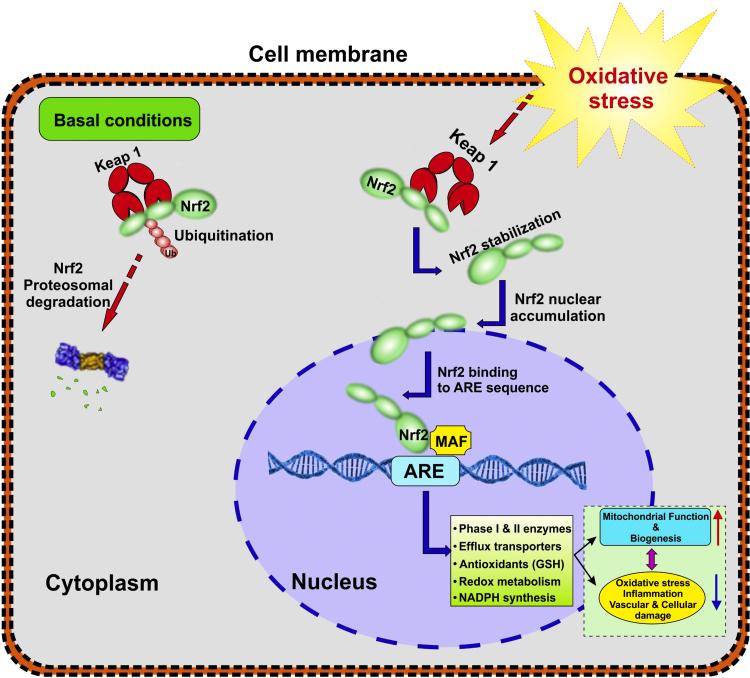
Electrophiles and reactive oxygen species (ROS) play a major role in modulating cellular defense mechanisms as well as physiological functions, and intracellular signaling. However, excessive ROS generation (endogenous and exogenous) can create a state of redox imbalance leading to cellular and tissue damage (Ma and He, 2012) [1]. A growing body of research data strongly suggests that imbalanced ROS and electrophile overproduction are among the major prodromal factors in the onset and progression of several cerebrovascular and neurodegenerative disorders such as amyotrophic lateral sclerosis (ALS), stroke, Alzheimer's disease (AD), Parkinson's disease (PD), and aging (Ma and He, 2012; Ramsey et al., 2017; Salminen et al., 2012; Sandberg et al., 2014; Sarlette et al., 2008; Tanji et al., 2013) [1-6]. Cells offset oxidative stress by the action of housekeeping antioxidative enzymes (such as superoxide dismutase, catalase, glutathione peroxidase) as well direct and indirect antioxidants (Dinkova-Kostova and Talalay, 2010) [7]. The DNA sequence responsible for modulating the antioxidative and cytoprotective responses of the cells has been identified as the antioxidant response element (ARE), while the nuclear factor erythroid 2-related factor (NRF2) is the major regulator of the xenobiotic-activated receptor (XAR) responsible for activating the ARE-pathway, thus defined as the NRF2-ARE system (Ma and He, 2012) [1]. In addition, the interplay between the NRF2-ARE system and nuclear factor kappa-light-chain-enhancer of activated B cells (NF-ĸB, a protein complex that controls cytokine production and cell survival), has been further investigated in relation to neurodegenerative and neuroinflammatory disorders. On these premises, we provide a review analysis of current understanding of the NRF2-NF-ĸB interplay, their specific role in major CNS disorders, and consequent therapeutic implication for the treatment of neurodegenerative and cerebrovascular diseases.
亲电试剂和活性氧 (ROS) 在调节细胞防御机制以及生理功能和细胞内信号转导方面发挥着重要作用。然而,过量的 ROS 生成(内源性和外源性)会导致氧化还原失衡,从而导致细胞和组织损伤(Ma 和 He,2012)[1]。越来越多的研究数据强烈表明,ROS 和亲电试剂产生的不平衡是几种脑血管和神经退行性疾病(如肌萎缩侧索硬化症(ALS)、中风、阿尔茨海默病(AD)、帕金森病(PD)和衰老)发病和进展的主要先兆因素之一(Ma 和 He,2012;Ramsey 等人,2017;Salminen 等人,2012;Sandberg 等人,2014;Sarlette 等人,2008;Tanji 等人,2013)[1-6]。细胞通过管家抗氧化酶(如超氧化物歧化酶、过氧化氢酶、谷胱甘肽过氧化物酶)以及直接和间接抗氧化剂(Dinkova-Kostova 和 Talalay,2010)[7]的作用来抵消氧化应激。负责调节细胞抗氧化和细胞保护反应的 DNA 序列已被确定为抗氧化反应元件(ARE),而核因子红细胞 2 相关因子(NRF2)是负责激活 ARE 途径的外源性激活受体(XAR)的主要调节剂,因此被定义为 NRF2-ARE 系统(Ma 和 He,2012)[1]。此外,还进一步研究了 NRF2-ARE 系统与核因子 kappa-轻链增强子激活 B 细胞(NF-ĸB,一种控制细胞因子产生和细胞存活的蛋白质复合物)之间的相互作用与神经退行性和神经炎症性疾病有关。基于这些前提,我们对 NRF2-NF-ĸB 相互作用的当前理解、它们在主要中枢神经系统疾病中的特定作用以及对神经退行性和脑血管疾病治疗的相应治疗意义进行了综述分析。



 Zotero 插件