
宏基因组下一代测序作为弓形虫脑炎的诊断工具。
Metagenomic next-generation sequencing as a diagnostic tool for toxoplasmic encephalitis.
机构信息
Department of Infectious Disease, the Second Hospital of Nanjing, Nanjing University of Chinese Medicine, 1-1 Zhongfu Road, Nanjing, 210003, China.
Center for Global Health, School of Public Health, Nanjing Medical University, Nanjing, 211166, China.
出版信息
Ann Clin Microbiol Antimicrob. 2018 Dec 26;17(1):45. doi: 10.1186/s12941-018-0298-1.
BACKGROUND
More than 100 different pathogens can cause encephalitis. Testing of all the neurological pathogens by conventional methods can be difficult. Metagenomic next-generation sequencing (NGS) could identify the infectious agents in a target-independent manner. The role of this novel method in clinical diagnostic microbiology still needs to be evaluated. In present study, we used metagenomic NGS to search for an infectious etiology in a human immunodeficiency virus (HIV)-infected patient with lethally diffuse brain lesions. Sequences mapping to Toxoplasma gondii were unexpectedly detected.
CASE PRESENTATION
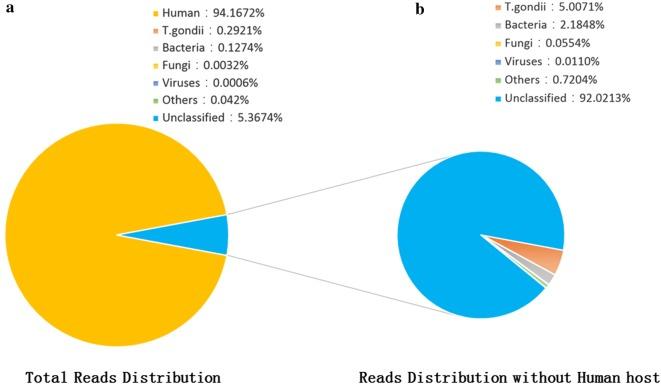
A 31-year-old HIV-infected patient presented to hospital in a critical ill condition with a Glasgow coma scale score of 3. Brain magnetic resonance imaging showed diffuse brain abnormalities with contrast enhancement. Metagenomic NGS was performed on DNA extract from 300 μL patient's cerebrospinal fluid (CSF) with the BGISEQ-50 platform. The sequencing detection identified 65,357 sequence reads uniquely aligned to the Toxoplasma gondii genome. Presence of Toxoplasma gondii genome in CSF was further verified by Toxoplasma gondii-specific polymerase chain reaction and Sanger sequencing. Altogether, those results confirmed the diagnosis of toxoplasmic encephalitis.
CONCLUSIONS
This study suggests that metagenomic NGS may be a useful diagnostic tool for toxoplasmic encephalitis. As metagenomic NGS is able to identify all pathogens in a single run, it may be a promising strategy to explore the clinical causative pathogens in central nervous system infections with atypical features.
背景
超过 100 种不同的病原体可引起脑炎。通过常规方法检测所有神经病原体可能具有挑战性。宏基因组下一代测序(NGS)可以以非靶向的方式识别感染因子。这种新方法在临床诊断微生物学中的作用仍需评估。在本研究中,我们使用宏基因组 NGS 来寻找一名 HIV 感染、致命性弥漫性脑病变患者的感染病因。出乎意料地检测到序列与弓形虫(Toxoplasma gondii)有映射关系。
病例介绍
一名 31 岁 HIV 感染患者因格拉斯哥昏迷评分 3 分,病情危重入住医院。脑部磁共振成像显示弥漫性脑异常伴增强。我们对来自 300μL 患者脑脊液的 DNA 提取物,使用 BGISEQ-50 平台进行了宏基因组 NGS。测序检测确定了 65357 条唯一映射到弓形虫基因组的序列读取。通过弓形虫特异性聚合酶链反应和 Sanger 测序进一步证实了 CSF 中存在弓形虫基因组。总之,这些结果证实了弓形虫性脑炎的诊断。
结论
本研究表明,宏基因组 NGS 可能是弓形虫性脑炎的一种有用的诊断工具。由于宏基因组 NGS 能够在单次运行中识别所有病原体,因此它可能是一种很有前途的策略,可以探索具有非典型特征的中枢神经系统感染的临床致病病原体。


 Zotero 插件