
循环中性粒细胞转录组的生物标志物具有检测未破裂颅内动脉瘤的潜力。
Biomarkers from circulating neutrophil transcriptomes have potential to detect unruptured intracranial aneurysms.
机构信息
Canon Stroke and Vascular Research Center, University at Buffalo, Clinical and Translational Research Center, 875 Ellicott Street, Buffalo, NY, 14214, USA.
Department of Biomedical Engineering, University at Buffalo, Buffalo, NY, USA.
出版信息
J Transl Med. 2018 Dec 28;16(1):373. doi: 10.1186/s12967-018-1749-3.
BACKGROUND
Intracranial aneurysms (IAs) are dangerous because of their potential to rupture and cause deadly subarachnoid hemorrhages. Previously, we found significant RNA expression differences in circulating neutrophils between patients with unruptured IAs and aneurysm-free controls. Searching for circulating biomarkers for unruptured IAs, we tested the feasibility of developing classification algorithms that use neutrophil RNA expression levels from blood samples to predict the presence of an IA.
METHODS
Neutrophil RNA extracted from blood samples from 40 patients (20 with angiography-confirmed unruptured IA, 20 angiography-confirmed IA-free controls) was subjected to next-generation RNA sequencing to obtain neutrophil transcriptomes. In a randomly-selected training cohort of 30 of the 40 samples (15 with IA, 15 controls), we performed differential expression analysis. Significantly differentially expressed transcripts (false discovery rate < 0.05, fold change ≥ 1.5) were used to construct prediction models for IA using four well-known supervised machine-learning approaches (diagonal linear discriminant analysis, cosine nearest neighbors, nearest shrunken centroids, and support vector machines). These models were tested in a testing cohort of the remaining 10 neutrophil samples from the 40 patients (5 with IA, 5 controls), and model performance was assessed by receiver-operating-characteristic (ROC) curves. Real-time quantitative polymerase chain reaction (PCR) was used to corroborate expression differences of a subset of model transcripts in neutrophil samples from a new, separate validation cohort of 10 patients (5 with IA, 5 controls).
RESULTS
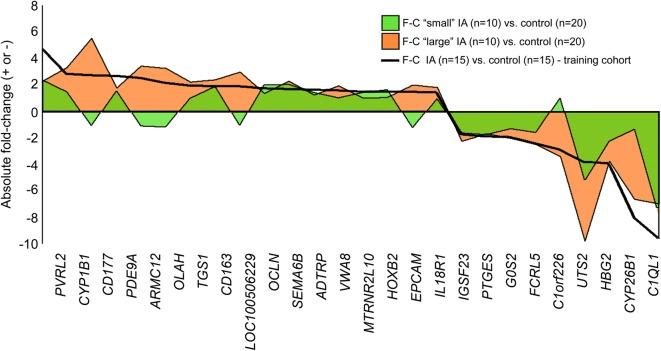
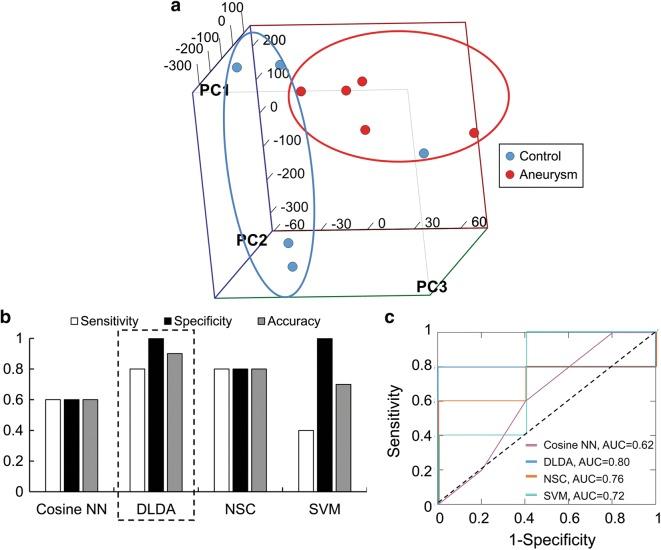
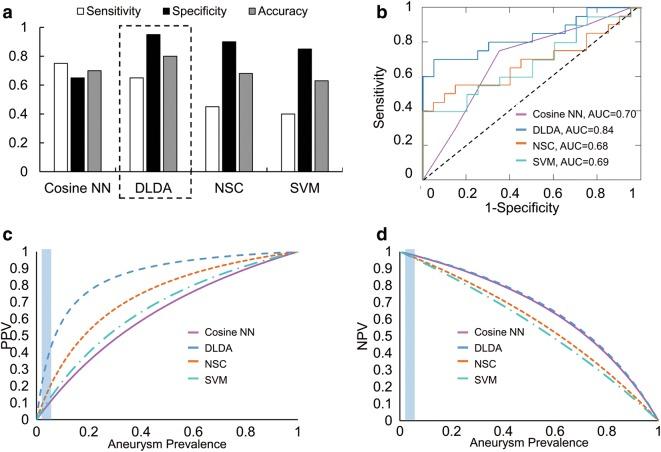
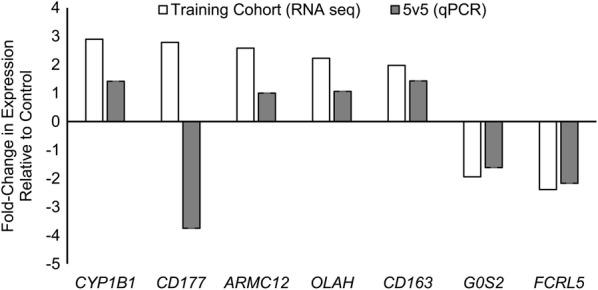
The training cohort yielded 26 highly significantly differentially expressed neutrophil transcripts. Models using these transcripts identified IA patients in the testing cohort with accuracy ranging from 0.60 to 0.90. The best performing model was the diagonal linear discriminant analysis classifier (area under the ROC curve = 0.80 and accuracy = 0.90). Six of seven differentially expressed genes we tested were confirmed by quantitative PCR using isolated neutrophils from the separate validation cohort.
CONCLUSIONS
Our findings demonstrate the potential of machine-learning methods to classify IA cases and create predictive models for unruptured IAs using circulating neutrophil transcriptome data. Future studies are needed to replicate these findings in larger cohorts.
背景
颅内动脉瘤(intracranial aneurysms,IAs)因其破裂并导致致命性蛛网膜下腔出血的潜在风险而十分危险。此前,我们发现破裂性颅内动脉瘤患者与无动脉瘤对照患者循环中性粒细胞的 RNA 表达存在显著差异。为了寻找未破裂性颅内动脉瘤的循环生物标志物,我们测试了使用血液样本中的中性粒细胞 RNA 表达水平来预测 IA 存在的分类算法的可行性。
方法
从 40 名患者(20 名经血管造影证实的未破裂性颅内动脉瘤,20 名血管造影证实的无颅内动脉瘤对照)的血液样本中提取中性粒细胞 RNA,进行下一代 RNA 测序以获得中性粒细胞转录组。在 40 个样本的随机选择的训练队列(IA 患者 15 名,对照组 15 名)中,我们进行了差异表达分析。使用四种著名的监督机器学习方法(对角线性判别分析、余弦最近邻、最近收缩质心和支持向量机),对差异表达显著的转录本(假发现率 < 0.05,倍数变化≥1.5)进行分析,构建 IA 预测模型。在来自 40 名患者的其余 10 名中性粒细胞样本的测试队列中测试这些模型(IA 患者 5 名,对照组 5 名),并通过接受者操作特征(receiver operating characteristic,ROC)曲线评估模型性能。实时定量聚合酶链反应(polymerase chain reaction,PCR)用于证实模型转录本中一组差异表达的验证队列中 10 名新患者(IA 患者 5 名,对照组 5 名)中性粒细胞样本中的表达差异。
结果
训练队列产生了 26 个高度显著差异表达的中性粒细胞转录本。在测试队列中,使用这些转录本的模型对 IA 患者的识别准确率在 0.60 至 0.90 之间。表现最好的模型是对角线性判别分析分类器(ROC 曲线下面积为 0.80,准确率为 0.90)。我们使用独立验证队列中的分离中性粒细胞进行实时定量 PCR 验证了其中的 7 个差异表达基因。
结论
我们的研究结果表明,使用机器学习方法对 IA 病例进行分类,并使用循环中性粒细胞转录组数据为未破裂性颅内动脉瘤创建预测模型具有潜力。需要进一步的研究来在更大的队列中复制这些发现。

 Zotero 插件