
长时程增强现象(LTP)告诉了我们 CaMKII 和 PKMζ 在记忆中的作用是什么?
What does LTP tell us about the roles of CaMKII and PKMζ in memory?
机构信息
Department of Physiology and Pharmacology, The Robert F. Furchgott Center for Neural and Behavioral Science, State University of New York Downstate Medical Center, Brooklyn, NY, 11203, USA.
Departments of Neurology and Anesthesiology, State University of New York Downstate Medical Center, Brooklyn, NY, 11203, USA.
出版信息
Mol Brain. 2018 Dec 28;11(1):77. doi: 10.1186/s13041-018-0420-5.
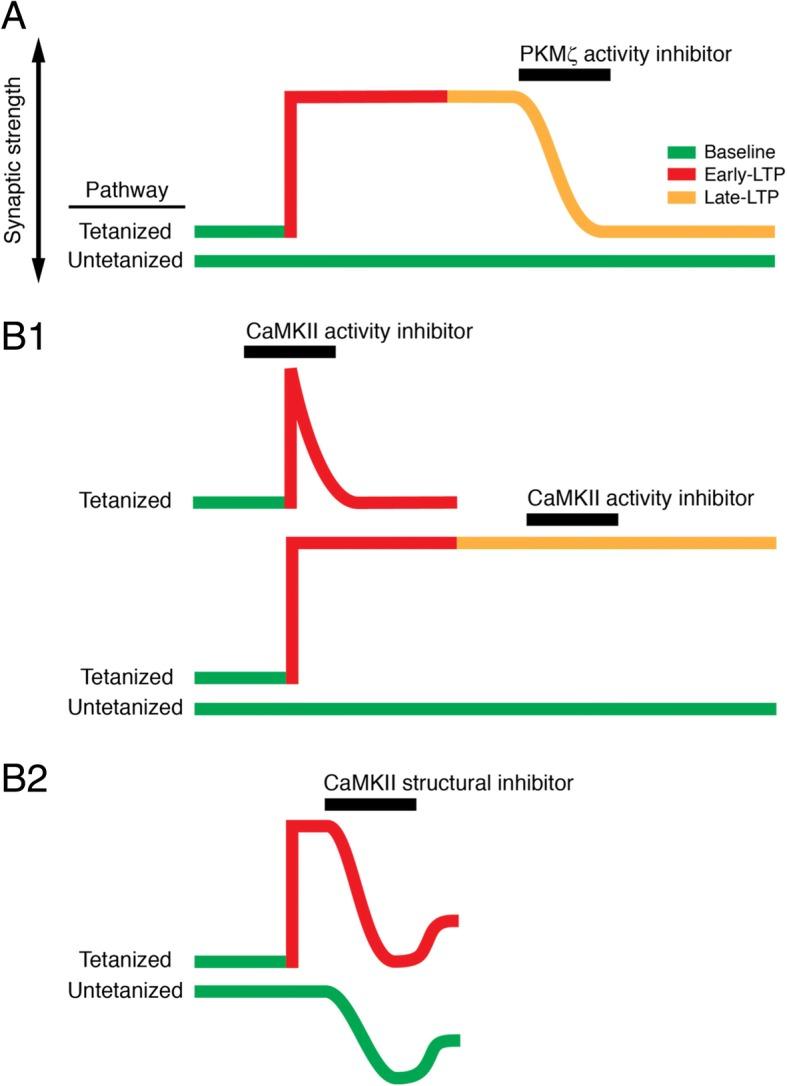
In "Criteria for identifying the molecular basis of the engram (CaMKII, PKMζ)," Lisman proposes that elucidating the mechanism of LTP maintenance is key to understanding memory storage. He suggests three criteria for a maintenance mechanism to evaluate data on CaMKII and PKMζ as memory storage molecules: necessity, occlusion, and erasure. Here we show that when the criteria are tested, the results reveal important differences between the molecules. Inhibiting PKMζ reverses established, protein synthesis-dependent late-LTP, without affecting early-LTP or baseline synaptic transmission. In contrast, blocking CaMKII has two effects: 1) inhibiting CaMKII activity blocks LTP induction but not maintenance, and 2) disrupting CaMKII interactions with NMDARs in the postsynaptic density (PSD) depresses both early-LTP and basal synaptic transmission equivalently. To identify a maintenance mechanism, we propose a fourth criterion - persistence. PKMζ increases for hours during LTP maintenance in hippocampal slices, and for over a month in specific brain regions during long-term memory storage in conditioned animals. In contrast, increased CaMKII activity lasts only minutes following LTP induction, and CaMKII translocation to the PSD in late-LTP or memory has not been reported. Lastly, do the PKMζ and CaMKII models integrate the many other signaling molecules important for LTP? Activity-dependent PKMζ synthesis is regulated by many of the signaling molecules that induce LTP, including CaMKII, providing a plausible mechanism for new gene expression in the persistent phosphorylation by PKMζ maintaining late-LTP and memory. In contrast, CaMKII autophosphorylation and translocation do not appear to require new protein synthesis. Therefore, the cumulative evidence supports a core role for PKMζ in late-LTP and long-term memory maintenance, and separate roles for CaMKII in LTP induction and for the maintenance of postsynaptic structure and synaptic transmission in a mechanism distinct from late-LTP.
在“确定情景记忆印迹分子基础的标准(CaMKII、PKMζ)”中,利斯曼提出阐明 LTP 维持的机制是理解记忆存储的关键。他提出了维持机制的三个标准,以评估 CaMKII 和 PKMζ 作为记忆存储分子的数据:必要性、阻断和擦除。在这里,我们表明,当测试这些标准时,结果揭示了这两种分子之间的重要差异。抑制 PKMζ 可逆转已建立的、依赖于蛋白质合成的晚期-LTP,而不影响早期-LTP 或基础突触传递。相比之下,阻断 CaMKII 有两个作用:1)抑制 CaMKII 活性会阻止 LTP 的诱导,但不会阻止其维持;2)破坏 CaMKII 与突触后密度(PSD)中的 NMDA 受体之间的相互作用会同等地抑制早期-LTP 和基础突触传递。为了确定维持机制,我们提出了第四个标准——持久性。在海马切片中,PKMζ 在 LTP 维持期间持续增加数小时,在条件反射动物的长时记忆存储中,特定脑区的 PKMζ 增加持续超过一个月。相比之下,在 LTP 诱导后,CaMKII 活性仅持续几分钟,并且尚未报道晚期-LTP 或记忆中的 CaMKII 易位到 PSD。最后,PKMζ 和 CaMKII 模型是否整合了许多其他对 LTP 很重要的信号分子?依赖于活性的 PKMζ 合成受到许多诱导 LTP 的信号分子的调节,包括 CaMKII,这为 PKMζ 持续磷酸化维持晚期-LTP 和记忆中的新基因表达提供了一种合理的机制。相比之下,CaMKII 自动磷酸化和易位似乎不需要新的蛋白质合成。因此,累积证据支持 PKMζ 在晚期-LTP 和长时记忆维持中的核心作用,以及 CaMKII 在 LTP 诱导以及与晚期-LTP 不同的机制中的突触后结构和突触传递维持中的独立作用。
 Zotero 插件