
脂肪干细胞与化疗残留乳腺癌细胞的串扰:对肿瘤复发的影响。
Adipose stem cell crosstalk with chemo-residual breast cancer cells: implications for tumor recurrence.
机构信息
Department of Pathology, Duke University Medical Center, Durham, NC, USA.
Division of Plastic and Reconstructive Surgery, Department of Surgery, Duke University Hospital, Durham, NC, USA.
出版信息
Breast Cancer Res Treat. 2019 Apr;174(2):413-422. doi: 10.1007/s10549-018-05103-w. Epub 2018 Dec 29.
PURPOSE
Most triple-negative breast cancer (TNBC) patients exhibit an incomplete response to neoadjuvant chemotherapy, resulting in chemo-residual tumor cells that drive tumor recurrence and patient mortality. Accordingly, strategies for eliminating chemo-residual tumor cells are urgently needed. Although stromal cells contribute to tumor cell invasion, to date, their ability to influence chemo-residual tumor cell behavior has not been examined. Our study is the first to investigate cross-talk between adipose-derived stem cells (ASCs) and chemo-residual TNBC cells. We examine if ASCs promote chemo-residual tumor cell proliferation, having implications for tumor recurrence.
METHODS
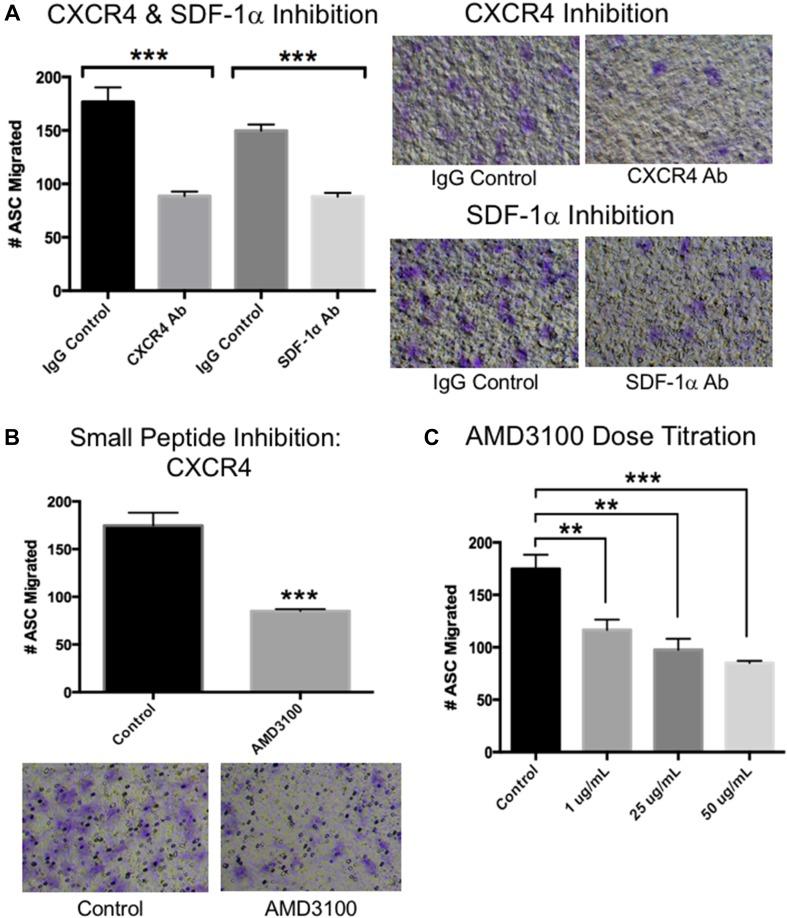
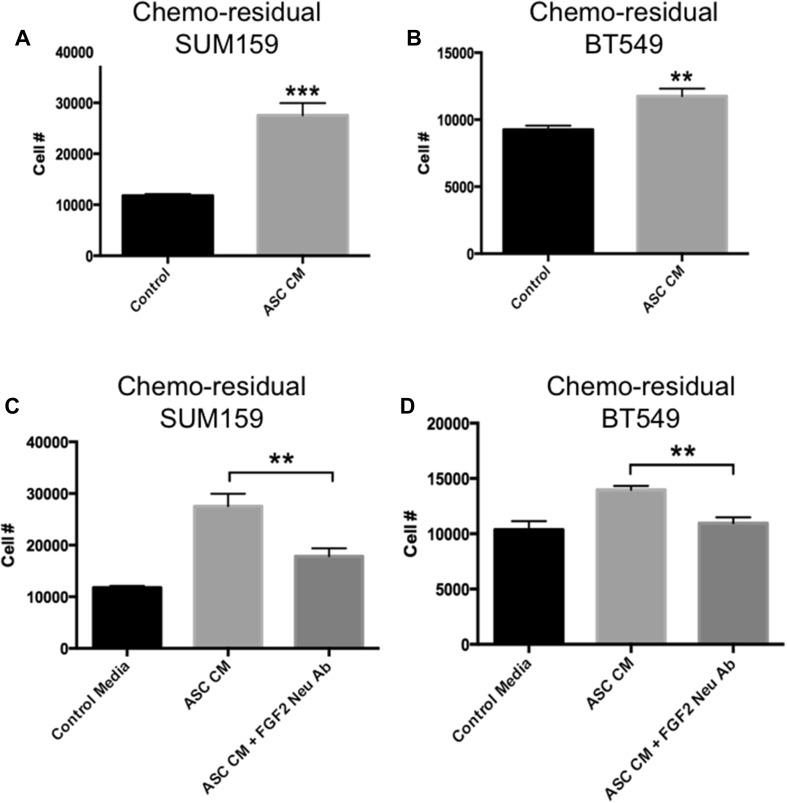
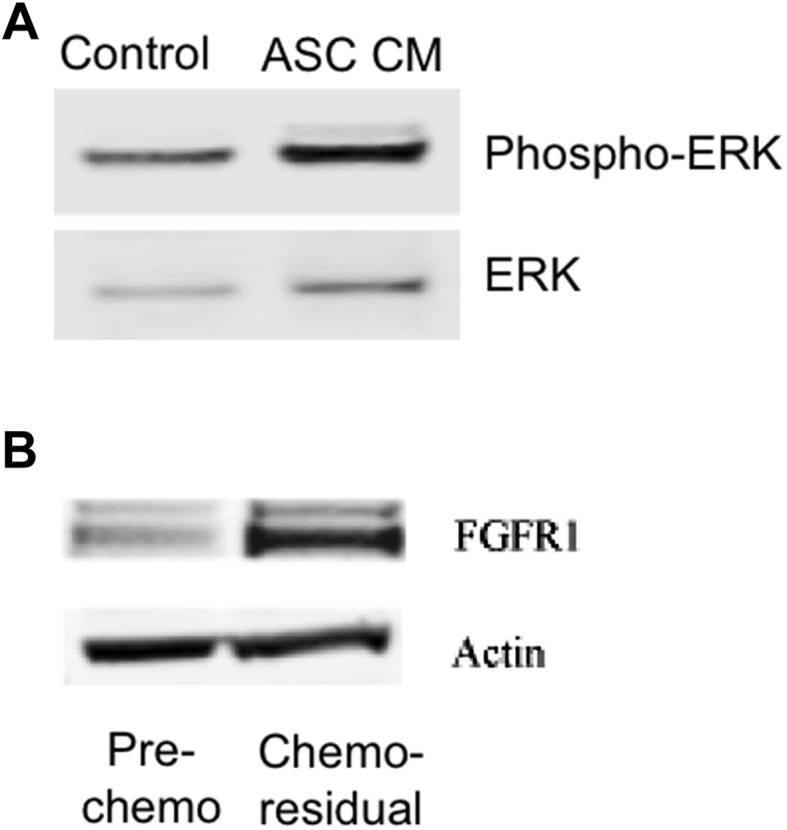
ASC migration toward chemo-residual TNBC cells was tested in a transwell migration assay. Importance of the SDF-1α/CXCR4 axis was determined using neutralizing antibodies and a small molecule inhibitor. The ability of ASCs to drive tumor cell proliferation was analyzed by culturing tumor cells ± ASC conditioned media (CM) and determining cell counts. Downstream signaling pathways activated in chemo-residual tumor cells following their exposure to ASC CM were studied by immunoblotting. Importance of FGF2 in promoting proliferation was assessed using an FGF2-neutralizing antibody.
RESULTS
ASCs migrated toward chemo-residual TNBC cells in a CXCR4/SDF-1α-dependent manner. Moreover, ASC CM increased chemo-residual tumor cell proliferation and activity of extracellular signal-regulated kinase (ERK). An FGF2-neutralizing antibody inhibited ASC-induced chemo-residual tumor cell proliferation.
CONCLUSIONS
ASCs migrate toward chemo-residual TNBC cells via SDF-1α/CXCR4 signaling, and drive chemo-residual tumor cell proliferation in a paracrine manner by secreting FGF2 and activating ERK. This paracrine signaling can potentially be targeted to prevent tumor recurrence.
目的
大多数三阴性乳腺癌(TNBC)患者对新辅助化疗表现出不完全反应,导致化疗残留肿瘤细胞驱动肿瘤复发和患者死亡。因此,迫切需要消除化疗残留肿瘤细胞的策略。尽管基质细胞有助于肿瘤细胞侵袭,但迄今为止,其影响化疗残留肿瘤细胞行为的能力尚未得到检验。我们的研究首次探讨了脂肪来源干细胞(ASCs)与化疗残留 TNBC 细胞之间的串扰。我们研究了 ASCs 是否促进化疗残留肿瘤细胞增殖,这对肿瘤复发有影响。
方法
通过 Transwell 迁移实验检测 ASC 向化疗残留 TNBC 细胞的迁移。使用中和抗体和小分子抑制剂确定 SDF-1α/CXCR4 轴的重要性。通过培养肿瘤细胞±ASC 条件培养基(CM)并测定细胞计数来分析 ASC 促进肿瘤细胞增殖的能力。通过免疫印迹研究化疗残留肿瘤细胞在暴露于 ASC CM 后激活的下游信号通路。使用 FGF2 中和抗体评估 FGF2 在促进增殖中的重要性。
结果
ASCs 以 CXCR4/SDF-1α 依赖的方式向化疗残留 TNBC 细胞迁移。此外,ASC CM 增加了化疗残留肿瘤细胞的增殖和细胞外信号调节激酶(ERK)的活性。FGF2 中和抗体抑制了 ASC 诱导的化疗残留肿瘤细胞增殖。
结论
ASCs 通过 SDF-1α/CXCR4 信号向化疗残留 TNBC 细胞迁移,并通过分泌 FGF2 和激活 ERK 以旁分泌方式驱动化疗残留肿瘤细胞增殖。这种旁分泌信号可能成为预防肿瘤复发的潜在靶点。


 Zotero 插件