
饮食和交配系统对淡水蜗牛生殖(及生殖后)寿命的影响。
The effects of diet and mating system on reproductive (and post-reproductive) life span in a freshwater snail.
作者信息
Auld Josh R
机构信息
Department of Biology West Chester University West Chester Pennsylvania.
出版信息
Ecol Evol. 2018 Nov 16;8(23):12260-12270. doi: 10.1002/ece3.4689. eCollection 2018 Dec.
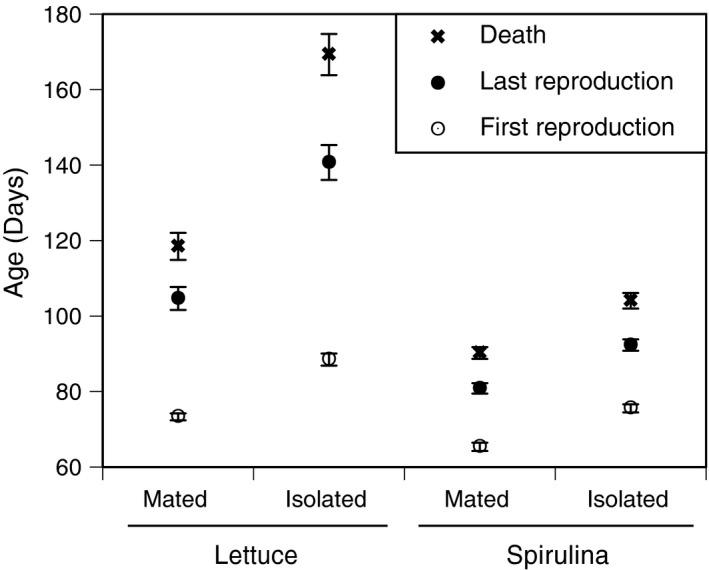
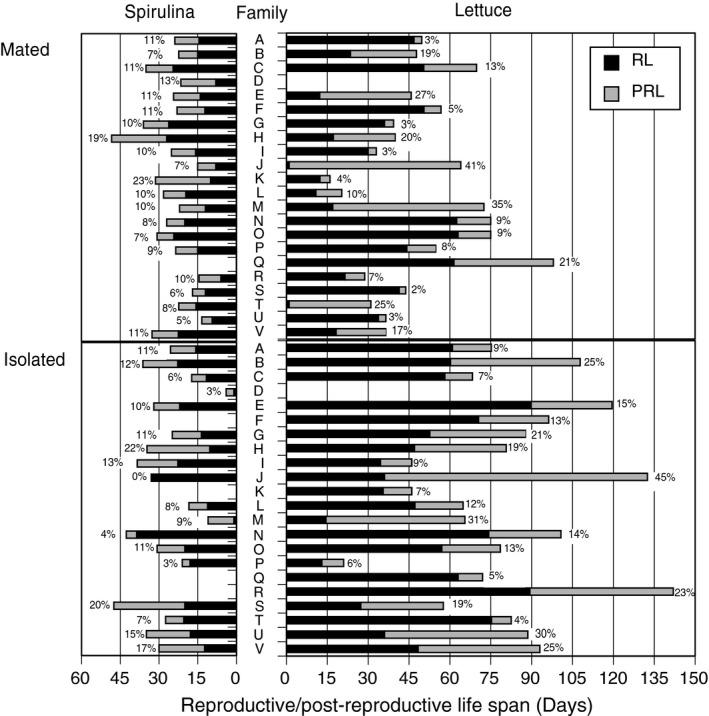
The length of the reproductive life span, along with the number/frequency/magnitude of reproductive events, quantifies an individual's potential contribution to the next generation. By examining reproductive life span, and distinguishing it from somatic life span, we gain insight into critical aspects of an individual's potential fitness as well as reproductive and somatic senescence. Additionally, differentiating somatic and reproductive life spans can provide insight into the existence of a post-reproductive period and factors that shape its duration. Given the known importance of diet and mating system on resource allocation, I reared individual freshwater snails () from 22 full-sib families under a 2 × 2 factorial design that crossed mate availability (available [outcrossing] or not [selfing]) and diet (Spirulina or lettuce) and quantified aspects of the entire life history enabling me to distinguish reproductive and somatic life spans, determine the total number of reproductive events, and evaluate how the reproductive rate changes with age. Overall, mated snails experienced shorter reproductive and somatic life spans; a diet of Spirulina also shortened both reproductive and somatic life spans. A post-reproductive period existed in all conditions; its duration was proportional to somatic but not reproductive life span. I evaluate several hypotheses for the existence and duration of the post-reproductive period, including a novel hypothesis that the post-reproductive period may result from an increase in reproductive interval with age. I conclude that the post-reproductive period may be indicative of a randomly timed death occurring as the interval between reproductive events continues to increase. As such, a "post-reproductive" period can be viewed as a by-product of a situation where reproductive senescence outpaces somatic senescence.
生殖寿命的长短,连同生殖事件的数量/频率/规模,量化了个体对下一代的潜在贡献。通过研究生殖寿命,并将其与体细胞寿命区分开来,我们能够深入了解个体潜在适合度以及生殖和体细胞衰老的关键方面。此外,区分体细胞寿命和生殖寿命可以洞察生殖后期的存在以及影响其持续时间的因素。鉴于饮食和交配系统对资源分配的已知重要性,我在一个2×2析因设计下饲养了来自22个全同胞家系的淡水蜗牛(),该设计交叉了交配机会(有交配机会[杂交]或无交配机会[自交])和饮食(螺旋藻或生菜),并量化了整个生活史的各个方面,使我能够区分生殖寿命和体细胞寿命,确定生殖事件的总数,并评估生殖率如何随年龄变化。总体而言,交配过的蜗牛的生殖寿命和体细胞寿命较短;以螺旋藻为食也缩短了生殖寿命和体细胞寿命。在所有条件下都存在一个生殖后期;其持续时间与体细胞寿命成正比,但与生殖寿命无关。我评估了关于生殖后期存在和持续时间的几种假设,包括一个新的假设,即生殖后期可能是由于生殖间隔随年龄增加所致。我得出结论,生殖后期可能表明随着生殖事件间隔的不断增加,随机定时死亡的发生。因此,“生殖后期”可以被视为生殖衰老超过体细胞衰老的一种副产品。




 Zotero 插件