
存在筛查的情况下,对新发生乳腺癌病例的肿瘤大小和淋巴结转移的联合模型。
Joint models of tumour size and lymph node spread for incident breast cancer cases in the presence of screening.
机构信息
Department of Medical Epidemiology and Biostatistics, Karolinska Institutet, Solna, Sweden.
出版信息
Stat Methods Med Res. 2019 Dec;28(12):3822-3842. doi: 10.1177/0962280218819568. Epub 2019 Jan 3.
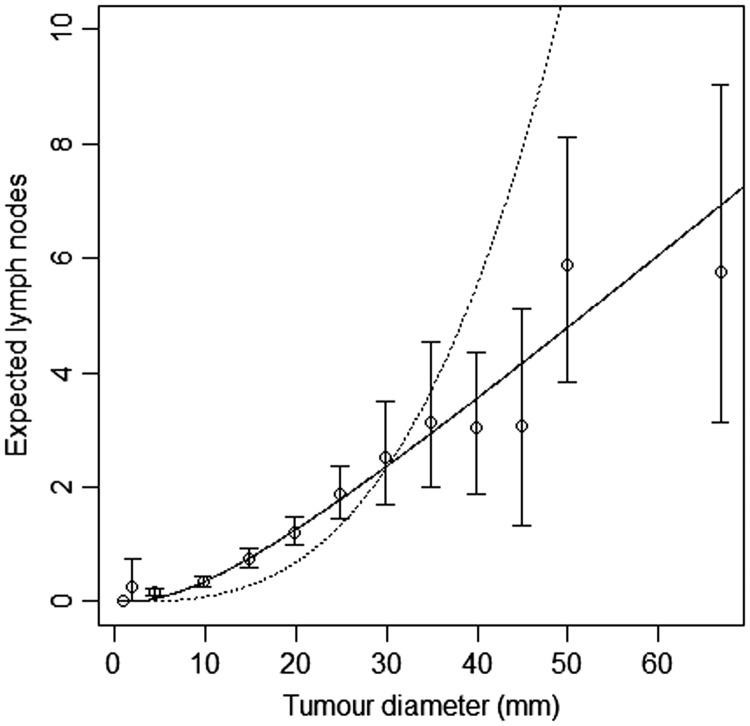
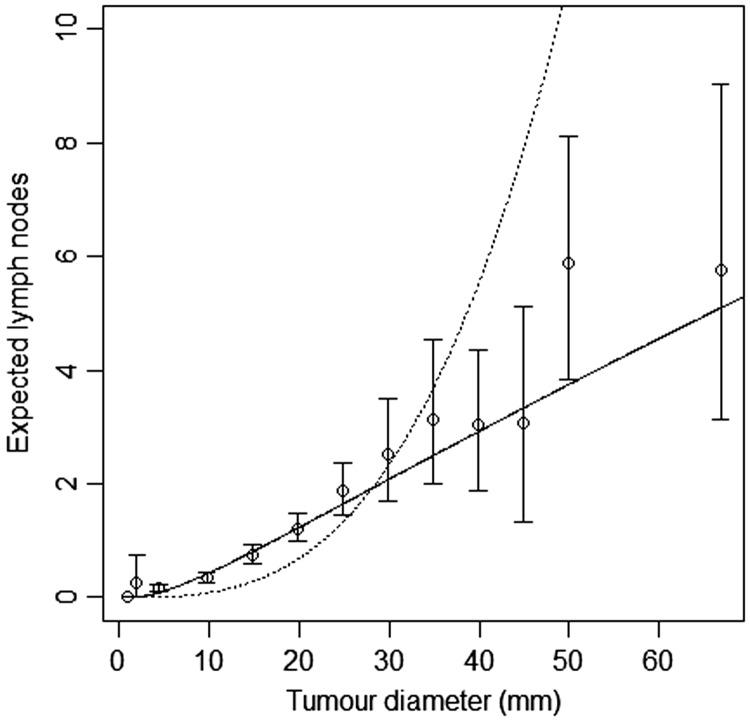
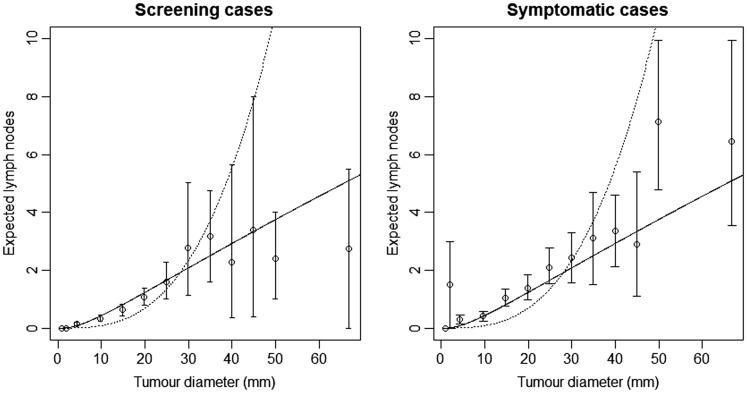
Continuous growth models show great potential for analysing cancer screening data. We recently described such a model for studying breast cancer tumour growth based on modelling tumour size at diagnosis, as a function of screening history, detection mode, and relevant patient characteristics. In this article, we describe how the approach can be extended to jointly model tumour size and number of lymph node metastases at diagnosis. We propose a new class of lymph node spread models which are biologically motivated and describe how they can be extended to incorporate random effects to allow for heterogeneity in underlying rates of spread. Our final model provides a dramatically better fit to empirical data on 1860 incident breast cancer cases than models in current use. We validate our lymph node spread model on an independent data set consisting of 3961 women diagnosed with invasive breast cancer.
连续增长模型在分析癌症筛查数据方面具有很大的潜力。我们最近描述了一种基于诊断时肿瘤大小建模的乳腺癌肿瘤生长模型,作为筛查史、检测模式和相关患者特征的函数。在本文中,我们描述了如何将该方法扩展到联合建模诊断时的肿瘤大小和淋巴结转移数量。我们提出了一类新的具有生物学意义的淋巴结扩散模型,并描述了如何将其扩展到包含随机效应,以允许潜在的扩散率异质性。我们的最终模型比当前使用的模型更能很好地拟合 1860 例乳腺癌发病病例的实际数据。我们在一个由 3961 例浸润性乳腺癌患者组成的独立数据集上验证了我们的淋巴结扩散模型。





 Zotero 插件