
绝对湿度、相对湿度、温度和风速对加拿大安大略省多伦多市流感活动的影响。
Effects of Absolute Humidity, Relative Humidity, Temperature, and Wind Speed on Influenza Activity in Toronto, Ontario, Canada.
机构信息
Public Health Ontario, Toronto, Ontario, Canada
Public Health Ontario, Toronto, Ontario, Canada.
出版信息
Appl Environ Microbiol. 2019 Mar 6;85(6). doi: 10.1128/AEM.02426-18. Print 2019 Mar 15.
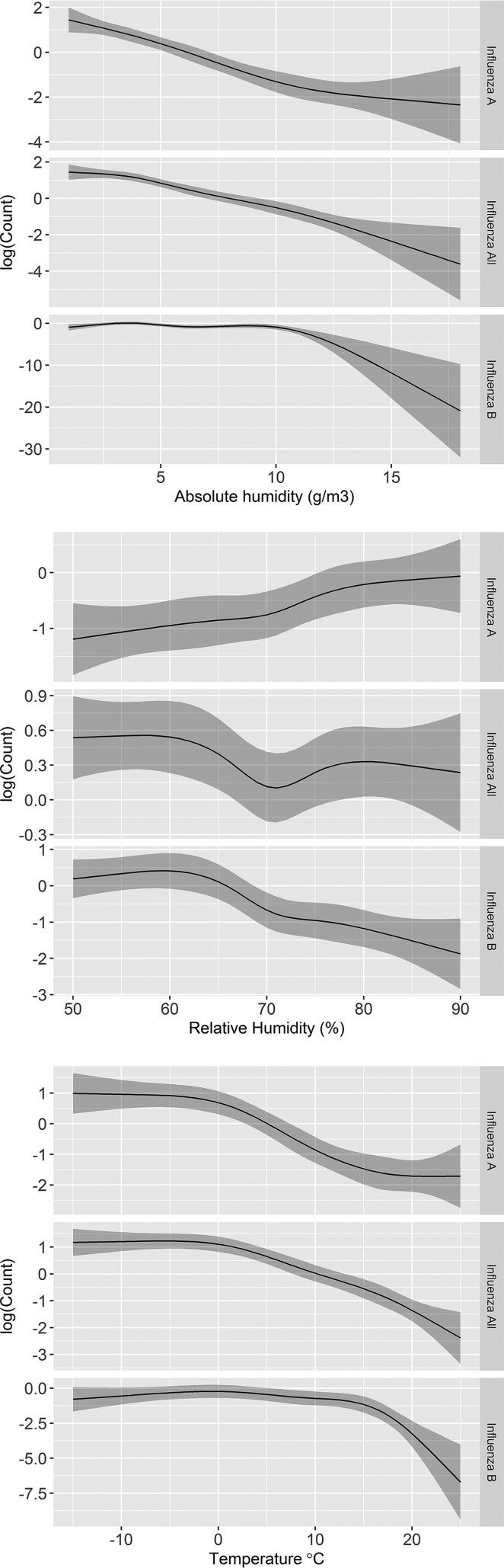
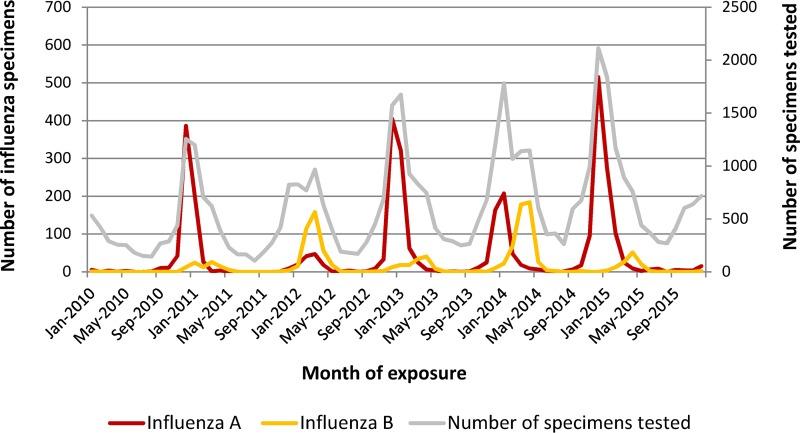
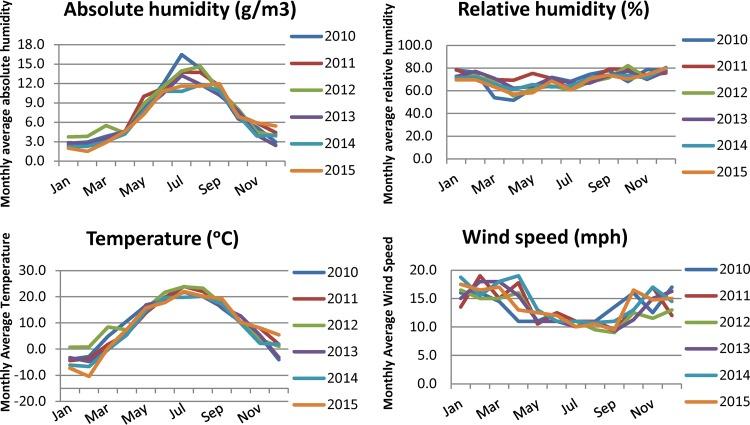
The occurrence of influenza in different climates has been shown to be associated with multiple meteorological factors. The incidence of influenza has been reported to increase during rainy seasons in tropical climates and during the dry, cold months of winter in temperate climates. This study was designed to explore the role of absolute humidity (AH), relative humidity (RH), temperature, and wind speed (WS) on influenza activity in the Toronto, ON, Canada, area. Environmental data obtained from four meteorological stations in the Toronto area over the period from 1 January 2010 to 31 December 2015 were linked to patient influenza data obtained for the same locality and period. Data were analyzed using correlation, negative binomial regressions with linear predictors, and splines to capture the nonlinear relationship between exposure and outcomes. Our study found a negative association of both AH and temperature with influenza A and B virus infections. The effect of RH on influenza A and B viruses was controversial. Temperature fluctuation was associated with increased numbers of influenza B virus infections. Influenza virus was less likely to be detected from community patients than from patients tested as part of an institutional outbreak investigation. This could be more indicative of nosocomial transmission rather than climactic factors. The nonlinear nature of the relationship of influenza A virus with temperature and of influenza B virus with AH, RH, and temperature could explain the complexity and variation between influenza A and B virus infections. Predicting influenza activity is important for the timing of implementation of disease prevention and control measures as well as for resource allocation. This study examined the relationship between environmental factors and the occurrence of influenza in general. Since the seasonality of influenza A and B viruses is different in most temperate climates, we also examined each influenza virus separately. This study reports a negative association of both absolute humidity and temperature with influenza A and B viruses and tries to understand the controversial effect of RH on influenza A and B viruses. This study reports a nonlinear relation between influenza A and B viruses with temperature and influenza B virus with absolute and relative humidity. The nonlinear nature of these relations could explain the complexity and difference in seasonality between influenza A and B viruses, with the latter predominating later in the season. Separating community-based specimens from those obtained during outbreaks was also a novel approach in this research. These findings provide a further understanding of influenza virus transmission in temperate climates.
不同气候下流感的发生与多种气象因素有关。据报道,在热带气候的雨季和温带气候的干燥寒冷的冬季月份,流感发病率会增加。本研究旨在探讨绝对湿度(AH)、相对湿度(RH)、温度和风速(WS)对加拿大安大略省多伦多地区流感活动的影响。本研究将 2010 年 1 月 1 日至 2015 年 12 月 31 日期间从多伦多地区的四个气象站获得的环境数据与同一地点和同一时期获得的患者流感数据相联系。使用相关性、具有线性预测因子的负二项回归和样条来分析数据,以捕捉暴露和结果之间的非线性关系。我们的研究发现,AH 和温度均与甲型和乙型流感病毒感染呈负相关。RH 对甲型和乙型流感病毒的影响存在争议。温度波动与乙型流感病毒感染数量增加有关。与作为机构暴发调查一部分接受检测的患者相比,社区患者中流感病毒的检出率较低。这可能更能说明是医院内传播而不是气候因素。甲型流感病毒与温度之间以及乙型流感病毒与 AH、RH 和温度之间的关系的非线性性质可以解释甲型和乙型流感病毒感染之间的复杂性和变异性。预测流感活动对于疾病预防和控制措施的实施时间以及资源分配都很重要。本研究检查了环境因素与一般流感发生之间的关系。由于大多数温带气候中甲型和乙型流感病毒的季节性不同,我们还分别检查了每种流感病毒。本研究报告了绝对湿度和温度与甲型和乙型流感病毒呈负相关,并试图了解 RH 对甲型和乙型流感病毒的有争议的影响。本研究报告了甲型和乙型流感病毒与温度之间以及乙型流感病毒与绝对湿度和相对湿度之间的非线性关系。这些关系的非线性性质可以解释甲型和乙型流感病毒之间季节性的复杂性和差异,后者在季节后期占主导地位。将社区标本与暴发期间获得的标本分开也是本研究中的一种新方法。这些发现进一步了解了温带气候中流感病毒的传播。
 Zotero 插件