
人肝干细胞通过调节小鼠髓源抑制细胞和 CD4 T 细胞减轻伴刀豆球蛋白 A 诱导的急性肝损伤。
Human liver stem cells attenuate concanavalin A-induced acute liver injury by modulating myeloid-derived suppressor cells and CD4 T cells in mice.
机构信息
Beijing Artificial Liver Treatment & Training Center, Beijing Youan Hospital, Captial Medical University, Beijing, 100069, People's Republic of China.
Department of General Surgery, The Second Hospital of Jilin University, Changchun, 130041, People's Republic of China.
出版信息
Stem Cell Res Ther. 2019 Jan 11;10(1):22. doi: 10.1186/s13287-018-1128-2.
BACKGROUND
Acute liver failure (ALF) is a serious threat to the life of people all over the world. Finding an effective way to manage ALF is important. Human liver stem cells (HLSCs) are early undifferentiated cells that have been implicated in the regeneration and functional reconstruction of the liver. In this study, we aimed to evaluate the protective effects of the HLSC line HYX1 against concanavalin A (ConA)-induced acute liver injury.
METHODS
HYX1 cells were characterized by microscopy, functional assays, gene expression, and western blot analyses. We showed that HYX1 cells can differentiate into hepatocytes. We intraperitoneally injected HYX1 cells in mice and administered ConA via caudal vein injection 3, 6, 12, 24, and 48 h later. The effects of HYX1 cell transplantation were evaluated through blood tests, histology, and flow cytometry.
RESULTS
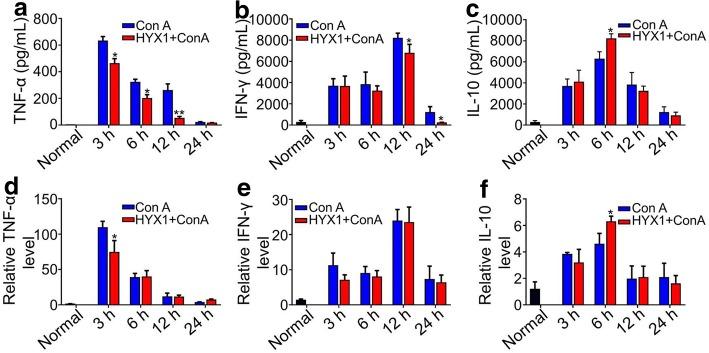
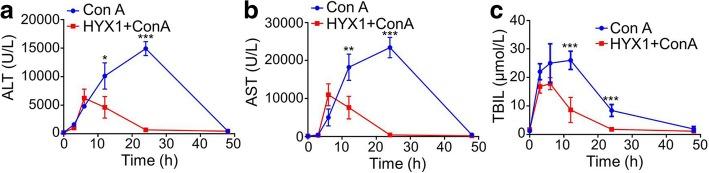
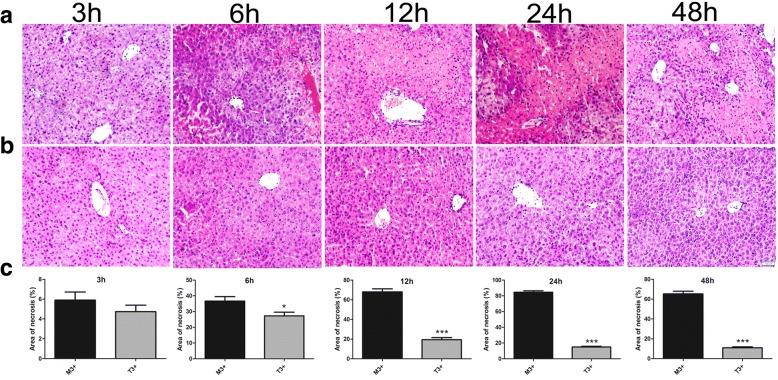
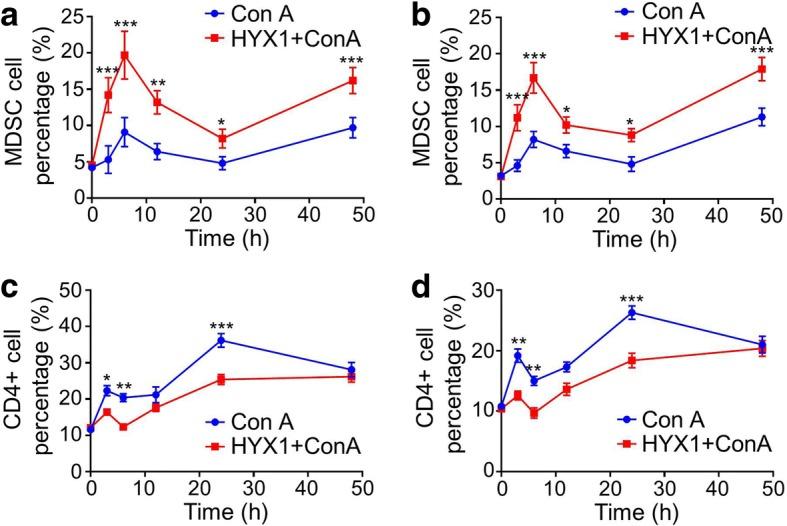
HYX1 cells reduced the levels of alanine transaminase (ALT), aspartate aminotransferase (AST), and total bilirubin (TBIL) in serum and dramatically decreased the severity of liver injuries. Mechanistically, HYX1 cells promoted myeloid-derived suppressor cell (MDSC) migration into the spleen and liver, while reducing CD4 T cell levels in both tissues. In addition, HYX1 cells suppressed the secretion of proinflammatory cytokines, such as tumour necrosis factor-α (TNF-α) and interferon-γ (IFN-γ), but led to increased interleukin-10 (IL-10) production.
CONCLUSIONS
These results confirm the efficacy of HLSCs in the prevention of the ConA-induced acute liver injury through modulation of MDSCs and CD4 T cell migration and cytokine secretion.
背景
急性肝衰竭(ALF)是全世界人民生命的严重威胁。寻找有效的方法来治疗 ALF 非常重要。人肝干细胞(HLSCs)是早期未分化的细胞,已被牵涉到肝的再生和功能重建中。在本研究中,我们旨在评估 HLSC 系 HYX1 对伴刀豆球蛋白 A(ConA)诱导的急性肝损伤的保护作用。
方法
通过显微镜、功能测定、基因表达和 Western blot 分析对 HYX1 细胞进行了特征描述。我们表明 HYX1 细胞可以分化为肝细胞。我们通过腹腔内注射 HYX1 细胞,并在 3、6、12、24 和 48 小时后通过尾静脉注射 ConA,来进行细胞移植。通过血液检查、组织学和流式细胞术来评估 HYX1 细胞移植的效果。
结果
HYX1 细胞降低了血清中天冬氨酸转氨酶(ALT)、丙氨酸转氨酶(AST)和总胆红素(TBIL)的水平,并显著降低了肝损伤的严重程度。在机制上,HYX1 细胞促进髓源抑制细胞(MDSC)向脾和肝迁移,同时降低了这两个组织中的 CD4 T 细胞水平。此外,HYX1 细胞抑制了促炎细胞因子如肿瘤坏死因子-α(TNF-α)和干扰素-γ(IFN-γ)的分泌,但导致白细胞介素-10(IL-10)的产生增加。
结论
这些结果证实了 HLSCs 通过调节 MDSC 和 CD4 T 细胞迁移以及细胞因子分泌,在预防 ConA 诱导的急性肝损伤中的疗效。



 Zotero 插件