
肥胖母亲所生婴儿的肠道微生物失衡会增加肠道通透性以及引发肥胖和非酒精性脂肪性肝病的髓样细胞适应性变化。
Imbalance in gut microbes from babies born to obese mothers increases gut permeability and myeloid cell adaptations that provoke obesity and NAFLD.
作者信息
Soderborg Taylor K, Friedman Jacob E
机构信息
Department of Pediatrics, Section of Neonatology, University of Colorado Anschutz Medical Campus, Aurora, CO USA.
Department of Medicine, Division of Endocrinology, Metabolism & Diabetes, University of Colorado Anschutz Medical Campus, Aurora, CO USA.
出版信息
Microb Cell. 2018 Dec 19;6(1):102-104. doi: 10.15698/mic2019.01.666.
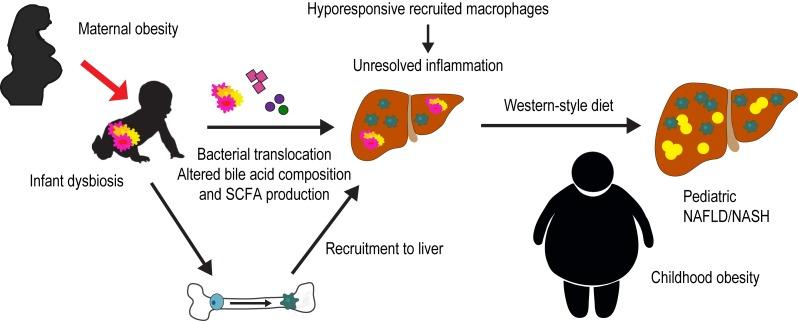
Non-alcoholic fatty liver disease (NAFLD) is a multifactorial disease affecting nearly 40% of obese youth and up to 10% of the general pediatric population. A key aspect of NAFLD pathogenesis is proinflammatory hepatic macrophage activation and hepatic recruitment of circulating monocytes, which originate from the bone marrow. In neonates, the activation and polarization of myeloid immune cells are normally shaped in part by systemic factors derived from intestinal microbiota during the first 1000 days of life. Perturbations of the gut microbiome, and in turn the metabolites and bacterial products released systemically, can affect the functional phenotype of these immune cells. Evidence in germ-free mice has shown that fecal microbial transfer from obese mice or obese human donors promotes obesity and inflammation in the recipients, suggesting a direct role for the gut microbiome in promoting obesity and possibly NAFLD. Indeed, patients suffering from NAFLD show evidence for dysbiosis, increased gut permeability, and changes in bile acids that drive the progression of hepatic inflammation toward non-alcoholic steatohepatitis (NASH), the more severe form of the disease. Compared with infants born to normal-weight mothers, we previously showed that the gut microbiome from neonates born to obese mothers is compositionally distinct. However, whether this alteration in early gut microbiota in infants born to obese mothers can inflammatory processes that initiate development of NAFLD or obesity is unknown. How these alterations contribute to long-term immune cell mediated liver inflammation and progression of NAFLD needs to be determined. Our recently published work (Soderborg , Nat Commun 9:4462) demonstrates a causative role of early life microbiome dysbiosis in infants born to mothers with obesity in novel pathways that promote developmental programming of NAFLD.
非酒精性脂肪性肝病(NAFLD)是一种多因素疾病,影响着近40%的肥胖青少年以及高达10%的普通儿科人群。NAFLD发病机制的一个关键方面是促炎性肝巨噬细胞激活以及循环单核细胞的肝脏募集,这些单核细胞起源于骨髓。在新生儿中,髓系免疫细胞的激活和极化通常部分由生命最初1000天内源自肠道微生物群的全身因素塑造。肠道微生物群的扰动,以及由此全身释放的代谢产物和细菌产物,会影响这些免疫细胞的功能表型。无菌小鼠的证据表明,来自肥胖小鼠或肥胖人类供体的粪便微生物转移会促进受体的肥胖和炎症,这表明肠道微生物群在促进肥胖以及可能的NAFLD中起直接作用。事实上,患有NAFLD的患者表现出肠道菌群失调、肠道通透性增加以及胆汁酸变化的证据,这些变化会促使肝脏炎症向非酒精性脂肪性肝炎(NASH,该疾病更严重的形式)发展。与体重正常母亲所生的婴儿相比,我们之前表明肥胖母亲所生新生儿的肠道微生物群在组成上有所不同。然而,肥胖母亲所生婴儿早期肠道微生物群的这种改变是否会引发启动NAFLD或肥胖发展的炎症过程尚不清楚。这些改变如何导致长期免疫细胞介导的肝脏炎症以及NAFLD的进展有待确定。我们最近发表的研究(索德伯格,《自然通讯》9:4462)证明了肥胖母亲所生婴儿早期生命微生物群失调在促进NAFLD发育编程的新途径中的因果作用。

 Zotero 插件