
肾移植女性的妊娠结局:荟萃分析和系统评价。
Pregnancy outcomes in women with kidney transplant: Metaanalysis and systematic review.
机构信息
Division of Nephrology Kidney C.A.R.E. Program, University of Cincinnati, 231 Albert Sabin Way, MSB 6112, Cincinnati, OH, 45267, USA.
Department of Environmental Health, University of Cincinnati, Cincinnati, OH, USA.
出版信息
BMC Nephrol. 2019 Jan 23;20(1):24. doi: 10.1186/s12882-019-1213-5.
BACKGROUND
Reproductive function in women with end stage renal disease generally improves after kidney transplant. However, pregnancy remains challenging due to the risk of adverse clinical outcomes.
METHODS
We searched PubMed/MEDLINE, Elsevier EMBASE, Scopus, BIOSIS Previews, ISI Science Citation Index Expanded, and the Cochrane Central Register of Controlled Trials from date of inception through August 2017 for studies reporting pregnancy with kidney transplant.
RESULTS
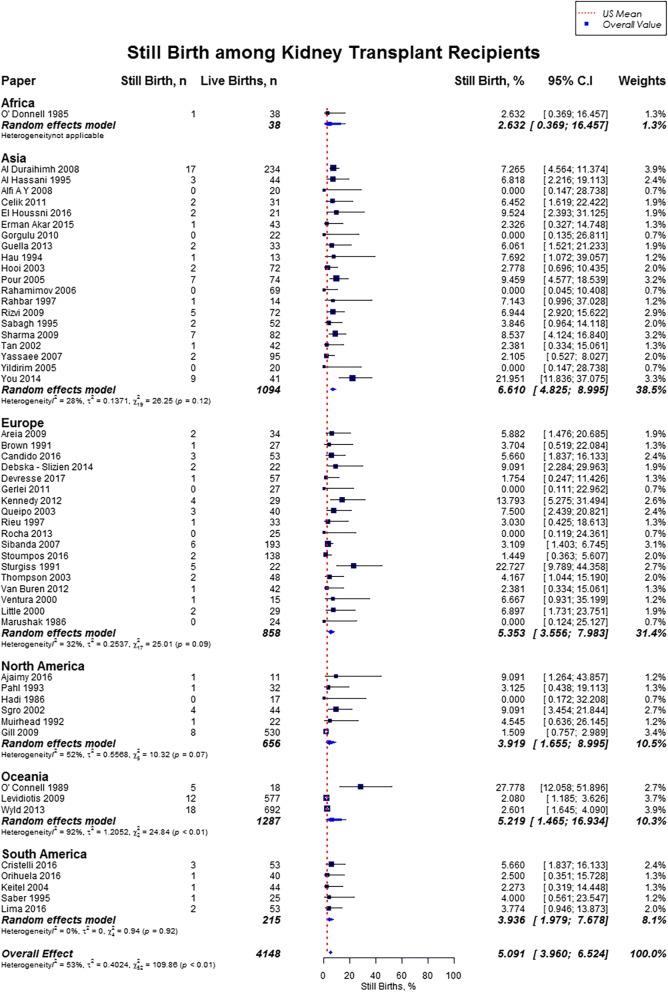
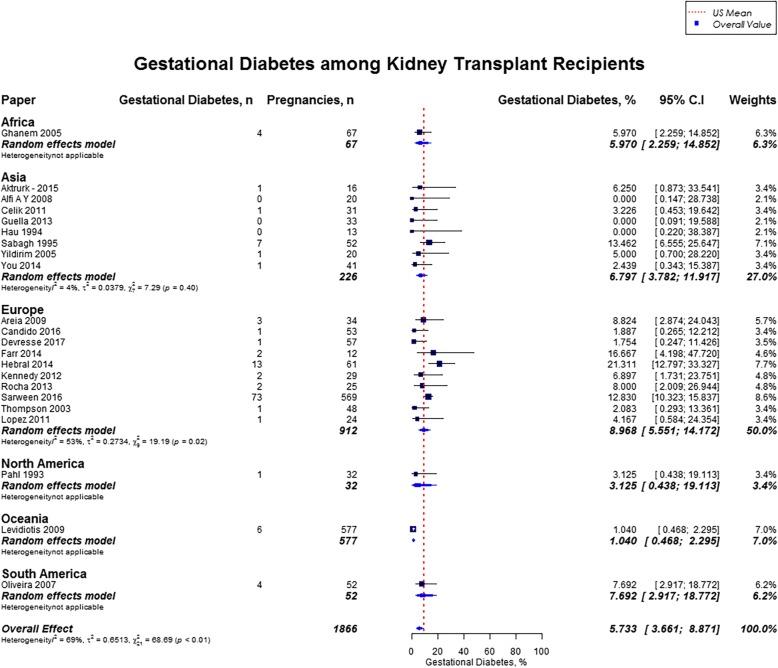
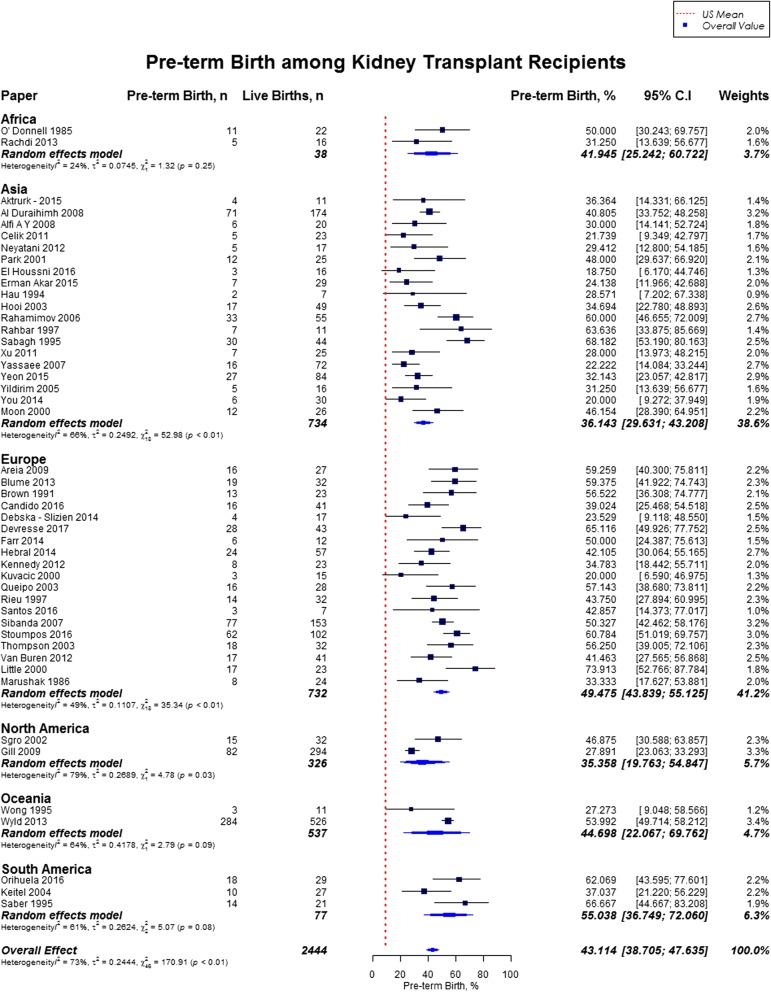
Of 1343 unique studies, 87 met inclusion criteria, representing 6712 pregnancies in 4174 kidney transplant recipients. Mean maternal age was 29.6 ± 2.4 years. The live-birth rate was 72.9% (95% CI, 70.0-75.6). The rate of other pregnancy outcomes was as follows: induced abortions (12.4%; 95% CI, 10.4-14.7), miscarriages (15.4%; 95% CI, 13.8-17.2), stillbirths (5.1%; 95% CI, 4.0-6.5), ectopic pregnancies (2.4%; 95% CI, 1.5-3.7), preeclampsia (21.5%; 95% CI, 18.5-24.9), gestational diabetes (5.7%; 95% CI, 3.7-8.9), pregnancy induced hypertension (24.1%; 95% CI, 18.1-31.5), cesarean section (62.6, 95% CI 57.6-67.3), and preterm delivery was 43.1% (95% CI, 38.7-47.6). Mean gestational age was 34.9 weeks, and mean birth weight was 2470 g. The 2-3-year interval following kidney transplant had higher neonatal mortality, and lower rates of live births as compared to > 3 year, and < 2-year interval. The rate of spontaneous abortion was higher in women with mean maternal age < 25 years and > 35 years as compared to women aged 25-34 years.
CONCLUSION
Although the outcome of live births is favorable, the risks of maternal and fetal complications are high in kidney transplant recipients and should be considered in patient counseling and clinical decision making.
背景
女性在接受肾移植后,生殖功能通常会有所改善。然而,由于存在不良临床结局的风险,妊娠仍然具有挑战性。
方法
我们检索了从建库到 2017 年 8 月期间 PubMed/MEDLINE、Elsevier EMBASE、Scopus、BIOSIS Previews、ISI 科学引文索引扩展版和 Cochrane 对照试验中心注册库,以获取报道肾移植后妊娠的研究。
结果
在 1343 项独特的研究中,有 87 项符合纳入标准,涉及 4174 名肾移植受者的 6712 例妊娠。产妇平均年龄为 29.6±2.4 岁。活产率为 72.9%(95%CI,70.0-75.6)。其他妊娠结局的发生率如下:人工流产(12.4%;95%CI,10.4-14.7)、流产(15.4%;95%CI,13.8-17.2)、死胎(5.1%;95%CI,4.0-6.5)、异位妊娠(2.4%;95%CI,1.5-3.7)、子痫前期(21.5%;95%CI,18.5-24.9)、妊娠期糖尿病(5.7%;95%CI,3.7-8.9)、妊娠高血压(24.1%;95%CI,18.1-31.5)、剖宫产(62.6%;95%CI,57.6-67.3)和早产(43.1%;95%CI,38.7-47.6)。平均孕龄为 34.9 周,平均出生体重为 2470 克。与>3 年和<2 年间隔相比,肾移植后 2-3 年间隔的新生儿死亡率更高,活产率更低。与 25-34 岁的女性相比,年龄<25 岁和>35 岁的女性自然流产率更高。
结论
尽管活产率良好,但肾移植受者的母婴并发症风险较高,在患者咨询和临床决策时应予以考虑。






 Zotero 插件