
多发性硬化症患者对用于疾病管理的移动健康应用程序的接受度:基于网络的调查研究
Acceptance of Mobile Health Apps for Disease Management Among People With Multiple Sclerosis: Web-Based Survey Study.
作者信息
Apolinário-Hagen Jennifer, Menzel Mireille, Hennemann Severin, Salewski Christel
机构信息
Department of Health Psychology, Faculty of Psychology, University of Hagen, Hagen, Germany.
Department of Clinical Psychology, Psychotherapy and Experimental Psychopathology, Institute of Psychology, University of Mainz, Mainz, Germany.
出版信息
JMIR Form Res. 2018 Dec 12;2(2):e11977. doi: 10.2196/11977.
BACKGROUND
Mobile health (mHealth) apps might have the potential to promote self-management of people with multiple sclerosis (MS) in everyday life. However, the uptake of MS apps remains poor, and little is known about the facilitators and barriers for their efficient utilization, such as technology acceptance.
OBJECTIVE
The aim of this study was to examine the acceptance of mHealth apps for disease management in the sense of behavioral intentions to use and explore determinants of utilization among people with MS based on the Unified Theory of Acceptance and Use of Technology (UTAUT).
METHODS
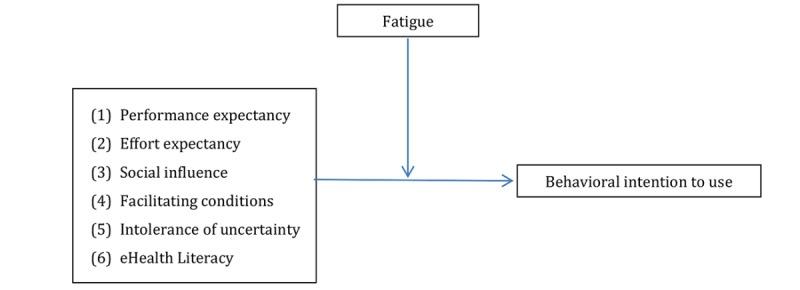
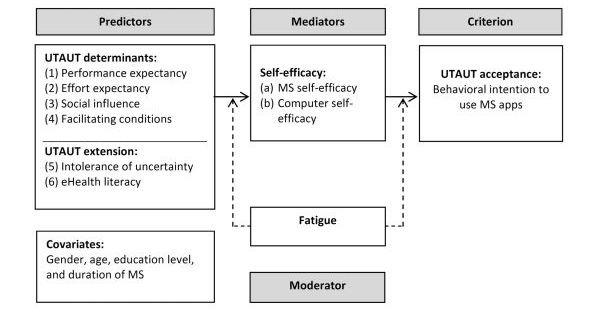
Participants for this Web-based cross-sectional study were recruited throughout Germany with the support of regional MS associations and self-help groups. To identify determinants of intention to use MS apps, a measure based on the UTAUT was adapted with 4 key determinants (performance expectancy, effort expectancy, social influence, and facilitating conditions) and extended by Intolerance of Uncertainty (IU) and electronic health literacy. Potential influencing effects of both MS and computer self-efficacy (C-SE) as mediators and fatigue as a moderator were analyzed using Hayes's PROCESS macro (SPSS version 3.0) for IBM SPSS version 24.0.
RESULTS
A total of 98 participants (mean age 47.03 years, SD 10.17; 66/98, 67% female) with moderate fatigue levels completed the survey. Although most participants (91/98, 92%) were daily smartphone users, almost two-thirds (62/98, 63%) reported no experience with MS apps. Overall, the acceptance was moderate on average (mean 3.11, SD 1.31, minimum=1 and maximum=5), with lower scores among persons with no experience (P=.04) and higher scores among current users (P<.001). In multiple regression analysis (R=63% variance explained), performance expectancy (beta=.41) and social influence (beta=.33) were identified as significant predictors of acceptance (all P<.001). C-SE was confirmed as a partial mediator in the relationship between IU and acceptance (indirect effect: B=-.095, 95% CI -0.227 to -0.01). Furthermore, a moderated mediation by C-SE was shown in the relationship between IU and behavioral intentions to use MS apps for low (95% CI -0.42 to -0.01) and moderate levels (95% CI -0.27 to -0.01) of fatigue.
CONCLUSIONS
Overall, this exploratory pilot study indicates for the first time that positive expectations about the helpfulness for self-management purposes and social support might be important factors to be considered for improving the acceptance of MS apps among smartphone users with MS. However, given some inconsistent findings, especially regarding the role of effort expectancy and IU and self-efficacy, the conceptual model needs replication with a larger sample of people with MS, varying more in fatigue levels, and a longitudinal assessment of the actual usage of MS apps predicted by acceptance in the sense of behavioral intentions to use.
背景
移动健康(mHealth)应用程序可能有潜力促进多发性硬化症(MS)患者在日常生活中的自我管理。然而,MS应用程序的使用率仍然很低,对于其有效利用的促进因素和障碍,如技术接受度,人们了解甚少。
目的
本研究的目的是基于技术接受与使用统一理论(UTAUT),从使用行为意图的角度检验mHealth应用程序在疾病管理方面的接受度,并探索MS患者中应用程序使用的决定因素。
方法
在德国各地的地区MS协会和自助团体的支持下,招募了参与这项基于网络的横断面研究的参与者。为了确定使用MS应用程序的意图的决定因素,采用了基于UTAUT的测量方法,包括4个关键决定因素(绩效期望、努力期望、社会影响和促进条件),并通过不确定性不耐受(IU)和电子健康素养进行扩展。使用IBM SPSS 24.0版本的Hayes PROCESS宏分析了MS和计算机自我效能(C-SE)作为中介以及疲劳作为调节因素的潜在影响效应。
结果
共有98名中度疲劳水平的参与者(平均年龄47.03岁,标准差10.17;66/98,67%为女性)完成了调查。尽管大多数参与者(91/98,92%)是日常智能手机用户,但几乎三分之二(62/98,63%)表示没有使用过MS应用程序的经验。总体而言,接受度平均适中(平均3.11,标准差1.31,最小值=1,最大值=5),没有经验的人得分较低(P=0.04),当前用户得分较高(P<0.001)。在多元回归分析(R=63%,解释方差)中,绩效期望(β=0.41)和社会影响(β=0.33)被确定为接受度的显著预测因素(所有P<0.001)。C-SE被确认为IU与接受度之间关系的部分中介因素(间接效应:B=-0.095,95%CI -0.227至-0.01)。此外,在IU与使用MS应用程序的行为意图之间的关系中,对于低(95%CI -0.42至-0.01)和中度(95%CI -0.27至-0.01)疲劳水平,显示出C-SE的调节中介作用。
结论
总体而言,这项探索性试点研究首次表明,对自我管理目的的帮助和社会支持的积极期望可能是提高MS智能手机用户对MS应用程序接受度时需要考虑的重要因素。然而,鉴于一些不一致的发现,特别是关于努力期望、IU和自我效能的作用,该概念模型需要在更大的MS患者样本中进行复制,这些样本的疲劳水平差异更大,并对基于使用行为意图接受度预测的MS应用程序的实际使用情况进行纵向评估。

 Zotero 插件