
双组分信号转导系统:将输入刺激与生物膜形成相联系的一种主要策略。
Two-Component Signal Transduction Systems: A Major Strategy for Connecting Input Stimuli to Biofilm Formation.
作者信息
Liu Cong, Sun Di, Zhu Jingrong, Liu Weijie
机构信息
School of Life Science, Jiangsu Normal University, Xuzhou, China.
出版信息
Front Microbiol. 2019 Jan 10;9:3279. doi: 10.3389/fmicb.2018.03279. eCollection 2018.
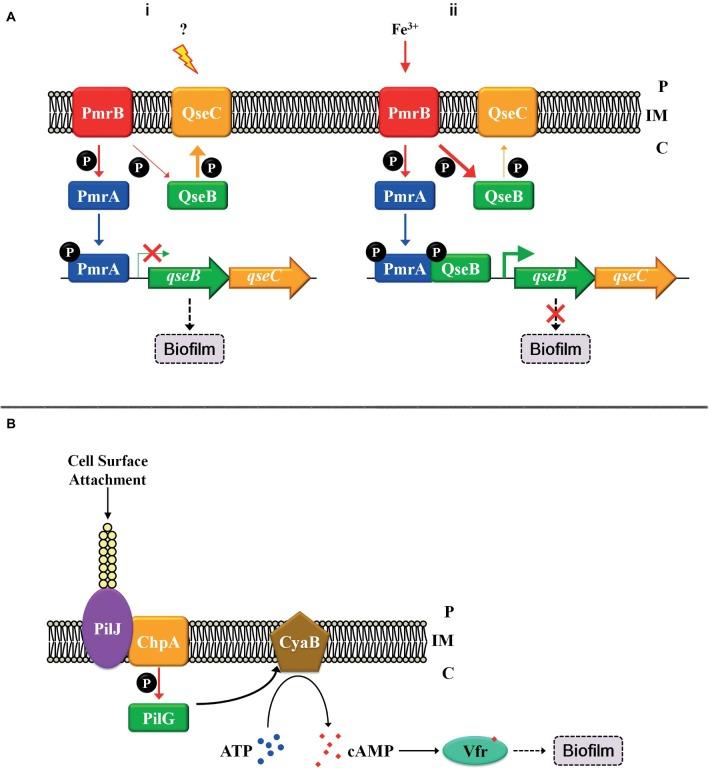
Biofilms are multicellular communities of microbes that are encased within an extracellular matrix. Environmental factors induce bacteria to form biofilm. Bacteria have several regulatory mechanisms in response to environmental changes, and the two-component signal transduction system (TCS) is a major strategy in connecting changes in input signals to changes in cellular physiological output. The TCS employs multiple mechanisms such as cross-regulation, to integrate and coordinate various input stimuli to control biofilm formation. In this mini-review, we demonstrate the roles of TCS on biofilm formation, illustrating these input signals and modulation modes, which may be utilized by future investigations in elucidating the regulatory signals and underlying the mechanisms of biofilm formation.
生物膜是包裹在细胞外基质中的微生物多细胞群落。环境因素诱导细菌形成生物膜。细菌具有多种响应环境变化的调节机制,而双组分信号转导系统(TCS)是将输入信号变化与细胞生理输出变化联系起来的主要策略。TCS采用交叉调节等多种机制,整合和协调各种输入刺激以控制生物膜形成。在本综述中,我们阐述了TCS在生物膜形成中的作用,说明了这些输入信号和调节模式,未来的研究可能会利用它们来阐明生物膜形成的调控信号和潜在机制。

 Zotero 插件