
乙肝表面抗原和 HBV DNA 水平低可预测乙肝 e 抗原阳性慢性乙型肝炎患者加用聚乙二醇干扰素治疗的应答。
Low hepatitis B surface antigen and HBV DNA levels predict response to the addition of pegylated interferon to entecavir in hepatitis B e antigen positive chronic hepatitis B.
机构信息
Toronto Centre for Liver Disease, Toronto General Hospital, University Health Network, Toronto, Ontario, Canada.
Department of Gastroenterology and Hepatology, Erasmus University Medical Center Rotterdam, Rotterdam, The Netherlands.
出版信息
Aliment Pharmacol Ther. 2019 Feb;49(4):448-456. doi: 10.1111/apt.15098.
BACKGROUND
Various treatment combinations of peginterferon (PEG-IFN) and nucleos(t)ide analogues have been evaluated for chronic hepatitis B (CHB), but the optimal regimen remains unclear.
AIMS
To study whether PEG-IFN add-on increases response compared to entecavir (ETV) monotherapy, and whether the duration of ETV pretreatment influences response.
METHODS
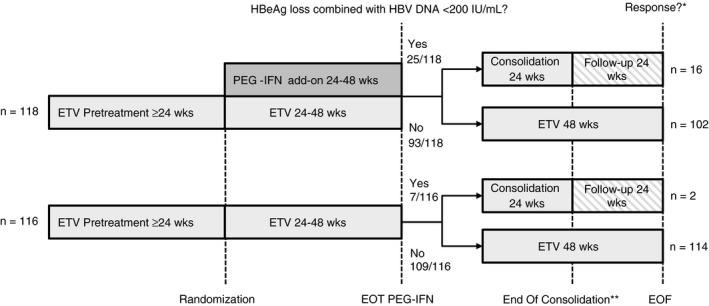
Response was evaluated in HBeAg positive patients previously treated in two randomized controlled trials. Patients received ETV pretreatment for at least 24 weeks and were then allocated to 24-48 weeks of ETV+PEG-IFN add-on, or continued ETV monotherapy. Response was defined as HBeAg loss combined with HBV DNA <200 IU/mL 48 weeks after discontinuing PEG-IFN.
RESULTS
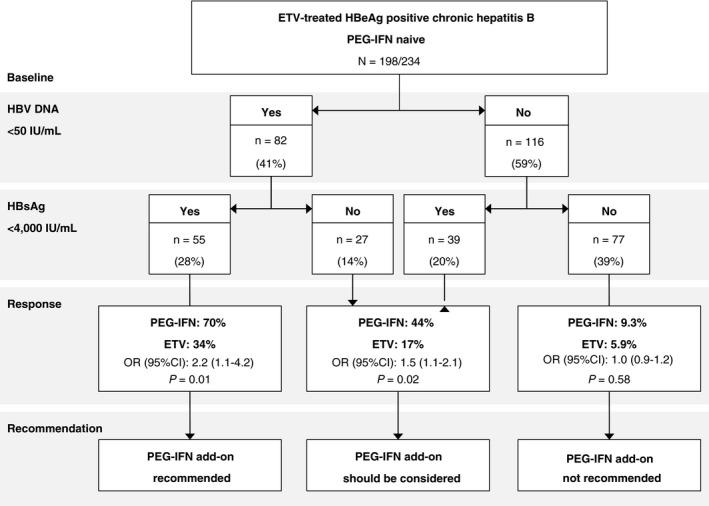
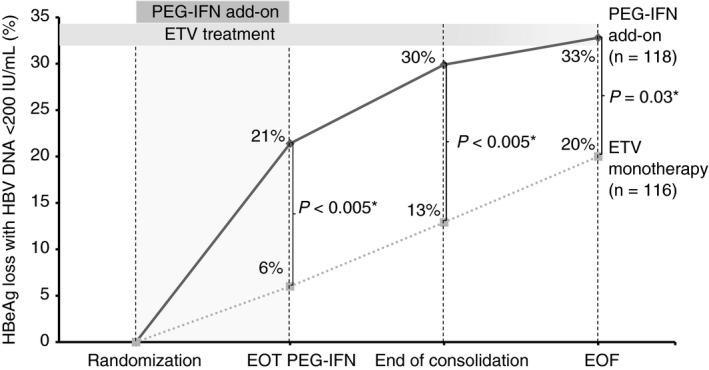
Of 234 patients, 118 were assigned PEG-IFN add-on and 116 continued ETV monotherapy. Response was observed in 38/118 (33%) patients treated with add-on therapy and in 23/116 (20%) with monotherapy (P = 0.03). The highest response to add-on therapy compared to monotherapy was observed in PEG-IFN naive patients with HBsAg levels below 4000 IU/mL and HBV DNA levels below 50 IU/mL at randomization (70% vs 34%; P = 0.01). Above the cut-off levels, response was low and not significantly different between treatment groups. Duration of ETV pretreatment was associated with HBsAg and HBV DNA levels (both P < 0.005), but not with response (P = 0.82).
CONCLUSIONS
PEG-IFN add-on to ETV therapy was associated with higher response compared to ETV monotherapy in patients with HBeAg positive CHB. Response doubled in PEG-IFN naive patients with HBsAg below 4000 IU/mL and HBV DNA below 50 IU/mL, and therefore identifies them as the best candidates for PEG-IFN add-on (Identifiers: NCT00877760, NCT01532843).
背景
聚乙二醇干扰素(PEG-IFN)与核苷(酸)类似物的各种治疗组合已被评估用于慢性乙型肝炎(CHB),但最佳方案仍不清楚。
目的
研究 PEG-IFN 附加治疗是否比恩替卡韦(ETV)单药治疗更能提高应答率,以及 ETV 预处理的持续时间是否影响应答率。
方法
在两项随机对照试验中,对先前接受治疗的 HBeAg 阳性患者进行了应答评估。患者接受 ETV 预处理至少 24 周,然后被分配接受 24-48 周的 ETV+PEG-IFN 附加治疗,或继续 ETV 单药治疗。停药 48 周后,HBeAg 丢失且 HBV DNA<200 IU/mL 定义为应答。
结果
在 234 例患者中,118 例接受 PEG-IFN 附加治疗,116 例继续 ETV 单药治疗。附加治疗组 38/118(33%)例患者和单药治疗组 23/116(20%)例患者观察到应答(P=0.03)。与单药治疗相比,PEG-IFN 初治、HBsAg<4000IU/mL 和随机时 HBV DNA<50IU/mL 的患者接受附加治疗的应答率最高(70%比 34%;P=0.01)。在临界值以上,两组之间的应答率较低且无显著差异。ETV 预处理的持续时间与 HBsAg 和 HBV DNA 水平相关(均 P<0.005),但与应答无关(P=0.82)。
结论
与 ETV 单药治疗相比,PEG-IFN 附加治疗可提高 HBeAg 阳性 CHB 患者的应答率。在 HBsAg<4000IU/mL 和 HBV DNA<50IU/mL 的 PEG-IFN 初治患者中,应答率增加一倍,因此这些患者是 PEG-IFN 附加治疗的最佳候选者(标识符:NCT00877760,NCT01532843)。
 Zotero 插件