
现行策略在高级别浆液性上皮性卵巢癌的靶向治疗中的应用及 BRCA 突变状态的相关性。
Current strategies for the targeted treatment of high-grade serous epithelial ovarian cancer and relevance of BRCA mutational status.
机构信息
Department of Experimental and Clinical Medicine, Division of Gynecology and Obstetrics, University of Pisa, Pisa, Italy.
Department of Surgery, Oncology and Gastroenterology, University of Padova, Padova, Italy.
出版信息
J Ovarian Res. 2019 Jan 28;12(1):9. doi: 10.1186/s13048-019-0484-6.
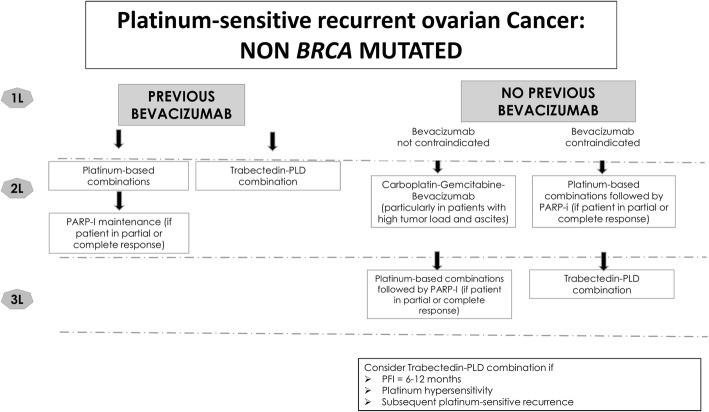
Epithelial ovarian cancer is the most lethal gynecologic malignancy. In most women, it is diagnosed at an advanced stage, which largely explains the poor prognosis of this malignancy. Germline mutations of the genes BRCA1 and BRCA2, which encode proteins essential for the repair of double-strand DNA breaks through homologous recombination, lead to increased cancer predisposition. BRCA mutations are present in approximately 14% of epithelial ovarian cancers. Somatic BRCA mutations have also been described. Current first-line treatment of high-grade epithelial ovarian cancer includes debulking surgery followed by combination chemotherapy, usually carboplatin and paclitaxel. Ovarian cancer is highly sensitive to chemotherapy, in particular to platinum drugs. Most patient will achieve remission with initial chemotherapy, but most will eventually experience disease recurrence. Targeted therapies, including the anti-angiogenic agent bevacizumab and oral poly (ADP-ribose) polymerase (PARP) inhibitors, have been recently approved for the treatment of ovarian cancer, based on the results from randomized clinical trials showing significant benefits in terms of progression-free survival, with acceptable tolerability and no detrimental effects on quality of life. Olaparib, the first PARP inhibitor to be granted approval, is currently indicated as maintenance monotherapy in ovarian cancer patients with relapsed disease and mutated BRCA who have achieved a complete or partial response to platinum-based chemotherapy. The analysis of BRCA mutational status has, therefore, also become crucial for therapeutic decisions. Such advances are making personalized treatment of ovarian cancer feasible. Here we briefly review treatments for platinum-sensitive, high-grade serous epithelial ovarian cancer that are currently available in Italy, with a focus on targeted therapies and the relevance of BRCA mutational analysis. Based on the evidence and on current guidelines, we propose strategies for the tailored treatment of patients with relapsed ovarian cancer that take into account BRCA mutational status and the treatment received in the first-line setting.
上皮性卵巢癌是最致命的妇科恶性肿瘤。在大多数女性中,该病在晚期被诊断出来,这在很大程度上解释了这种恶性肿瘤预后不良的原因。BRCA1 和 BRCA2 基因的种系突变,这些基因编码同源重组修复双链 DNA 断裂所必需的蛋白质,导致癌症易感性增加。BRCA 突变存在于约 14%的上皮性卵巢癌中。也描述了体细胞 BRCA 突变。目前高级别上皮性卵巢癌的一线治疗包括肿瘤细胞减灭术,然后联合化疗,通常是卡铂和紫杉醇。卵巢癌对化疗高度敏感,特别是铂类药物。大多数患者在初始化疗时会缓解,但大多数患者最终会复发。靶向治疗,包括抗血管生成药物贝伐单抗和口服多聚(ADP-核糖)聚合酶(PARP)抑制剂,最近已根据随机临床试验的结果获得批准用于治疗卵巢癌,这些结果显示在无进展生存期方面具有显著益处,耐受性可接受,对生活质量没有不利影响。奥拉帕利是第一个获得批准的 PARP 抑制剂,目前被批准用于对铂类化疗有反应的复发性 BRCA 突变上皮性卵巢癌患者的维持单药治疗。因此,BRCA 突变状态分析也成为治疗决策的关键。这些进展使得卵巢癌的个性化治疗成为可能。在这里,我们简要回顾了目前在意大利可用于治疗铂类敏感的高级别浆液性上皮性卵巢癌的治疗方法,重点介绍了靶向治疗和 BRCA 突变分析的相关性。根据证据和当前指南,我们提出了针对复发性卵巢癌患者的个体化治疗策略,这些策略考虑了 BRCA 突变状态和一线治疗中接受的治疗。

 Zotero 插件