
健康志愿者的 MRI 显示猕猴桃对肠道功能影响的作用机制。
Mechanisms underlying effects of kiwifruit on intestinal function shown by MRI in healthy volunteers.
机构信息
National Institute for Health Research (NIHR) Nottingham Biomedical Research Centre, Nottingham University Hospitals NHS Trust and University of Nottingham, Nottingham, UK.
Nottingham Digestive Diseases Centre, University of Nottingham, Nottingham, UK.
出版信息
Aliment Pharmacol Ther. 2019 Mar;49(6):759-768. doi: 10.1111/apt.15127. Epub 2019 Jan 31.
BACKGROUND
Chronic constipation affects approximately 17% of the population worldwide and remains an important unmet need since patients are often dissatisfied with treatment. Kiwifruit may offer an alternative to traditional laxatives and have been shown to increase stool volume, frequency and improve consistency.
AIMS
Using non-invasive MRI techniques, we assessed the effect of ingestion of kiwifruit on fluid distribution in the intestines and bowel function.
METHODS
Two period crossover trial of kiwifruit vs control in healthy adults.
INTERVENTION
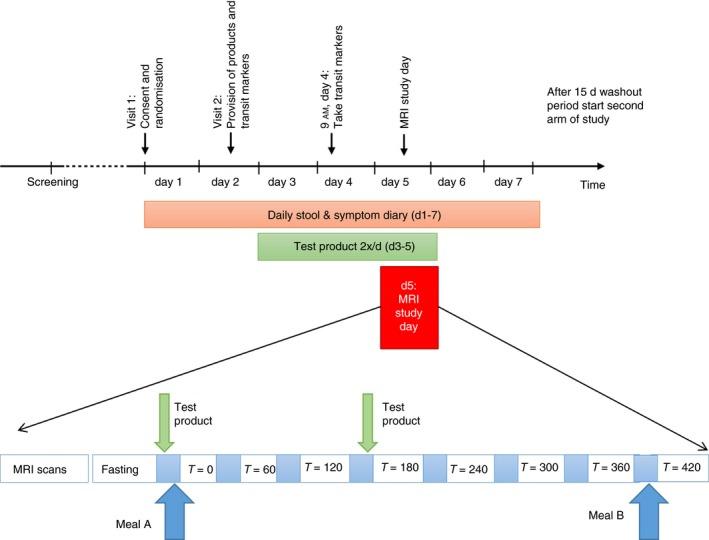
two kiwifruits twice daily vs isocaloric control (maltodextrin) twice daily, consumed for a total of 3 days. Subjects underwent MRI scanning fasted and at hourly intervals for 7 hours on the third day.
PRIMARY OUTCOME
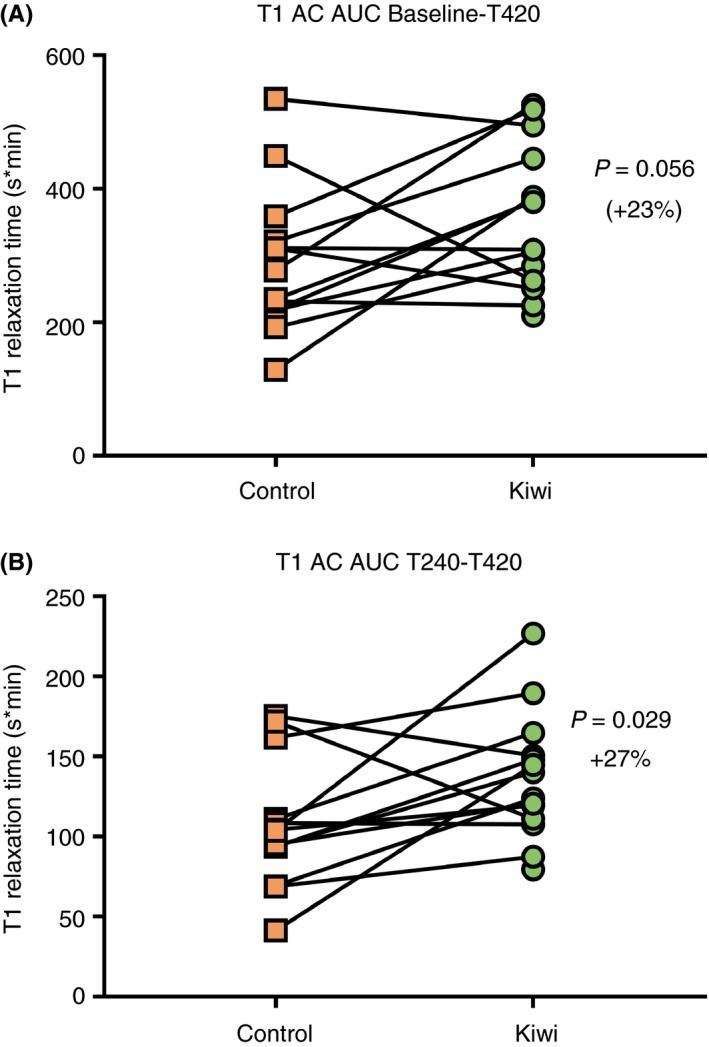
T1 relaxation time of ascending colon (T1AC) using MRI.
SECONDARY OUTCOMES
Small bowel water content (SBWC), colonic volume, gut transit time, T1 of descending colon, stool frequency and form.
RESULTS
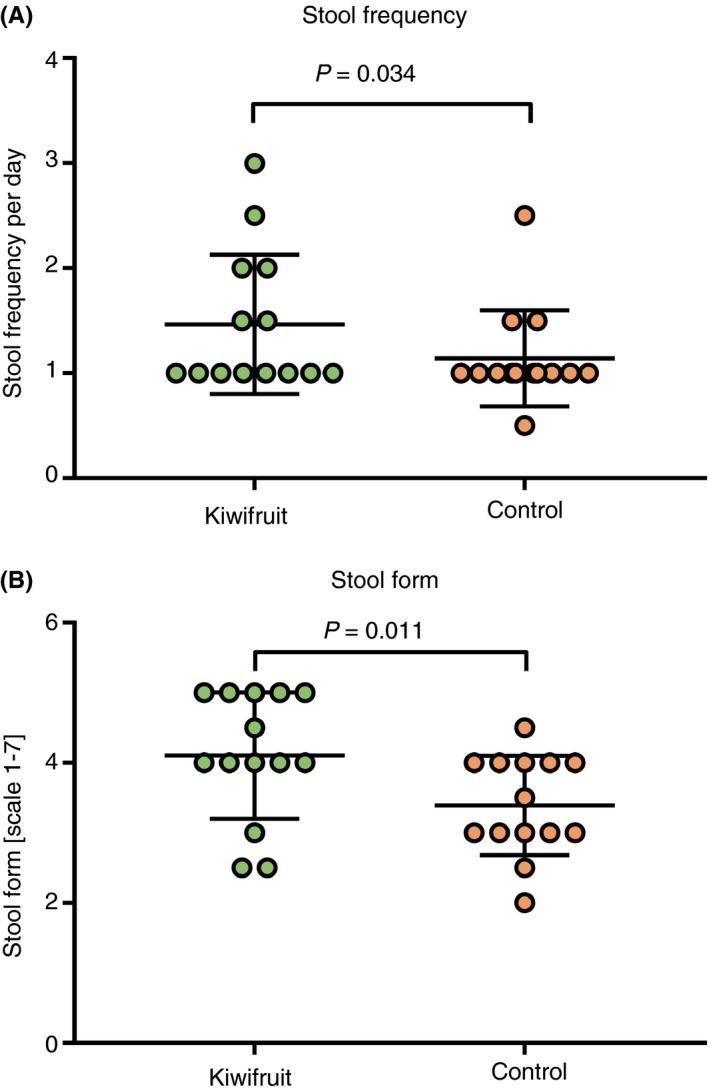
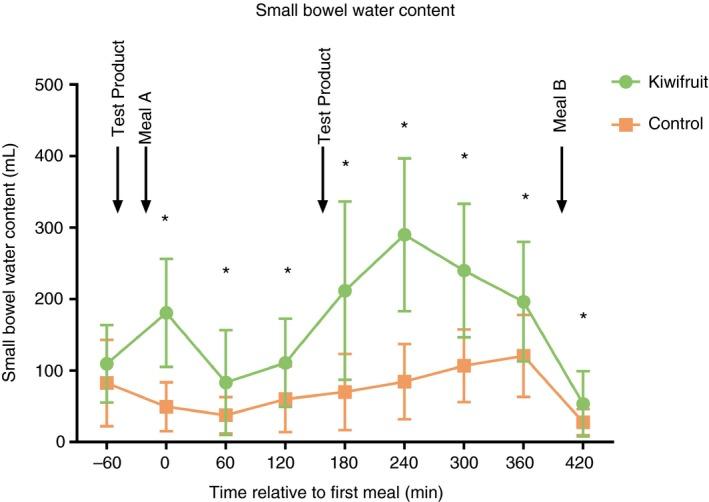
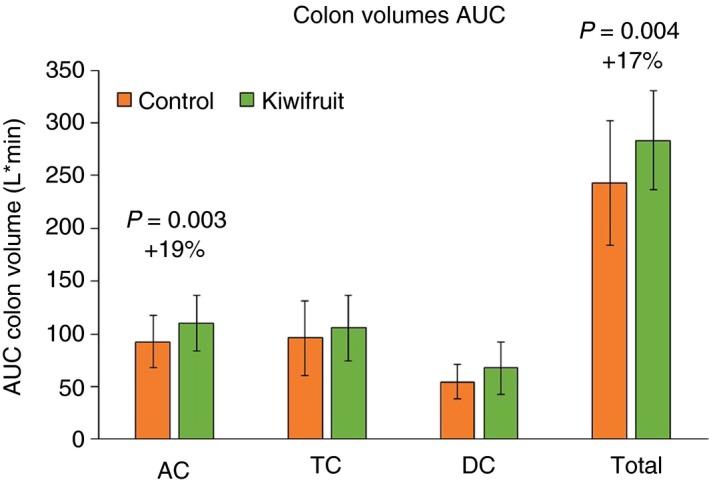
Fourteen volunteers completed the study. T1AC was higher after kiwifruit ingestion (P = 0.029) during the second half of the day (when meal residue would be expected to reach the AC, AUC T1 T240-420 minutes; mean (SD) 137 (39) sminute with kiwifruit versus 108 (40) sminute with control. SBWC (P < 0.001), colon volumes (P = 0.004), as well as stool frequency (1.46 ± 0.66 with kiwifruit vs 1.14 ± 0.46 stools per day with control; P = 0.034) and stool form score (Bristol Stool Chart score 4.1 (0.9) with kiwifruit versus 3.4 (0.7) with control; P = 0.011) were markedly increased in participants consuming kiwifruit compared to control.
CONCLUSION
Consumption of kiwifruit in healthy volunteers increases water retention in the small bowel and ascending colon and increases total colonic volume. The data may explain the observed increase in stool frequency and looser stool consistencies, suggesting that kiwifruit could be used as a dietary alternative to laxatives in mild constipation.
背景
慢性便秘影响全球约 17%的人群,且仍然是一种重要的未满足需求,因为患者通常对治疗不满意。奇异果可能为传统泻药提供替代方案,并已被证明可增加粪便量、频率并改善一致性。
目的
使用非侵入性 MRI 技术,我们评估了奇异果摄入对肠道内液体分布和肠道功能的影响。
方法
在健康成年人中进行奇异果与对照的双周期交叉试验。
干预措施
每天两次食用两个奇异果,每天两次食用等热量的对照物(麦芽糊精),共 3 天。在第三天,受试者空腹进行 MRI 扫描,并在 7 小时内每小时进行一次扫描。
主要结果
使用 MRI 测量升结肠的 T1 弛豫时间(T1AC)。
次要结果
小肠水含量(SBWC)、结肠体积、肠道转运时间、降结肠 T1、排便频率和形状。
结果
14 名志愿者完成了这项研究。在当天的后半段(当餐残余物预计会到达升结肠时),奇异果摄入后 T1AC 更高(P = 0.029),T1AC 时间为 240-420 分钟(AUC T1);奇异果组的 T1AC 为 137(39)s分钟,而对照组的 T1AC 为 108(40)s分钟。奇异果组的 SBWC(P < 0.001)、结肠体积(P = 0.004)以及排便频率(奇异果组 1.46 ± 0.66 次/天,对照组 1.14 ± 0.46 次/天;P = 0.034)和粪便形态评分(奇异果组布里斯托尔粪便图表评分 4.1(0.9),对照组 3.4(0.7);P = 0.011)均明显高于对照组。
结论
在健康志愿者中食用奇异果可增加小肠和升结肠的水分保留,并增加总结肠体积。这些数据可以解释观察到的排便频率增加和粪便一致性变稀,表明奇异果可作为轻度便秘的替代泻药。
 Zotero 插件