
长时程研究显示产志贺毒素大肠杆菌存在于芬兰的奶牛场及生牛乳中。
Longitudinal Study of Shiga Toxin-Producing and on Finnish Dairy Farms and in Raw Milk.
机构信息
Microbiology Research Unit, Finnish Food Safety Authority Evira, Helsinki, Finland
Department of Food Hygiene and Environmental Health, Faculty of Veterinary Medicine, University of Helsinki, Helsinki, Finland.
出版信息
Appl Environ Microbiol. 2019 Mar 22;85(7). doi: 10.1128/AEM.02910-18. Print 2019 Apr 1.
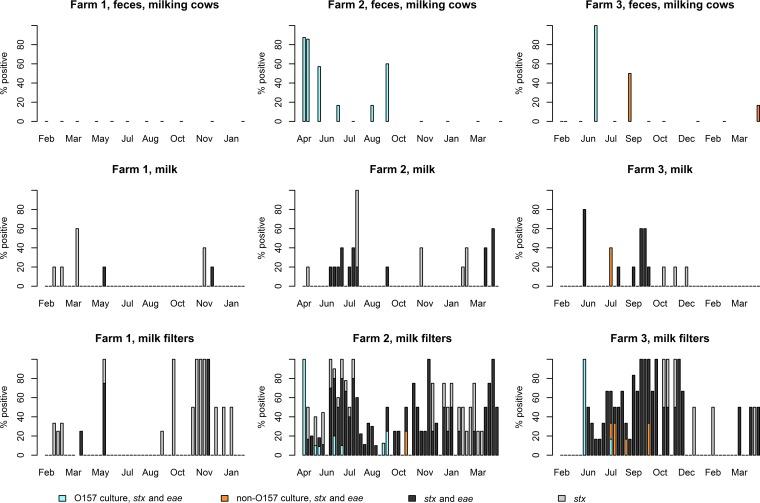
Shiga toxin-producing (STEC) and are notable health hazards associated with the consumption of raw milk. These bacteria may colonize the intestines of asymptomatic cattle and enter bulk tank milk via fecal contamination during milking. We studied the frequency of STEC O157:H7 and contamination in tank milk ( = 785) and the in-line milk filters of milking machines ( = 631) versus the frequency of isolation from cattle feces ( = 257) on three Finnish dairy farms for 1 year. Despite simultaneous isolation of STEC O157:H7 (17%) or (53%) from cattle, these bacteria were rarely isolated from milk filters (2% or <1%, respectively) and milk (0%). As revealed by phylogenomics, one STEC O157:H7 strain at a time was detected on each farm and persisted for ≤12 months despite rigorous hygienic measures. strains of a generalist sequence type (ST-883 and ST-1080) persisted in the herds for ≥11 months, and several other types were detected sporadically. The gene carried by STEC was detected more frequently from milk filters (37%) than from milk (7%), suggesting that milk filters are more suitable sampling targets for monitoring than milk. A questionnaire of on-farm practices suggested lower contamination of milk when major cleansing in the barn, culling, or pasturing of dairy cows was applied, while a higher average outdoor temperature was associated with higher contamination. Because pathogen contamination occurred despite good hygiene and because pathogen detection from milk and milk filters proved challenging, we recommend heat treatment for raw milk before consumption. The increased popularity of raw milk consumption has created demand for relaxing legislation, despite the risk of contamination by pathogenic bacteria, notably STEC and However, the epidemiology of these milk-borne pathogens on the herd level is still poorly understood, and data are lacking on the frequency of milk contamination on farms with cattle shedding these bacteria in their feces. This study suggests (i) that STEC contamination in milk can be reduced, but not prevented, by on-farm hygienic measures while fecal shedding is observable, (ii) that milk filters are more suitable sampling targets for monitoring than milk although pathogen detection from both sample matrices may be challenging, and (iii) that STEC and genotypes may persist in cattle herds for several months. The results can be utilized in developing and targeting pathogen monitoring and risk management on the farm level and contributed to the revision of Finnish legislation in 2017.
产志贺毒素(STEC)和 是与食用生奶相关的显著健康危害。这些细菌可能在牛的肠道中定植,并在挤奶过程中通过粪便污染进入散装奶罐。我们在芬兰的三个奶牛场进行了为期 1 年的研究,调查了 785 份奶罐奶和 631 份挤奶机在线奶滤器中 STEC O157:H7 和 污染的频率,以及 257 份奶牛粪便分离的频率。尽管同时从奶牛中分离出 STEC O157:H7(17%)或 (53%),但这些细菌很少从奶滤器(分别为 2%或<1%)和牛奶(0%)中分离出来。通过系统基因组学揭示,在每个农场都检测到一次 STEC O157:H7 菌株,尽管采取了严格的卫生措施,但该菌株仍持续存在≤12 个月。普遍性序列型(ST-883 和 ST-1080)的 菌株在畜群中持续存在≥11 个月,并且偶尔还检测到其他几种 类型。从奶滤器(37%)中检测到的 STEC 携带的 基因比从牛奶(7%)中更频繁,这表明奶滤器比牛奶更适合监测采样。农场实践问卷表明,当在畜棚中进行大规模清洁、淘汰或放牧奶牛时,牛奶中的 污染程度较低,而较高的平均室外温度与较高的 污染程度相关。尽管采取了良好的卫生措施,但由于病原体污染的发生,并且由于从牛奶和奶滤器中检测病原体具有挑战性,我们建议在食用前对生奶进行热处理。由于受污染的生奶可能导致食源性疾病,包括产志贺毒素(STEC)和 ,因此,尽管存在污染风险,但人们对生奶的消费需求不断增加,导致了立法的放宽。然而,这些奶源性病原体在畜群中的流行病学仍知之甚少,并且缺乏关于粪便中存在这些细菌的奶牛农场牛奶污染频率的数据。本研究表明:(i)通过在牛场实施卫生措施,可降低但不能完全消除牛奶中 STEC 的污染,而粪便中的 STEC 仍处于可检测状态;(ii)尽管从两种样本基质中检测病原体可能具有挑战性,但奶滤器比牛奶更适合作为监测的采样目标;(iii)STEC 和 基因型可能在牛群中持续存在数月。这些结果可用于在农场层面制定和靶向监测和风险管理,并有助于 2017 年芬兰法规的修订。

 Zotero 插件