
CD8+PD-1+免疫浸润和 PDCD1 基因表达在三阴性乳腺癌中的预后价值。
Prognostic value of CD8 + PD-1+ immune infiltrates and PDCD1 gene expression in triple negative breast cancer.
机构信息
Division of Pathology, Singapore General Hospital, 20 College Road, Academia, Level 7, Singapore, 169856, Singapore.
Singapore Immunology Network (SIgN), Agency of Science, Technology and Research (A*STAR), 8A, Biomedical Grove, Immunos, Singapore, 138648, Singapore.
出版信息
J Immunother Cancer. 2019 Feb 6;7(1):34. doi: 10.1186/s40425-019-0499-y.
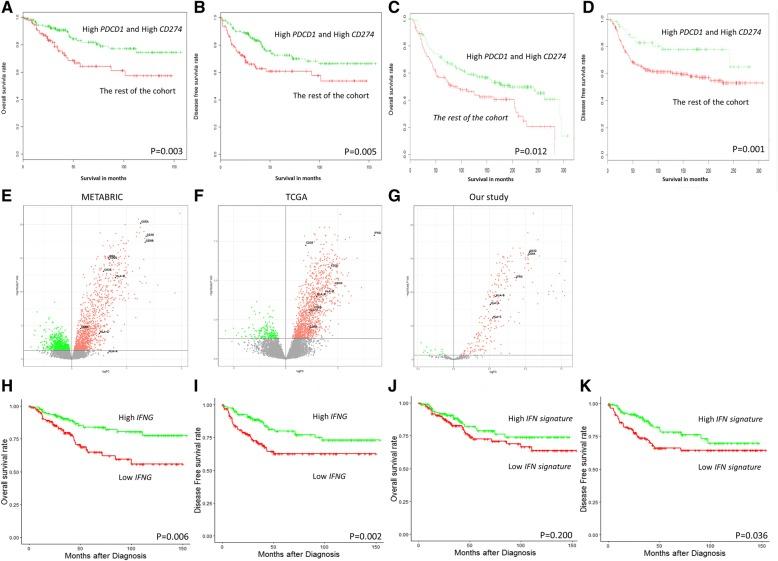
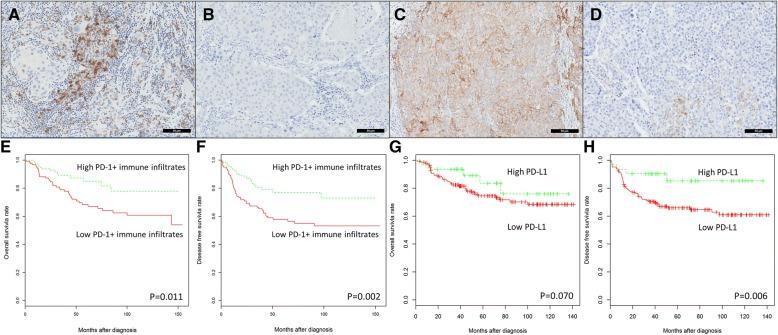
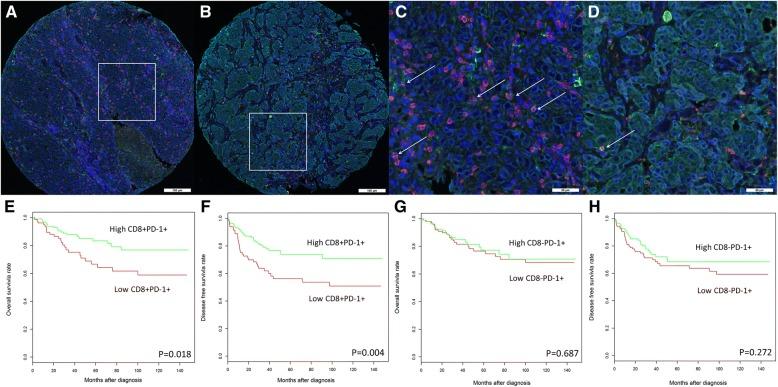
The role of programmed cell death protein-1 (PD-1)/programmed cell death ligand 1 (PD-L1) in triple negative breast cancer (TNBC) remains to be fully understood. In this study, we investigated the role of PD-1 as a prognostic marker for TNBC in an Asian cohort (n = 269). Samples from patients with TNBC were labeled with antibodies against PD-L1 and PD-1, and subjected to NanoString assays to measure the expression of immune-related genes. Associations between disease-free survival (DFS), overall survival (OS) and biomarker expression were investigated. Multivariate analysis showed that tumors with high PD-1 immune infiltrates harbored significantly increased DFS, and this increase was significant even after controlling for clinicopathological parameters (HR 0.95; P = 0.030). In addition, the density of cells expressing both CD8 and PD-1, but not the density of CD8PD-1 immune infiltrates, was associated with improved DFS. Notably, this prognostic significance was independent of clinicopathological parameters and the densities of total CD8 cell (HR 0.43, P = 0.011). At the transcriptional level, high expression of PDCD1 within the tumor was significantly associated with improved DFS (HR 0.38; P = 0.027). In line with these findings, high expression of IFNG (HR 0.38; P = 0.001) and IFN signaling genes (HR 0.46; p = 0.027) was also associated with favorable DFS. Inclusion of PD-1 immune infiltrates and PDCD1 gene expression added significant prognostic value for DFS (ΔLRχ = 6.35; P = 0.041) and OS (ΔLRχ = 9.53; P = 0.008), beyond that provided by classical clinicopathological variables. Thus, PD-1 mRNA and protein expression status represent a promising, independent indicator of prognosis in TNBC.
程序性细胞死亡蛋白 1(PD-1)/程序性细胞死亡配体 1(PD-L1)在三阴性乳腺癌(TNBC)中的作用仍有待充分了解。在这项研究中,我们在亚洲队列(n=269)中研究了 PD-1 作为 TNBC 预后标志物的作用。使用针对 PD-L1 和 PD-1 的抗体对 TNBC 患者的样本进行标记,并进行 NanoString 检测以测量免疫相关基因的表达。研究了无病生存(DFS)、总生存(OS)与生物标志物表达之间的关系。多变量分析显示,高 PD-1 免疫浸润的肿瘤具有显著改善的 DFS,即使在控制临床病理参数后,这种改善仍然显著(HR 0.95;P=0.030)。此外,表达 CD8 和 PD-1 的细胞密度与改善的 DFS 相关,而不是 CD8PD-1 免疫浸润的密度。值得注意的是,这种预后意义独立于临床病理参数和总 CD8 细胞密度(HR 0.43,P=0.011)。在转录水平上,肿瘤内 PDCD1 的高表达与改善的 DFS 显著相关(HR 0.38;P=0.027)。与这些发现一致,IFNG(HR 0.38;P=0.001)和 IFN 信号基因(HR 0.46;p=0.027)的高表达也与良好的 DFS 相关。纳入 PD-1 免疫浸润和 PDCD1 基因表达为 DFS(ΔLRχ=6.35;P=0.041)和 OS(ΔLRχ=9.53;P=0.008)提供了显著的预后价值,超出了经典临床病理变量提供的价值。因此,PD-1 mRNA 和蛋白表达状态代表了 TNBC 预后的一个很有前途的独立指标。
 Zotero 插件