
精神科危机干预小组的 CORE 服务改进项目:一项群组随机试验的结果。
The CORE service improvement programme for mental health crisis resolution teams: results from a cluster-randomised trial.
机构信息
Senior Lecturer, Division of Psychiatry, University College London, UK.
Professor of Psychiatric Epidemiology, Division of Psychiatry, University College London; and St Pancras Hospital, Camden and Islington NHS Foundation Trust, UK.
出版信息
Br J Psychiatry. 2020 Jun;216(6):314-322. doi: 10.1192/bjp.2019.21.
BACKGROUND
Crisis resolution teams (CRTs) offer brief, intensive home treatment for people experiencing mental health crisis. CRT implementation is highly variable; positive trial outcomes have not been reproduced in scaled-up CRT care.
AIMS
To evaluate a 1-year programme to improve CRTs' model fidelity in a non-masked, cluster-randomised trial (part of the Crisis team Optimisation and RElapse prevention (CORE) research programme, trial registration number: ISRCTN47185233).
METHOD
Fifteen CRTs in England received an intervention, informed by the US Implementing Evidence-Based Practice project, involving support from a CRT facilitator, online implementation resources and regular team fidelity reviews. Ten control CRTs received no additional support. The primary outcome was patient satisfaction, measured by the Client Satisfaction Questionnaire (CSQ-8), completed by 15 patients per team at CRT discharge (n = 375). Secondary outcomes: CRT model fidelity, continuity of care, staff well-being, in-patient admissions and bed use and CRT readmissions were also evaluated.
RESULTS
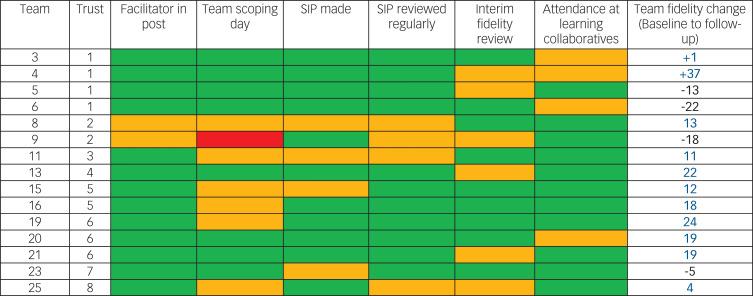
All CRTs were retained in the trial. Median follow-up CSQ-8 score was 28 in each group: the adjusted average in the intervention group was higher than in the control group by 0.97 (95% CI -1.02 to 2.97) but this was not significant (P = 0.34). There were fewer in-patient admissions, lower in-patient bed use and better staff psychological health in intervention teams. Model fidelity rose in most intervention teams and was significantly higher than in control teams at follow-up. There were no significant effects for other outcomes.
CONCLUSIONS
The CRT service improvement programme did not achieve its primary aim of improving patient satisfaction. It showed some promise in improving CRT model fidelity and reducing acute in-patient admissions.
背景
危机解决小组(CRT)为经历心理健康危机的人提供简短、密集的家庭治疗。CRT 的实施方式差异很大;在扩大 CRT 护理规模的情况下,并未再现积极的试验结果。
目的
在一项非盲、整群随机试验(Crisis team Optimisation and RElapse prevention (CORE) 研究计划的一部分,试验注册号:ISRCTN47185233)中评估一项为期 1 年的计划,以提高 CRT 的模型保真度。
方法
英格兰的 15 个 CRT 小组接受了一项干预措施,该措施借鉴了美国实施循证实践项目的经验,包括 CRT 促进者的支持、在线实施资源和定期团队保真度审查。10 个对照 CRT 小组未获得额外支持。主要结果是患者满意度,通过 15 名患者对每个 CRT 小组的满意度问卷(CSQ-8)来衡量(n = 375)。次要结果:还评估了 CRT 模型保真度、护理连续性、员工幸福感、住院入院和床位使用以及 CRT 再入院。
结果
所有 CRT 小组均保留在试验中。每组的中位数随访 CSQ-8 评分均为 28:干预组的平均调整值高于对照组 0.97(95%CI-1.02 至 2.97),但无统计学意义(P = 0.34)。干预组的住院人数较少,住院床位使用率较低,员工心理健康状况较好。大多数干预小组的模型保真度提高,并且在随访时明显高于对照组。其他结果没有显著影响。
结论
CRT 服务改进计划并未实现提高患者满意度的主要目标。它在提高 CRT 模型保真度和减少急性住院人数方面显示出一些希望。

 Zotero 插件