
氟脱氧葡萄糖正电子发射断层扫描/计算机断层扫描在犬附肢骨肉瘤中的预后价值
Prognostic value of fluorine flourodeoxyglucose positron emission tomography/computed tomography in dogs with appendicular osteosarcoma.
作者信息
Griffin Lynn R, Thamm Douglas H, Brody Ariel, Selmic Laura E
机构信息
Department of Environmental and Radiological Health Sciences, Colorado State University, Fort Collins, Colorado.
Department of Clinical Sciences and Flint Animal Cancer Center, Colorado State University, Fort Collins, Colorado.
出版信息
J Vet Intern Med. 2019 Mar;33(2):820-826. doi: 10.1111/jvim.15453. Epub 2019 Feb 15.
BACKGROUND
Factors indicative of a negative prognosis for appendicular osteosarcoma (OSA) in dogs are visible metastatic disease, location, and size of lesion. In human medicine maximum standard uptake value (SUV ), as measured on a fluorine flourodeoxyglucose positron emission tomography/computed tomography ( F-FDG PET/CT), is prognostic for survival for several tumor types.
OBJECTIVE
Determine if SUV is associated with progression-free interval (PFI) and determination of survival in dogs with appendicular OSA.
ANIMALS
Sixty-two dogs with untreated appendicular OSA that had been staged with F-FDG PET/CT.
METHODS
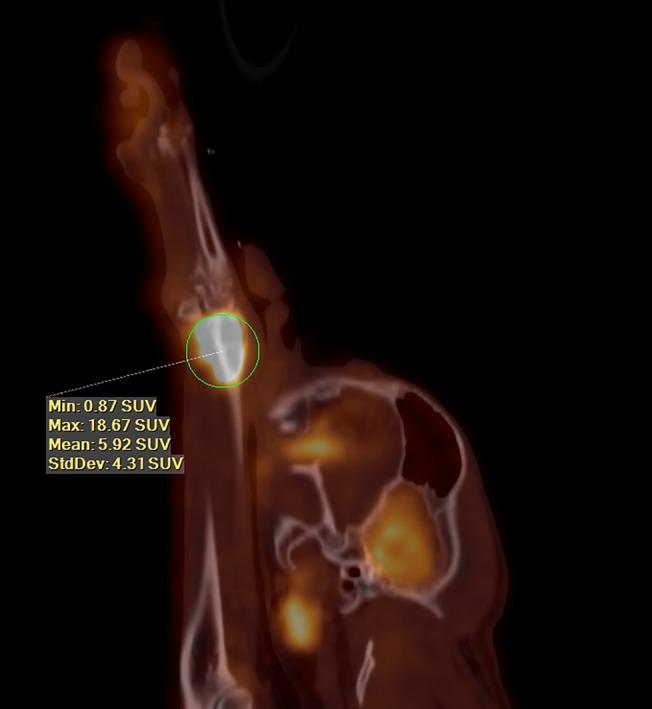
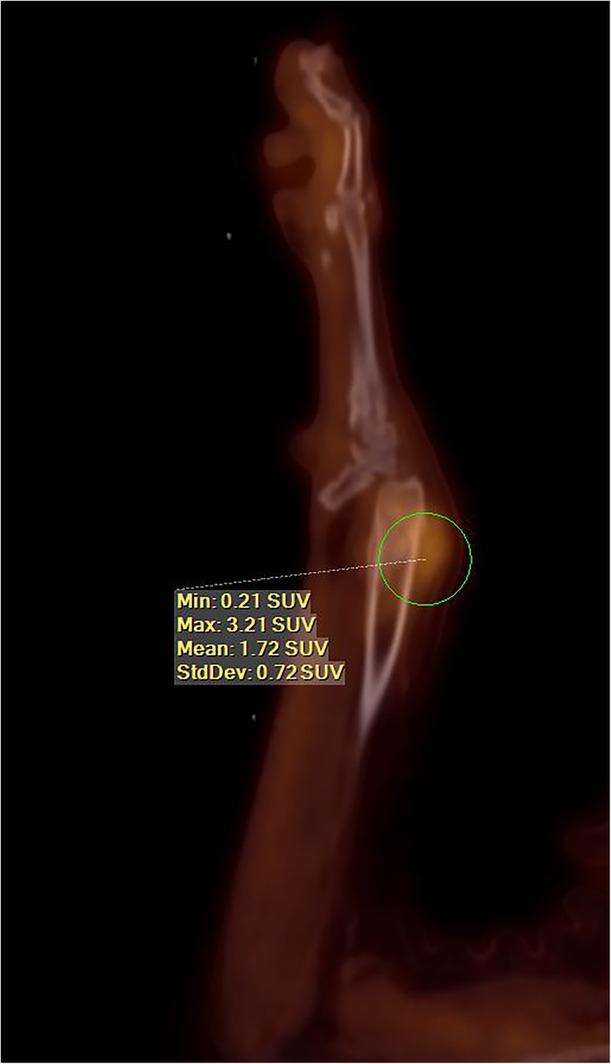
Retrospective analysis of the F-FDG PET/CT was performed. Dogs were excluded from the study if they did not receive definitive intent treatment for their primary OSA and adjuvant chemotherapy with carboplatin, or had visible metastatic disease on initial imaging. A region of interest (ROI) was created around the primary tumor to measure SUV . Univariable and multivariable Cox proportional hazards analysis was performed to evaluate for associations between variables including SUV and outcome of PFI and overall survival (OS).
RESULTS
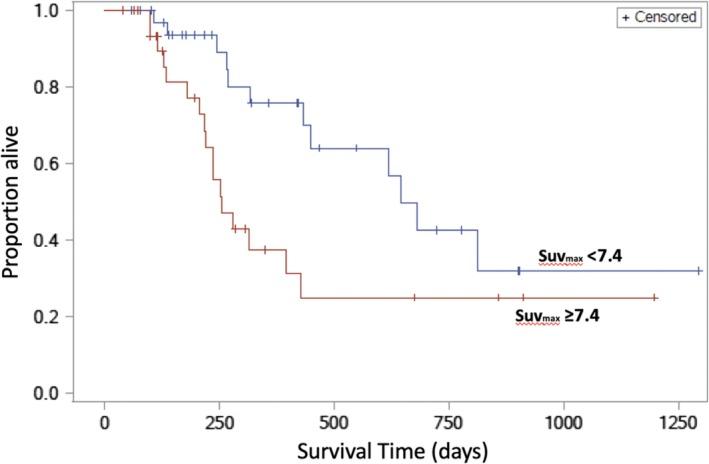
Maximum standard uptake value of the primary tumor was significantly associated with the OS (P = .04) with adjustment for treatment type and monocyte count. The overall median survival time (OST) was 284 days (range, 39-1293 days) with the OST of dogs having an SUV of ≥7.4 of 254 days (range, 98-428 days) and dogs with an SUV of <7.4 of 680 days (range, 108-811 days, P = .01).
CONCLUSIONS AND CLINICAL IMPORTANCE
Maximum standard uptake value as measured via F-FDG PET/CT is significantly associated with survival in dogs with appendicular OSA with a high SUV being an indicator of a negative prognosis.
背景
犬类阑尾骨肉瘤(OSA)预后不良的因素包括可见转移性疾病、病变位置和大小。在人类医学中,通过氟脱氧葡萄糖正电子发射断层扫描/计算机断层扫描(F-FDG PET/CT)测量的最大标准摄取值(SUV)对几种肿瘤类型的生存具有预后价值。
目的
确定SUV是否与犬类阑尾OSA的无进展生存期(PFI)和生存期相关。
动物
62只未经治疗的阑尾OSA犬,已通过F-FDG PET/CT进行分期。
方法
对F-FDG PET/CT进行回顾性分析。如果犬类未接受针对原发性OSA的确定性意向治疗和卡铂辅助化疗,或在初始影像学检查中有可见转移性疾病,则将其排除在研究之外。在原发性肿瘤周围创建感兴趣区域(ROI)以测量SUV。进行单变量和多变量Cox比例风险分析,以评估包括SUV在内的变量与PFI和总生存期(OS)结果之间的关联。
结果
在调整治疗类型和单核细胞计数后,原发性肿瘤的最大标准摄取值与OS显著相关(P = 0.04)。总中位生存期(OST)为284天(范围为39 - 1293天),SUV≥7.4的犬类OST为254天(范围为98 - 428天),SUV<7.4的犬类OST为680天(范围为108 - 811天,P = 0.01)。
结论及临床意义
通过F-FDG PET/CT测量的最大标准摄取值与犬类阑尾OSA的生存期显著相关,高SUV是预后不良的指标。
 Zotero 插件