
儿童时期的居住绿地与青少年期到成年期的精神障碍风险较低有关。
Residential green space in childhood is associated with lower risk of psychiatric disorders from adolescence into adulthood.
机构信息
Section for Ecoinformatics & Biodiversity, Department of Bioscience, Aarhus University, 8000 Aarhus C, Denmark;
Center for Biodiversity Dynamics in a Changing World, Department of Bioscience, Aarhus University, 8000 Aarhus C, Denmark.
出版信息
Proc Natl Acad Sci U S A. 2019 Mar 12;116(11):5188-5193. doi: 10.1073/pnas.1807504116. Epub 2019 Feb 25.
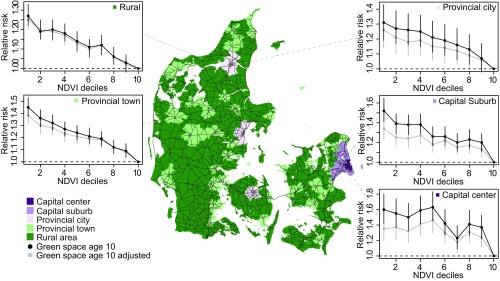
Urban residence is associated with a higher risk of some psychiatric disorders, but the underlying drivers remain unknown. There is increasing evidence that the level of exposure to natural environments impacts mental health, but few large-scale epidemiological studies have assessed the general existence and importance of such associations. Here, we investigate the prospective association between green space and mental health in the Danish population. Green space presence was assessed at the individual level using high-resolution satellite data to calculate the normalized difference vegetation index within a 210 × 210 m square around each person's place of residence (∼1 million people) from birth to the age of 10. We show that high levels of green space presence during childhood are associated with lower risk of a wide spectrum of psychiatric disorders later in life. Risk for subsequent mental illness for those who lived with the lowest level of green space during childhood was up to 55% higher across various disorders compared with those who lived with the highest level of green space. The association remained even after adjusting for urbanization, socioeconomic factors, parental history of mental illness, and parental age. Stronger association of cumulative green space presence during childhood compared with single-year green space presence suggests that presence throughout childhood is important. Our results show that green space during childhood is associated with better mental health, supporting efforts to better integrate natural environments into urban planning and childhood life.
城市居住与一些精神疾病的风险增加有关,但潜在的驱动因素仍不清楚。越来越多的证据表明,暴露于自然环境的程度会影响心理健康,但很少有大规模的流行病学研究评估这种关联的普遍存在和重要性。在这里,我们调查了丹麦人口中绿色空间与心理健康之间的前瞻性关联。使用高分辨率卫星数据在个体水平上评估绿色空间的存在情况,以计算每个人居住地周围 210×210 平方米范围内的归一化差异植被指数(约 100 万人),从出生到 10 岁。我们表明,儿童时期绿色空间存在水平较高与一生中更广泛的精神疾病风险较低有关。与那些居住在绿色空间最高水平的人相比,那些在儿童时期居住在绿色空间最低水平的人,随后患有各种精神疾病的风险要高出 55%。即使在调整城市化、社会经济因素、父母精神病史和父母年龄后,这种关联仍然存在。与单一年度绿色空间存在相比,儿童时期累积绿色空间存在的关联更强,这表明儿童时期的存在很重要。我们的研究结果表明,儿童时期的绿色空间与更好的心理健康有关,这支持了将自然环境更好地融入城市规划和儿童生活的努力。

 Zotero 插件