
夜间角膜塑形术对青少年近视患者眼表及睑板腺功能障碍的影响
The Influence of Overnight Orthokeratology on Ocular Surface and Meibomian Gland Dysfunction in Teenagers with Myopia.
作者信息
Wang Xiu, Li Jing, Zhang Rui, Li Na, Pang Yi, Zhang Yan, Wei Ruihua
机构信息
Tianjin Medical University Eye Hospital, Tianjin Medical University Eye Institute, College of Optometry and Ophthalmology, Tianjin Medical University, Fukang Rd. 251, Nankai District, Tianjin 300384, China.
Associate Dean for Research, Illinois College of Optometry, 3241 S, Michigan Ave, Chicago, IL 60616, USA.
出版信息
J Ophthalmol. 2019 Jan 21;2019:5142628. doi: 10.1155/2019/5142628. eCollection 2019.
PURPOSE
The aim of this study was to investigate the effect of overnight orthokeratology (OOK) on ocular surface and meibomian gland dysfunction in teenagers with myopia.
METHODS
A total of 59 subjects were recruited in this prospective study. The following tests were performed before and after 1, 3, 6, 12, and 24 months of OOK lens wear, including ocular surface disease index (OSDI) questionnaire, slit-lamp examination, and Keratograph 5M.
RESULTS
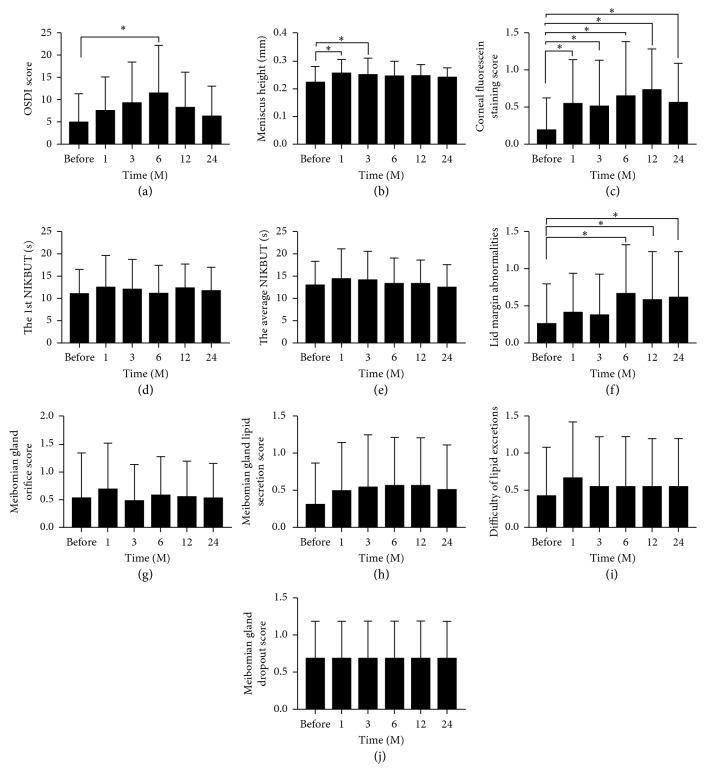
No infectious keratitis occurred during the study. OSDI scores increased gradually and reached the maximum at 6 months of OOK wear ( < 0.001). The meniscus height was significantly increased at 1 and 3 months after the initiation of OOK (=0.006, =0.035). The corneal fluorescein staining at 1, 3, 6, 12, and 24 months after wearing OOK were all increased than the prewearing level with significant difference (=0.014, =0.036, < 0.001, < 0.001, and =0.008, respectively). The first and the average tear film NIKBUT were all higher than the prewearing level, but there was no significant difference between every follow-up time points ( > 0.05). The lid margin abnormalities were significantly increased (=0.003, =0.038, and =0.015) at 6, 12, and 24 months after the initiation of OOK. There was no significant difference in the meibomian gland orifice scores at each follow-up time points compared to the prewearing level ( > 0.05). The meibomian gland lipid secretion scores after wearing OOK were higher than those of the prewearing level, however, without statistically significant difference ( > 0.05). No significant differences of the degree of difficulty of lipid excretions were detected after the initiation of OOK ( > 0.05). There was no significant difference in meibomian gland dropout scores between all follow-up time points and the prewearing level (=1.000).
CONCLUSION
OOK increased the symptoms of dry eye and decreased the function of tear film by affecting the meniscus height and BUT. OOK did not affect the function of meibomian glands.Clinical Study registration number: ChiCTR18000185708.
目的
本研究旨在探讨夜间角膜塑形术(OOK)对青少年近视患者眼表及睑板腺功能障碍的影响。
方法
本前瞻性研究共纳入59名受试者。在佩戴OOK镜片1、3、6、12和24个月前后进行以下检查,包括眼表疾病指数(OSDI)问卷、裂隙灯检查和角膜地形图仪5M检查。
结果
研究期间未发生感染性角膜炎。OSDI评分逐渐升高,在佩戴OOK 6个月时达到最高(<0.001)。佩戴OOK 1个月和3个月时,泪河高度显著增加(=0.006,=0.035)。佩戴OOK后1、3、6、12和24个月时角膜荧光素染色均高于佩戴前水平,差异有统计学意义(分别为=0.014,=0.036,<0.001,<0.001,=0.008)。首次及平均泪膜非侵入性泪膜破裂时间(NIKBUT)均高于佩戴前水平,但各随访时间点之间差异无统计学意义(>0.05)。佩戴OOK 6、12和24个月时睑缘异常显著增加(=0.003,=0.038,=0.015)。与佩戴前水平相比,各随访时间点睑板腺开口评分差异无统计学意义(>0.05)。佩戴OOK后睑板腺脂质分泌评分高于佩戴前水平,但差异无统计学意义(>0.05)。佩戴OOK后脂质排出难度程度差异无统计学意义(>0.05)。所有随访时间点睑板腺缺失评分与佩戴前水平相比差异无统计学意义(=1.000)。
结论
OOK通过影响泪河高度和泪膜破裂时间增加干眼症状并降低泪膜功能。OOK不影响睑板腺功能。临床研究注册号:ChiCTR18000185708。
 Zotero 插件