
分泌微线蛋白在慢性感染弓形虫的小鼠中诱导 T 细胞回忆反应。
Secretory Microneme Proteins Induce T-Cell Recall Responses in Mice Chronically Infected with Toxoplasma gondii.
机构信息
Department of Molecular Microbiology, Washington University School of Medicine, St. Louis, Missouri, USA.
Department of Molecular Microbiology, Washington University School of Medicine, St. Louis, Missouri, USA
出版信息
mSphere. 2019 Feb 27;4(1):e00711-18. doi: 10.1128/mSphere.00711-18.
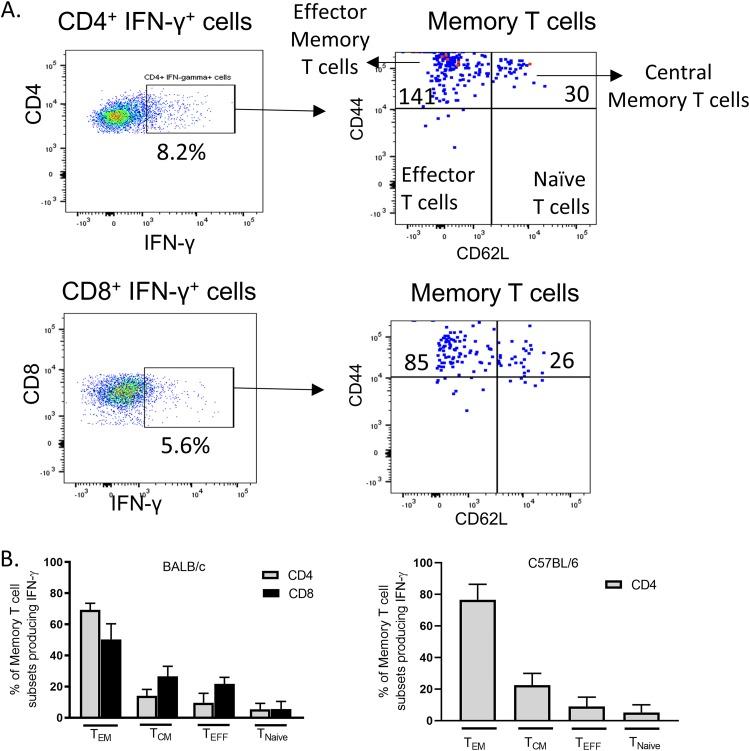
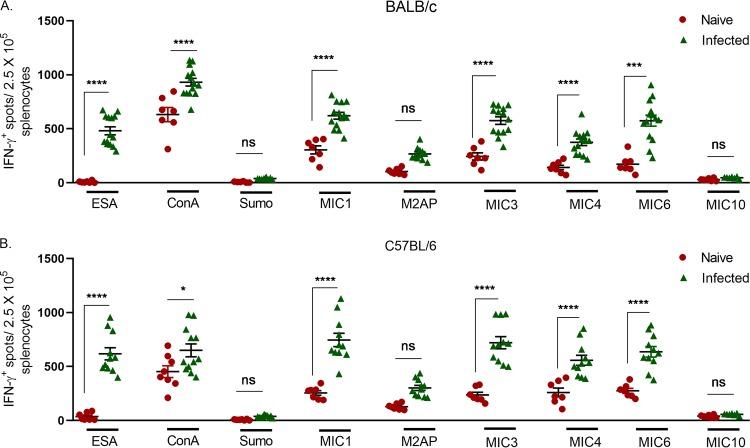
Microneme (MIC) proteins play important roles in the recognition, adhesion, and invasion of host cells by Previous studies have shown that MIC proteins are highly immunogenic in the mouse and recognized by human serum antibodies. Here we report that antigens MIC1, MIC3, MIC4, and MIC6 were capable of inducing memory responses leading to production of gamma interferon (IFN-γ) by T cells from -infected mice. Production of IFN-γ was demonstrated using enzyme-linked immunosorbent spot (ELISPOT) assay and also intracellular cytokine staining. All four MIC antigens displayed very high sensitivity (100%) and specificity (86 to 100%) for detecting chronic infection. Interestingly, IFN-γ was produced by both CD4 and CD8 T cells in BALB/c mice but primarily by CD4 T cells in C57BL/6 mice. Phenotypic characterization of IFN-γ-producing CD4 and CD8 T cells in BALB/c mice and CD4 T cells in C57BL/6 mice revealed effector memory T cells (CD44 CD62L) as the predominant cells that contributed to IFN-γ production in response to MIC antigens. Effector memory responses were seen in mice of different major histocompatibility complex class II (MHC-II) haplotypes, suggesting that MIC antigens contain epitopes that are broadly recognized. Current diagnosis of toxoplasmosis relies almost exclusively on antibody detection, and while detection of IgG provides a useful estimate of prior infection, it does not alone indicate immune status. In contrast, detection of IFN-γ responses to antigens has been used to monitor immune responsiveness in HIV-infected patients, thus providing valuable predictions about the potential for disease reactivation. However, specific antigens that can be used in assays to detect cellular immunity remain largely undefined. In this study, we examined the diagnostic potential of microneme antigens of using IFN-γ detection assays. Our findings demonstrate that MIC antigens (MIC1, MIC3, MIC4, and MIC6) elicit IFN-γ responses from memory T cells in chronically infected mice. Monitoring IFN-γ production by T cells stimulated with MIC antigens provided high sensitivity and specificity for detection of infection in mice. Taken together, these studies suggest that microneme antigens might be useful as an adjunct to serological testing to monitor immune status during infection.
微线(MIC)蛋白在宿主细胞的识别、黏附和入侵中发挥重要作用。先前的研究表明,MIC 蛋白在小鼠中具有高度免疫原性,并被人血清抗体识别。在这里,我们报告说,MIC1、MIC3、MIC4 和 MIC6 抗原能够诱导记忆反应,导致感染小鼠的 T 细胞产生γ干扰素(IFN-γ)。使用酶联免疫斑点(ELISPOT)测定和细胞内细胞因子染色证实了 IFN-γ的产生。所有四种 MIC 抗原对检测慢性感染均具有非常高的敏感性(100%)和特异性(86%至 100%)。有趣的是,IFN-γ是由 BALB/c 小鼠中的 CD4 和 CD8 T 细胞产生的,但主要是由 C57BL/6 小鼠中的 CD4 T 细胞产生的。在 BALB/c 小鼠中 IFN-γ产生的 CD4 和 CD8 T 细胞和 C57BL/6 小鼠中的 CD4 T 细胞的表型特征表明,效应记忆 T 细胞(CD44 CD62L)是对 MIC 抗原产生 IFN-γ反应的主要细胞。在不同主要组织相容性复合物 II(MHC-II)单倍型的小鼠中均可见效应记忆反应,表明 MIC 抗原包含广泛识别的表位。目前,弓形虫病的诊断几乎完全依赖于抗体检测,虽然 IgG 的检测提供了对既往感染的有用估计,但它并不能单独表明免疫状态。相比之下,检测针对 抗原的 IFN-γ反应已被用于监测 HIV 感染患者的免疫反应性,从而提供了有关疾病再激活潜力的有价值预测。然而,用于检测细胞免疫的特定 抗原在很大程度上仍未定义。在这项研究中,我们使用 IFN-γ 检测分析研究了 微线抗原的诊断潜力。我们的研究结果表明,MIC 抗原(MIC1、MIC3、MIC4 和 MIC6)从慢性感染的小鼠中的记忆 T 细胞中诱导 IFN-γ 反应。用 MIC 抗原刺激 T 细胞产生的 IFN-γ的检测提供了对小鼠感染的高敏感性和特异性。综上所述,这些研究表明,微线抗原可能是血清学检测的辅助手段,用于监测感染期间的免疫状态。



 Zotero 插件