
CD72是B细胞对核狼疮自身抗原反应及系统性红斑狼疮发生发展的负调节因子。
CD72 is a Negative Regulator of B Cell Responses to Nuclear Lupus Self-antigens and Development of Systemic Lupus Erythematosus.
作者信息
Tsubata Takeshi
机构信息
Department of Immunology, Medical Research Institute, Tokyo Medical and Dental University, Tokyo 113-8510, Japan.
出版信息
Immune Netw. 2019 Feb 13;19(1):e1. doi: 10.4110/in.2019.19.e1. eCollection 2019 Feb.
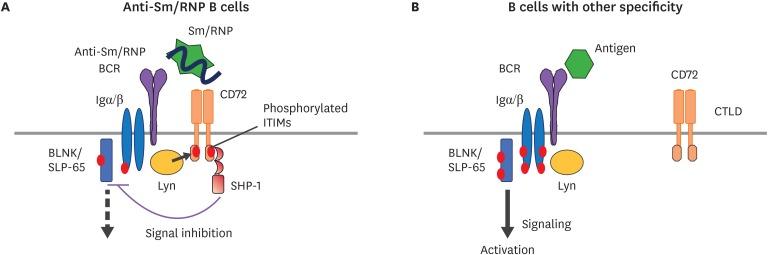
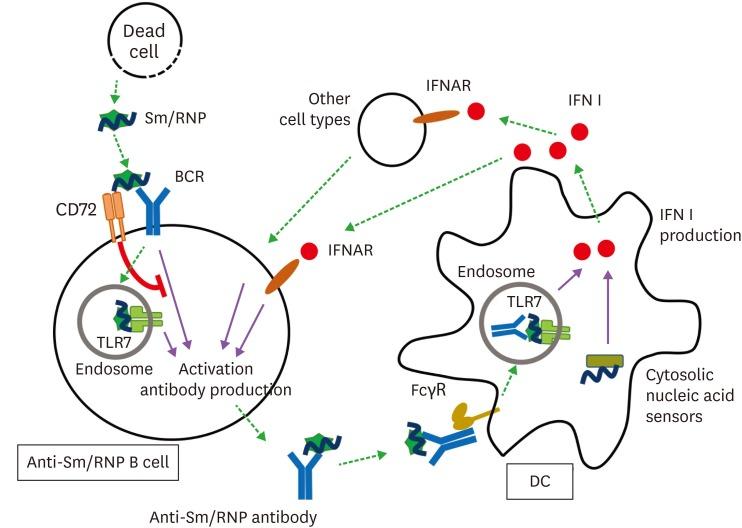
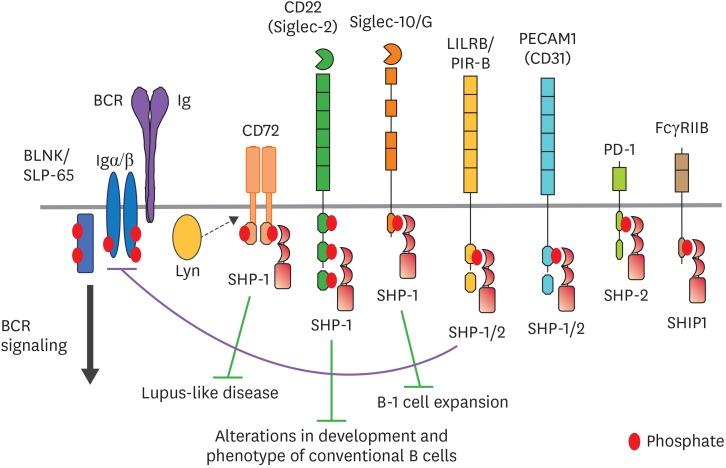
Systemic lupus erythematosus (SLE) is the prototypic systemic autoimmune disease characterized by production of autoantibodies to various nuclear antigens and overexpression of genes regulated by IFN-I called IFN signature. Genetic studies on SLE patients and mutational analyses of mouse models demonstrate crucial roles of nucleic acid (NA) sensors in development of SLE. Although NA sensors are involved in induction of anti-microbial immune responses by recognizing microbial NAs, recognition of self NAs by NA sensors induces production of autoantibodies to NAs in B cells and production of IFN-I in plasmacytoid dendritic cells. Among various NA sensors, the endosomal RNA sensor TLR7 plays an essential role in development of SLE at least in mouse models. CD72 is an inhibitory B cell co-receptor containing an immunoreceptor tyrosine-based inhibition motif (ITIM) in the cytoplasmic region and a C-type lectin like-domain (CTLD) in the extracellular region. CD72 is known to regulate development of SLE because CD72 polymorphisms associate with SLE in both human and mice and CD72 mice develop relatively severe lupus-like disease. CD72 specifically recognizes the RNA-containing endogenous TLR7 ligand Sm/RNP by its extracellular CTLD, and inhibits B cell responses to Sm/RNP by ITIM-mediated signal inhibition. These findings indicate that CD72 inhibits development of SLE by suppressing TLR7-dependent B cell response to self NAs. CD72 is thus involved in discrimination of self-NAs from microbial NAs by specifically suppressing autoimmune responses to self-NAs.
系统性红斑狼疮(SLE)是典型的系统性自身免疫性疾病,其特征是产生针对各种核抗原的自身抗体以及由I型干扰素(IFN-I)调控的基因过表达,即IFN特征。对SLE患者的遗传学研究以及小鼠模型的突变分析表明,核酸(NA)传感器在SLE的发病过程中起关键作用。尽管NA传感器通过识别微生物NA参与诱导抗微生物免疫反应,但NA传感器对自身NA的识别会诱导B细胞产生针对NA的自身抗体,并在浆细胞样树突状细胞中产生IFN-I。在各种NA传感器中,内体RNA传感器TLR7至少在小鼠模型中对SLE的发病起着至关重要的作用。CD72是一种抑制性B细胞共受体,其胞质区含有基于免疫受体酪氨酸的抑制基序(ITIM),胞外区含有C型凝集素样结构域(CTLD)。已知CD72可调节SLE的发病,因为CD72多态性在人和小鼠中均与SLE相关,且CD72基因敲除小鼠会发展为相对严重的狼疮样疾病。CD72通过其胞外CTLD特异性识别含RNA的内源性TLR7配体Sm/RNP,并通过ITIM介导的信号抑制来抑制B细胞对Sm/RNP的反应。这些发现表明,CD72通过抑制TLR7依赖的B细胞对自身NA的反应来抑制SLE的发病。因此,CD72通过特异性抑制对自身NA的自身免疫反应,参与了自身NA与微生物NA的区分。

 Zotero 插件