
二肽基肽酶-4 抑制剂与磺脲类药物联合二甲双胍比较:倾向评分匹配队列研究中的心血管和肾脏结局。
Dipeptidyl peptidase-4 inhibitor compared with sulfonylurea in combination with metformin: cardiovascular and renal outcomes in a propensity-matched cohort study.
机构信息
Division of Endocrinology and Metabolism, Department of Internal Medicine, Korea University Anam Hospital, Korea University College of Medicine, 73, Inchon-ro, Seongbuk-gu, Seoul, 02841, Republic of Korea.
Department of Biostatistics, Korea University College of Medicine, 73, Inchon-ro, Seongbuk-gu, Seoul, 02841, Republic of Korea.
出版信息
Cardiovasc Diabetol. 2019 Mar 11;18(1):28. doi: 10.1186/s12933-019-0835-z.
BACKGROUND
To determine the impact of dipeptidyl peptidase-4 inhibitor (DPP4i) on the risk of major cardiocerebrovascular and renal outcomes compared with sulfonylurea (SU) combined with metformin in patients with type 2 diabetes from a population-based cohort.
METHODS
From a nationwide cohort in Korea (2008-2013), 23,674 patients with type 2 diabetes treated with DPP4i plus metformin or SU plus metformin were selected and matched by propensity score. Composite cardiocerebrovascular events including incident ischemic heart disease (IHD), ischemic stroke (IS), hospitalization for heart failure (HHF), and cardiocerebrovascular death, as well as renal events including incident end-stage renal disease or initiation of renal-replacement therapy were assessed by Cox proportional-hazards models.
RESULTS
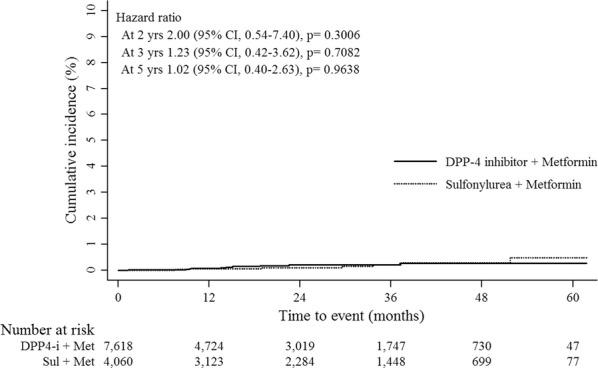
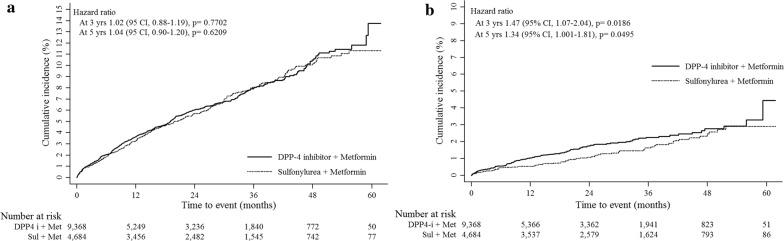
During a median follow-up of 19.6 months (interquartile range 7.2-36.4), 762 composite cardiocerebrovascular events and 17 end-stage renal events occurred. There was no significant difference in the risk of IHD (hazard ratio [HR], 1.00; 95% CI 0.81-1.23), IS (HR, 0.95; 95% CI 0.74-1.23), or cardiocerebrovascular death (HR, 0.74; 95% CI 0.46-1.18) in the DPP4i group compared to that in the SU group. Likewise, DPP4i therapy was not associated with the risk of end-stage renal outcomes (HR, 1.23; 95% CI 0.41-3.62). However, the risk of HHF was significantly higher in the DPP4i group than in the SU group (HR, 1.47; 95% CI 1.07-2.04).
CONCLUSIONS
This real-world database analysis showed that DPP4i therapy did not increase the overall risk of major cardiovascular and renal outcomes compared to SU therapy. However, the DPP4i-associated risk of HHF remained significant.
背景
本研究旨在通过观察基于人群的队列研究中,与磺酰脲类药物(SU)联合二甲双胍相比,二肽基肽酶-4 抑制剂(DPP4i)对 2 型糖尿病患者主要心脑血管和肾脏结局的影响。
方法
本研究从韩国的全国队列(2008-2013 年)中,选取了 23674 名接受 DPP4i 加二甲双胍或 SU 加二甲双胍治疗的 2 型糖尿病患者,并通过倾向评分进行匹配。通过 Cox 比例风险模型评估复合心脑血管事件(包括新发缺血性心脏病[IHD]、缺血性卒中[IS]、心力衰竭住院[HHF]和心脑血管死亡)以及肾脏事件(包括终末期肾病或开始肾脏替代治疗)的发生情况。
结果
中位随访 19.6 个月(四分位间距 7.2-36.4)期间,发生 762 例复合心脑血管事件和 17 例终末期肾病事件。与 SU 组相比,DPP4i 组发生 IHD(风险比 [HR],1.00;95%CI 0.81-1.23)、IS(HR,0.95;95%CI 0.74-1.23)或心脑血管死亡(HR,0.74;95%CI 0.46-1.18)的风险无显著差异。同样,DPP4i 治疗与终末期肾脏结局的风险无关(HR,1.23;95%CI 0.41-3.62)。然而,DPP4i 组的 HHF 风险明显高于 SU 组(HR,1.47;95%CI 1.07-2.04)。
结论
本真实世界数据库分析表明,与 SU 治疗相比,DPP4i 治疗并未增加主要心血管和肾脏结局的总体风险。然而,DPP4i 相关的 HHF 风险仍然显著。
 Zotero 插件