
晚期或放射性碘难治性分化型甲状腺癌患者使用酪氨酸激酶抑制剂的治疗相关不良反应:一项系统评价和荟萃分析
Treatment-related adverse effects with TKIs in patients with advanced or radioiodine refractory differentiated thyroid carcinoma: a systematic review and meta-analysis.
作者信息
Yu Shi-Tong, Ge Jun-Na, Luo Jing-Yi, Wei Zhi-Gang, Sun Bai-Hui, Lei Shang-Tong
机构信息
Department of General Surgery, Nanfang Hospital, Southern Medical University, Guangzhou, Guangdong, China,
State Key Laboratory of Ophthalmology, Zhongshan Ophthalmic Center, Sun Yat-sen University, Guangzhou, Guangdong, China.
出版信息
Cancer Manag Res. 2019 Feb 14;11:1525-1532. doi: 10.2147/CMAR.S191499. eCollection 2019.
BACKGROUND
Tyrosine kinase inhibitors (TKIs) have been administered to advanced or radio-iodine refractory differentiated thyroid carcinoma (RR-DTC) patients for years. We performed a pooled analysis to explore the frequency of severe adverse effects in advanced or RR-DTC patients treated with sorafenib and lenvatinib.
METHODS
We performed a comprehensive search of computerized databases, including PubMed, Web of Science, Ovid, EMASE, and the Cochrane Library, from the drugs' inception to July 2018 to identify clinical trials. All grade and severe adverse events (AEs; grade ≥3) were analyzed. This meta-analysis was conducted in accordance with PRISMA guidelines.
RESULTS
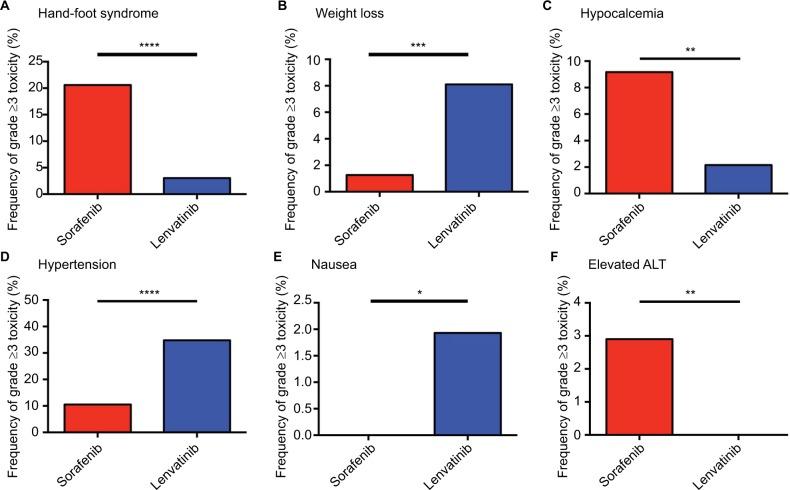
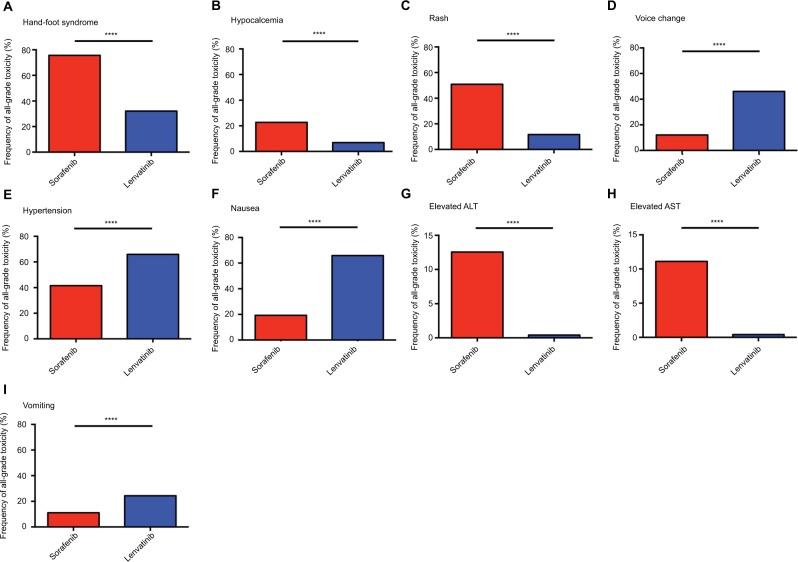
In total, seve studies published from 2012-2018 with 657 patients were eligible for this study. We included two studies (238 patients) that received 200 mg sorafenib twice and five studies (419 patients) that received 24 mg lenvatinib daily. The frequency of AEs was different among the two drugs. Patients in the sorafenib group had a significantly higher frequency of all grade hand-foot syndrome, hypocalcemia, rash, elevated alanine aminotransferase (ALT), and elevated aspartate aminotransferase (AST). Conversely, the lenvatinib group experienced more frequent all grade voice change, hypertension, nausea, and vomiting compared with those with sorafenib. For grade ≥3 adverse effects, hand-foot syndrome, hypocalcemia, and elevated ALT were more frequent in sorafenib-treated patients. Moreover, lenvatinib-treated patients had a significantly higher incidence of severe weight loss, hypertension, and nausea.
CONCLUSION
Significant differences in common adverse effects, such as all-grade and severe AEs, were detected between sorafenib and lenvatinib in the current study. Early intervention and management of treatment-related AEs (TRAEs) can minimize the impact on patients' quality-of-life, and avoid unnecessary dose reductions and treatment-related discontinuations.
背景
酪氨酸激酶抑制剂(TKIs)已应用于晚期或放射性碘难治性分化型甲状腺癌(RR-DTC)患者多年。我们进行了一项汇总分析,以探究接受索拉非尼和乐伐替尼治疗的晚期或RR-DTC患者中严重不良反应的发生频率。
方法
我们对计算机化数据库进行了全面检索,包括PubMed、Web of Science、Ovid、EMASE和Cochrane图书馆,检索时间从药物获批至2018年7月,以识别相关临床试验。分析了所有级别和严重不良事件(AEs;≥3级)。本荟萃分析按照PRISMA指南进行。
结果
总共,2012年至2018年发表的七项研究、共657例患者符合本研究条件。我们纳入了两项研究(238例患者),这些患者接受200 mg索拉非尼每日两次治疗,以及五项研究(419例患者),这些患者接受24 mg乐伐替尼每日治疗。两种药物的不良事件发生频率不同。索拉非尼组患者所有级别手足综合征、低钙血症、皮疹、丙氨酸氨基转移酶(ALT)升高和天冬氨酸氨基转移酶(AST)升高的发生频率显著更高。相反,与索拉非尼组相比,乐伐替尼组患者所有级别声音改变、高血压、恶心和呕吐更为常见。对于≥3级不良反应,索拉非尼治疗的患者中手足综合征、低钙血症和ALT升高更为常见。此外,乐伐替尼治疗的患者严重体重减轻、高血压和恶心的发生率显著更高。
结论
在本研究中,索拉非尼和乐伐替尼之间在常见不良反应(如所有级别和严重不良事件)方面存在显著差异。对治疗相关不良事件(TRAEs)进行早期干预和管理可将对患者生活质量的影响降至最低,并避免不必要的剂量减少和治疗相关的停药。

 Zotero 插件