
四跨膜蛋白修饰的细胞外囊泡模拟物作为一种新型的适应性参考材料。
Tetraspanin-decorated extracellular vesicle-mimetics as a novel adaptable reference material.
作者信息
Lozano-Andrés Estefanía, Libregts Sten F, Toribio Victor, Royo Félix, Morales Sara, López-Martín Soraya, Valés-Gómez Mar, Reyburn Hugh T, Falcón-Pérez Juan Manuel, Wauben Marca H, Soto Manuel, Yáñez-Mó María
机构信息
Centro de Biología Molecular Severo Ochoa (CSIC-UAM) Departamento de Biología Molecular, Universidad Autónoma de Madrid (UAM), Madrid, Spain.
Department of Biochemistry and Cell Biology Faculty of Veterinary Medicine, Utrecht University, Utrecht, The Netherlands.
出版信息
J Extracell Vesicles. 2019 Mar 4;8(1):1573052. doi: 10.1080/20013078.2019.1573052. eCollection 2019.
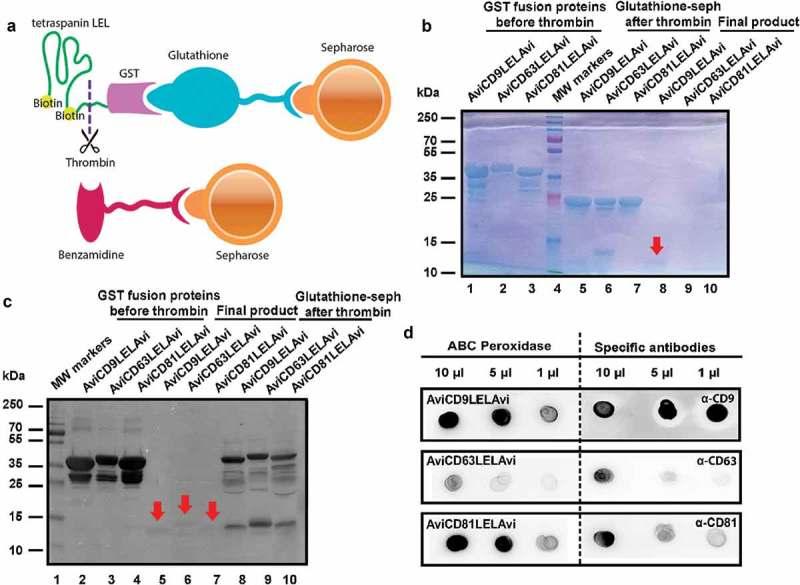
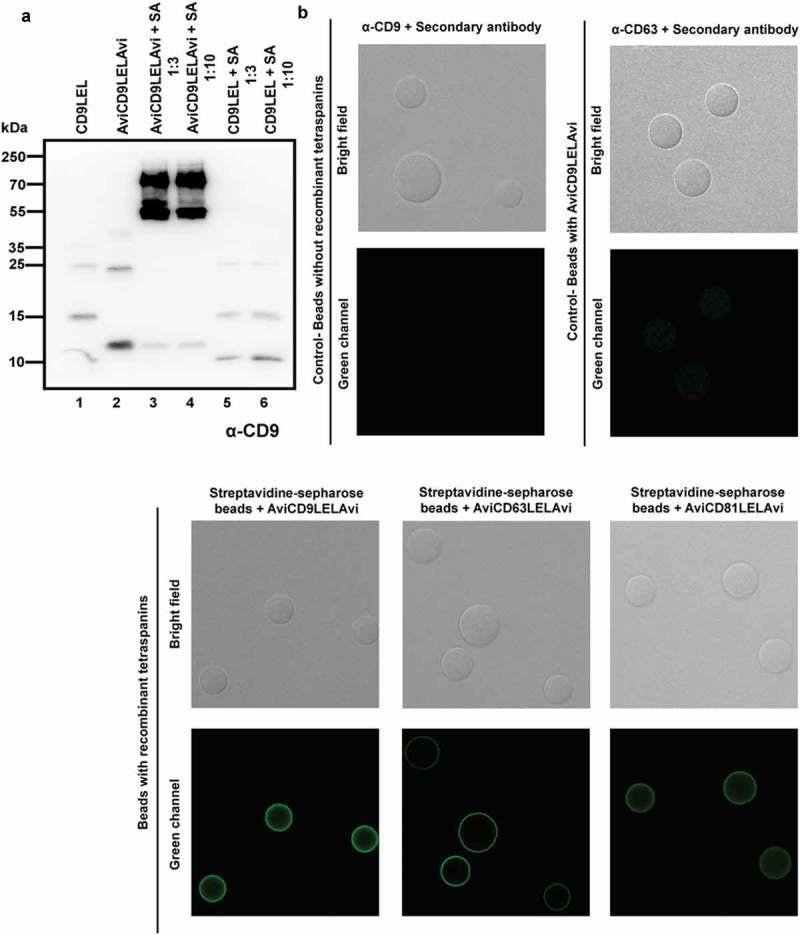
Features like small size, low refractive index and polydispersity pose challenges to the currently available detection methods for Extracellular Vesicles (EVs). In addition, the lack of appropriate standards to set up the experimental conditions makes it difficult to compare analyses obtained by different technical approaches. By modifying synthetic nanovesicles with recombinant antigenic regions of EV-enriched tetraspanins, we aimed to construct an EV-mimetic that can be used as a suitable standard for EV analyses. To this end, the sequences of the large extracellular loops of the tetraspanins CD9, CD63 and CD81 were tagged with a target sequence for the biotin ligase BirA, and co-transformed with a BirA expression plasmid into . GST fusion proteins were then isolated by affinity chromatography and released using thrombin. Biotinylated recombinant tetraspanin-loops were then coupled to (strept)avidin-coated synthetic nanovesicles and analysed and characterised by Dot-blot, Western-blot, Nanoparticle Tracking Analysis, Flow Cytometry and Transmission Electron Microscopy. With this method, we were able to efficiently produce tetraspanin-domain decorated nanovesicles that share biophysical properties with natural EVs, can be detected using specific antibodies against common EV markers such as tetraspanins, and can be used as robust reference materials for detection techniques that are often used in the EV field.
诸如小尺寸、低折射率和多分散性等特征,给目前可用的细胞外囊泡(EVs)检测方法带来了挑战。此外,缺乏用于设定实验条件的适当标准,使得难以比较通过不同技术方法获得的分析结果。通过用富含EV的四跨膜蛋白的重组抗原区域修饰合成纳米囊泡,我们旨在构建一种可作为EV分析合适标准的模拟EV。为此,将四跨膜蛋白CD9、CD63和CD81的大细胞外环序列用生物素连接酶BirA的靶序列进行标记,并与BirA表达质粒共转化到……然后通过亲和层析分离GST融合蛋白,并用凝血酶释放。然后将生物素化的重组四跨膜蛋白环与(链)抗生物素蛋白包被的合成纳米囊泡偶联,并通过斑点印迹、蛋白质免疫印迹、纳米颗粒跟踪分析、流式细胞术和透射电子显微镜进行分析和表征。通过这种方法,我们能够高效地生产出装饰有四跨膜蛋白结构域的纳米囊泡,这些纳米囊泡与天然EV具有共同的生物物理特性,可以使用针对常见EV标志物(如四跨膜蛋白)的特异性抗体进行检测,并且可以用作EV领域常用检测技术的可靠参考材料。




 Zotero 插件