
采用标准化两阶段置换的多学科团队方法治疗人工髋关节周围感染的治愈率高。
High cure rate of periprosthetic hip joint infection with multidisciplinary team approach using standardized two-stage exchange.
作者信息
Akgün Doruk, Müller Michael, Perka Carsten, Winkler Tobias
机构信息
Charité - Universitätsmedizin Berlin, corporate member of Freie Universität Berlin, Humboldt-Universität zu Berlin, and Berlin Institute of Health, Center for Musculoskeletal Surgery, Berlin, Germany.
Charite Universitätsmedizin, Augustenburger Platz 1, 13353, Berlin, Germany.
出版信息
J Orthop Surg Res. 2019 Mar 13;14(1):78. doi: 10.1186/s13018-019-1122-0.
BACKGROUND
Two-stage exchange arthroplasty is still the preferred treatment choice for chronic PJI. However, the results remain unpredictable. We analyzed the treatment success of patients with an infected hip prosthesis, who were treated according to a standardized algorithm with a multidisciplinary team approach and evaluated with a strict definition of failure.
METHODS
In this single-center prospective cohort study, all hip PJI episodes from March 2013 to May 2015 were included. Treatment failure was assessed according to the Delphi-based consensus definition. The Kaplan-Meier survival method was used to estimate the probability of infection-free survival. Patients were dichotomized into two groups depending on the number of previous septic revisions, duration of prosthesis-free interval, positive culture with difficult-to-treat microorganisms, microbiology at explantation, and microbiology at reimplantation.
RESULTS
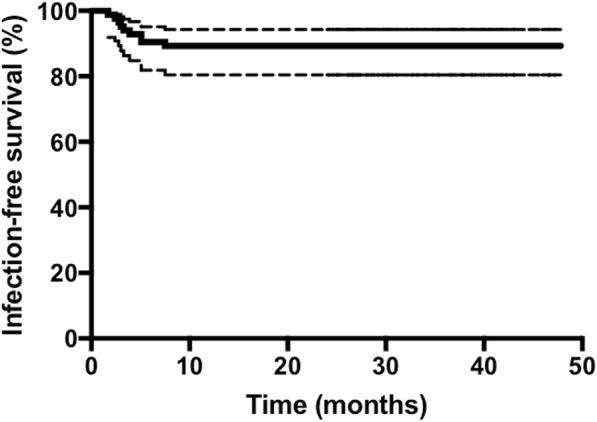
Eighty-four patients with hip PJI were the subject of this study. The most common isolated microorganisms were coagulase-negative staphylococci (CNS) followed by Staphylococcus aureus and Propionibacterium. Almost half of the study cohort (46%) had at least one previous septic revision before admission. The Kaplan-Meier estimated infection-free survival after 3 years was 89.3% (95% CI, 80% to 94%) with 30 patients at risk. The mean follow-up was 33.1 months (range, 24-48 months) with successful treatment of PJI. There were no statistical differences in infect eradication rate among the dichotomized groups.
CONCLUSIONS
High infect eradication rates were achieved in a challenging cohort using a standardized two-stage exchange supported by a multidisciplinary approach.
背景
两阶段翻修置换术仍是慢性假体周围感染(PJI)的首选治疗方法。然而,其结果仍不可预测。我们分析了感染髋关节假体患者的治疗成功率,这些患者按照标准化算法接受多学科团队治疗,并根据严格的失败定义进行评估。
方法
在这项单中心前瞻性队列研究中,纳入了2013年3月至2015年5月期间所有髋关节PJI病例。根据基于德尔菲法的共识定义评估治疗失败情况。采用Kaplan-Meier生存法估计无感染生存概率。根据既往脓毒性翻修次数、无假体间隔时间、培养出难治疗微生物呈阳性、取出时的微生物学情况以及再次植入时的微生物学情况,将患者分为两组。
结果
本研究共纳入84例髋关节PJI患者。最常见的分离微生物是凝固酶阴性葡萄球菌(CNS),其次是金黄色葡萄球菌和丙酸杆菌。几乎一半的研究队列(46%)在入院前至少有过一次脓毒性翻修。3年后Kaplan-Meier估计的无感染生存率为89.3%(95%CI,80%至94%),有30例患者处于风险中。PJI治疗成功后的平均随访时间为33.1个月(范围,24 - 48个月)。在二分法分组中,感染根除率没有统计学差异。
结论
在具有挑战性的队列中,采用多学科方法支持的标准化两阶段翻修置换术实现了高感染根除率。
 Zotero 插件